 By Willy · Founder & Lead Diesel Specialist
Willys Workshop · Oxley & Warana · 20+ years hands-on diesel experience
The TD42 is Nissan’s 4.2 litre inline six diesel, fitted to the GQ and GU Patrol. In Australian GU wagons it makes 91kW and 272Nm naturally aspirated, and 114kW and 330Nm with the factory turbo. The intercooled TD42Ti of February 2003 lifted torque to 360Nm.
This guide covers which Patrols got which version, why the engine has the reputation it does, when a rebuild makes sense, and how the turbo upgrade works. If you already know what you’re after, go straight to the turbochargers and turbo kits we stock.
Quick Links
- What the TD42 is
- Naturally aspirated, TD42T or TD42Ti
- Australian outputs
- Why the TD42 has its reputation
- When a TD42 is worth rebuilding
- The turbo upgrade path
- What the parts cost
- Buying a used TD42 Patrol
- Common questions
What the TD42 is
It’s Nissan’s 4.2 litre inline six diesel for the Patrol. In Australia it went into the GQ and then the GU. In the GU it was sold alongside the 2.8 litre RD28ETi, the 3.0 litre ZD30DDTi and the TB45E and TB48DE petrol sixes.
In the GU the 4.2 is listed with a five speed manual only. The 3.0 and the petrol sixes were offered with autos. Keep that in mind if you’re shopping for one.
It’s a big engine for its output, it’s a six, and until 2003 it had no electronic control over fuel pump timing. That came with the TD42Ti. All the figures in this guide are for the GU. We haven’t quoted GQ outputs.
Naturally aspirated, TD42T or TD42Ti
This decides which parts you buy, and plenty of listings get it wrong.
The naturally aspirated TD42 has no turbo. In the GU it was sold as the 4.2 litre diesel from 1998, making 91kW and 272Nm.
The TD42T is the factory turbo version, listed in the GU wagon range from 1999 at 114kW and 330Nm. Same displacement, same layout, and about 25 percent more power and 21 percent more torque, all of it from boost.
The TD42Ti replaced it in February 2003. It added an intercooler and electronic timing control for the fuel pump, and took the radiator from the 4.8 litre TB48DE petrol. Power stayed at 114kW and torque went to 360Nm. Compression on the TD42Ti is 22.7:1. That figure is published for the Ti only, so don’t assume it carries across to the other two.
What that means when you order:
- A naturally aspirated engine needs a complete turbo kit, including manifold, oil feed and drain, and plumbing.
- A factory turbo engine needs an upgrade that suits the manifold and mounting already there. That’s a different part number and a different job.
- Intercooler kits are listed by year, because the 1999 to 2003 and 2003 to 2007 cars aren’t the same fitment.
- Some late factory turbo engines have exhaust gas recirculation hardware, and there are EGR gaskets specific to the TD42T Late. The naturally aspirated engine doesn’t use them.
Not sure which you’ve got? Look for the turbo and the intercooler before you order anything.
Australian outputs
| Variant | Engine | Years | Peak power | Peak torque |
|---|---|---|---|---|
| GU.I wagon DX5 | 4.2 diesel, naturally aspirated | 1998 to 2000 | 91kW at 4,000rpm | 272Nm at 2,000rpm |
| GU.I to GU.III wagon | 4.2 turbo diesel | 1999 to 2003 | 114kW at 3,600rpm | 330Nm at 2,000rpm |
| GU.III to GU.V wagon, TD42Ti | 4.2 turbo diesel, intercooled | 2003 to 2007 | 114kW at 3,600rpm | 360Nm at 2,000rpm |
| GU.I cab chassis DX | 4.2 diesel, naturally aspirated | 1999 to 2002 | 91kW at 4,000rpm | 272Nm at 2,000rpm |
| GU.I cab chassis DX, ST | 4.2 turbo diesel | 1999 to 2002 | 116kW at 3,600rpm | 330Nm at 2,000rpm |
| GU.II cab chassis DX, ST | 4.2 turbo diesel | 2003 to 2007 | 116kW at 3,600rpm | 360Nm at 2,000rpm |
The cab chassis turbo is rated at 116kW and the wagon at 114kW, on the same engine. That’s a rating difference. It isn’t a reason to pick one over the other.
The 4.2 also ran later than most people think. It was still in the GU.V wagon range of March 2007 and was gone from the GU.VI range released in August 2007. In the cab chassis it lasted until October 2007, when the GU.VI cab chassis switched to the 3.0 litre.
Why the TD42 has its reputation
Ask around a 4WD club and you’ll be told the 4.2 is the one to have. There’s some evidence behind that, though it isn’t the evidence most people quote.
The published fault record for the 1997 to 2004 GU Patrol lists one engine fault, and it isn’t the 4.2. It’s the ZD30 piston failure: pistons three and four cracking, or holing through to the top ring land, on engines built from 2000 to 2005. The contributing factors given are intake restriction from exhaust gas recirculation, oil on the mass airflow sensor causing a lean condition, and boost spikes of up to 25psi that the engine is slow to react to.
There’s no matching entry for the 4.2. That doesn’t prove a TD42 can’t fail, and a short fault list isn’t a reliability ranking. It still counts for something, because both engines went into the same body, for the same buyers, doing the same work.
Look at those ZD30 causes again. Each one comes from running a small engine hard: boost spikes, a lean mixture from a dirty sensor, uneven mixture from recirculated exhaust. The naturally aspirated 4.2 has none of that, and the factory turbo 4.2 ran mild boost on 4.2 litres. It’s a big, lightly stressed, mechanically simple engine that was never asked to do much, which is why the turbo upgrade below works so well on it.
When a TD42 is worth rebuilding
Every 4.2 on the road is old now and most have done big kilometres. When one gets tired you’ve got four options, and the cheapest on paper often isn’t the cheapest in the end.
Repair the single fault. If the engine is doing one thing wrong, fix that. Oil leaks at the front of the engine are a gasket job, and the money goes on access, not parts. Heavy smoke on a mechanical TD42 usually points at the pump or injectors. Even compression across all six and steady oil pressure mean the bottom end is still fine.
Rebuild it. A rebuild makes sense when the wear is through the whole engine: low or uneven compression, oil use, heavy blow-by and falling oil pressure. The other case is a turbo conversion or more boost on an engine that’s already worn. Adding boost to a tired bottom end is how people pay for the job twice.
Buy a used engine. The last TD42 Patrols were built in 2007, so every used 4.2 is old and most have high kilometres. You’re swapping a worn engine you know for one you don’t. With service records it can work. Without them you’ll be making the same decision again in a few years.
Move the vehicle on. The engine often isn’t the expensive part of a tired Patrol. If the body, chassis and running gear are as worn as the engine, rebuild the engine in a vehicle worth keeping.
A TD42 rebuild isn’t a rebuild around a design fault. Build it properly and it goes back to being a big, lightly stressed engine.
What is in a kit and what is not
A rebuild kit is a box of parts. Machining, labour and usually cylinder head work all go on top, and the finished job costs several times the kit. We can’t put a number on that until the block and head have been measured, so ask us to quote the job, not the kit.
There are five TD42 kits: naturally aspirated, factory turbo, and turbo conversion or upgrade, with standard and performance versions. The listings don’t print a parts list, but the options you choose tell you what’s inside.
- The three standard kits are ordered by piston and ring size, main bearing size and conrod bearing size. Pistons come standard or 0.50 over, mains standard to 0.50, and conrod bearings standard to 0.75.
- The two performance kits are ordered on bearing sizes only, with no piston size to pick. Ask us what pistons they carry. Don’t assume they match the standard kit.
- The price doesn’t change with the sizes you choose, so the right oversize costs no more than standard.
- None of the five includes timing components. Kits for some other engines, like the Nissan TB42, TB45 and TB48, are sold “With Timing”. The TD42 kits aren’t, so price the timing gear separately.
- No kit includes a cylinder head, head work, machining or labour. Head gaskets, head bolt and stud sets and full gasket sets are separate items.
Order the kit after the machinist has measured the block. If STD, 0.25 and 0.50 don’t mean anything to you yet, our guide to bearing and piston sizes explains them. Send us the machining figures and we’ll pick the kit to suit.
The turbo upgrade path
Because the engine is under-stressed from the factory, adding boost is the biggest change you can make to how a TD42 Patrol drives. Where you start from decides which parts you need.
Starting from naturally aspirated
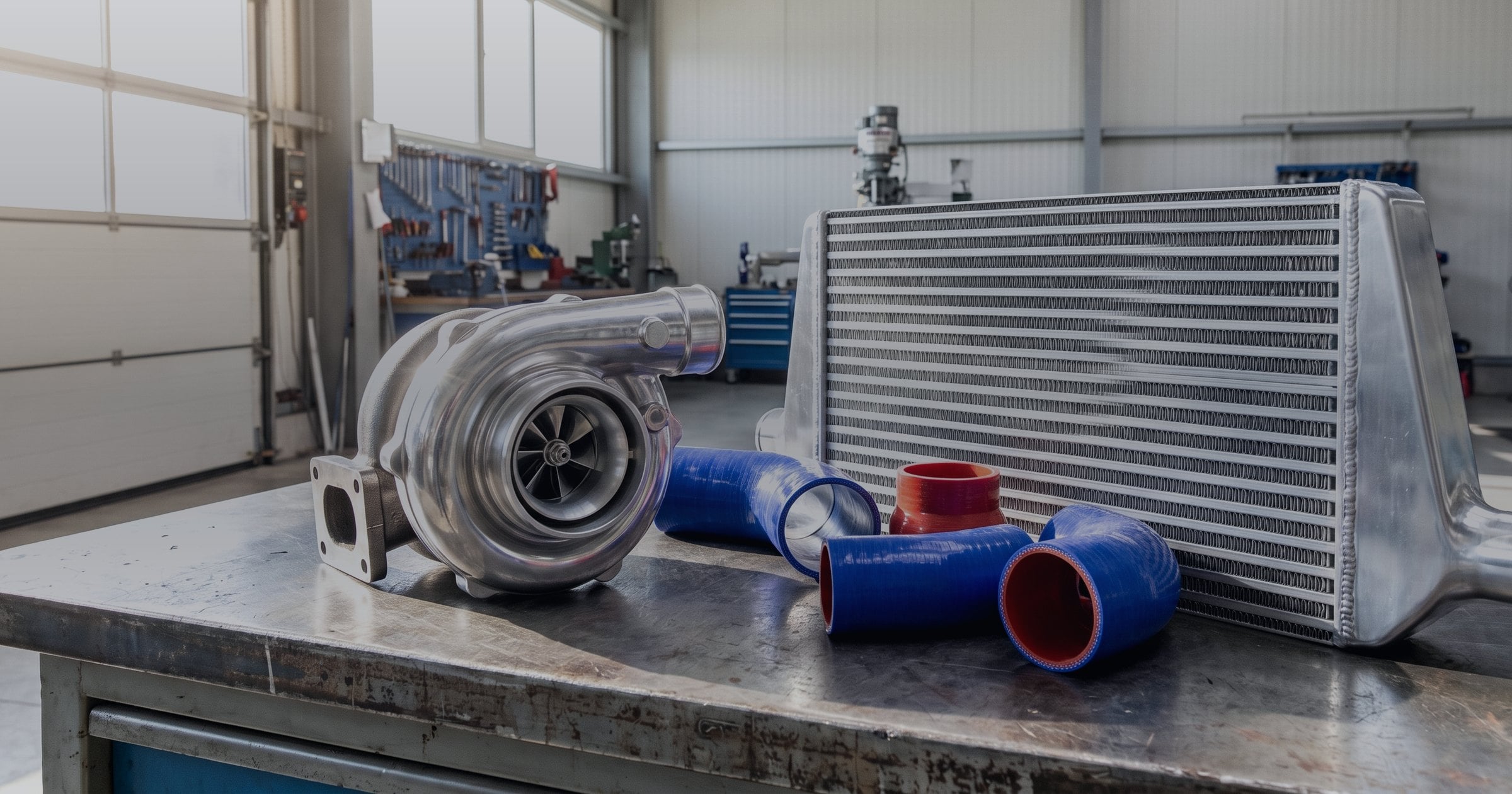
You need a turbo kit: turbocharger, manifold, oil feed and drain lines, and intake and exhaust plumbing, all matched to convert the engine. The HPD kits we carry for the TD42 use Garrett turbos. The GT28 kits are built around a Garrett GT2860R, with the bigger GTX2860 and GTX2867 Gen 2 offered as paid upgrades inside the same kit. There are two kits for the GQ and one for the naturally aspirated GU of 1999 to 2003.
For an idea of what to expect, Nissan’s own factory turbo version picked up about 25 percent more power and 21 percent more torque.
Starting from a factory turbo
On a TD42T or TD42Ti a conversion kit is the wrong part. You need an upgrade that suits what’s already on the engine. There’s a direct fit factory turbo upgrade kit for the 1999 to 2006 TD42T and TD42Ti.
Intercooler and bottom end
An intercooler cools the air coming off the turbo before it goes into the engine. Denser air and lower exhaust gas temperature are the result. It matters most in the heat and when towing, and more once you’ve added boost. Nissan fitted one to the TD42Ti for the same reason. Kits are listed separately for the GQ, the 1999 to 2003 GU and the 2003 to 2007 GU, so order against your build year. The intercooler range has the lot.
Going well past standard boost means looking at the bottom end too, which is what the two turbo upgrade rebuild kits are for. Ask before you assume you need the dearest one. A big turbo on a very tired engine is how people end up doing the job twice.
Late factory turbo engines also carry exhaust gas recirculation, which sends some exhaust back into the intake to lower combustion temperature. If you’re servicing it, genuine EGR valve and tube passage gaskets for the TD42T Late are listed below.
Parts for this job: TD42 rebuild kits
N/A, factory turbo and turbo-upgrade engines take different kits. Check each listing for what is in the box before you order.
TD42 turbo and intercooler kits
What the parts cost
These are parts prices only. Fitting, tuning, exhaust work and any machining are on top, so a quote that leaves them out isn’t a quote for the same job.
| Turbo and intercooler kits | Price |
|---|---|
| GQ TD42 GTX28 turbo kit | $4,610 |
| GU TD42T/Ti 1999 to 2006 factory turbo upgrade kit, direct fit | $4,350 |
| GQ TD42 GT28 turbo kit | $3,660 |
| GU TD42 1999 to 2003, factory non-turbo, turbo kit | $3,660 |
| Intercooler upgrade kit Pro, GU TD42 2003 to 2007 | $2,500 |
| Intercooler GQ TD42 Pro | $2,500 |
| Intercooler GU TD42 1999 to 2003 Pro | $2,350 |
The intercoolers above are the Pro spec. The same GQ and GU fitments also come with smaller cores for less, so the Pro isn’t the cheapest way to intercool a TD42.
| TD42 rebuild kit | What it suits | Price |
|---|---|---|
| Engine rebuild kit, TD42T | Factory turbo engine | from $1,867.90 |
| Engine rebuild kit, TD42 N/A | Naturally aspirated engine | from $1,941.90 |
| Engine rebuild kit, TD42 turbo upgrade | An engine being turbocharged | from $2,235.00 |
| High performance engine rebuild kit, TD42T | Factory turbo engine, harder use | from $2,312.10 |
| Performance engine rebuild kit, TD42 turbo upgrade | As above, hardest use | from $2,735.00 |
The TD42 is cheap to keep together below that. Some of the parts that turn up on a routine job:
- Tridon glow plug: $29.90
- Genuine radiator cap, 90kPa / 13psi: $28.60
- Genuine timing case cover gasket: $24.20
- Genuine EGR valve gasket, TD42T Late: $15
- NVP diesel injector thimbles spacer isolator: $12.20
- NVP valve stem seal, single: $4.80
Don’t price a rebuild off that list. Head gaskets, full gasket sets, piston and bearing sets, head bolt and stud sets, water pumps, oil pumps and crankshafts are all in our engine internals range, and they sit between those parts and the kits. Ask us for a line by line quote. And don’t reuse a thrust washer set or stem seals to save a few dollars. The cheap parts decide whether the expensive ones survive.
Buying a used TD42 Patrol
- Confirm what it actually has. Naturally aspirated, factory turbo or factory intercooled turbo. Check by looking, not by the badge or the ad.
- Check for an aftermarket turbo conversion. A good conversion is a plus. One with no intercooler, no supporting work and no records is something to negotiate on.
- Cold start and smoke. Watch the exhaust from cold and again under load. Heavy smoke on a mechanical diesel usually means the pump or injectors need work.
- Oil leaks at the front of the engine. Look hard around the timing case cover and harmonic balancer. The access is what makes those jobs cost money, not the gaskets.
- Service history and kilometres. These engines often show very high kilometres. A high number with records beats a low number without them.
Run the VIN through the PPSR for money owing and stolen or written-off status. Then check the recall register at Product Safety Australia. The 1997 to 2004 GU Patrol has had steering, brake pedal and airbag recall campaigns.
Common questions
Is the Nissan TD42 a good engine?
It has a strong name with Australian Patrol owners, and some evidence behind it. The published fault record for the 1997 to 2004 GU Patrol lists the ZD30 piston failure and nothing equivalent for the 4.2. That’s a good sign, not proof.
How much power does a TD42 make?
In Australian GU Patrols the naturally aspirated 4.2 makes 91kW at 4,000rpm and 272Nm at 2,000rpm. The factory turbo wagon makes 114kW at 3,600rpm, with 330Nm until February 2003 and 360Nm once it became the intercooled TD42Ti. The cab chassis turbo is rated at 116kW.
Can you turbocharge a naturally aspirated TD42?
Yes, and it’s the most common upgrade on this engine. A turbo on its own won’t do it. You need a complete kit, because the manifold, oil feed and drain, and intake and exhaust plumbing all have to suit. The cheapest complete TD42 conversion kit we carry is $3,660, built around a Garrett GT2860R. Fitting and tuning are on top.
Do I need an intercooler on a turbo TD42?
Not to make it run. But it’s the first thing to add once boost goes up. Cooler intake air is denser and brings exhaust gas temperature down under load, and exhaust gas temperature decides how long a converted engine lasts. Nissan fitted one to the TD42Ti from the factory.
Send us your build date before you order
Naturally aspirated and factory turbo TD42s take different parts, and the year splits in the turbo run catch people out. Send your build date and what the Patrol does, whether that’s touring, towing or paddock work, through our contact page. We’ll confirm the right kit and spec it to the job, not to a power figure. Our founder Willy has more than 20 years on the tools as a heavy diesel mechanic, and the team works on diesels across our Brisbane and Sunshine Coast workshops.
Last updated: October 2026