
 By Willy · Founder & Lead Diesel Specialist
Willys Workshop · Oxley & Warana · 20+ years hands-on diesel experience
The 1FZ-FE is Toyota’s 4.5 litre petrol inline six. It’s not a diesel. In the Australian 105 Series LandCruiser it makes 165kW at 4,600rpm and 387Nm at 3,600rpm, from 4,477cc on a 9.0:1 compression ratio.
That matters because most of what we sell is diesel. If your 80 Series or 105 Series has this engine, the parts, the faults and the upgrade path are all different from the 1HZ or 1HD in the same body. This guide covers the engine, why it uses so much fuel, the turbo and supercharger question, and what rebuild parts cost. If you already know what you need, go straight to the exhaust and extractor systems we stock.
Quick Links
- What the 1FZ-FE is
- Australian vehicles and outputs
- Specifications
- Why it uses so much fuel
- Turbocharging or supercharging a 1FZ-FE
- Rebuilding a 1FZ-FE
- What 1FZ-FE parts cost
- Buying a used 1FZ-FE LandCruiser
- Common questions
What the 1FZ-FE is
The 1FZ-FE replaced Toyota’s 3F-E. It has a cast iron block with 100.0mm bores and a 95.0mm stroke, double overhead cams and four valves per cylinder in a cross-flow head. The valves run on outer pad type lifters with adjusting shims. A single roller chain drives the intake cam, and the exhaust cam is driven off the intake cam by a scissor gear. The combustion chambers are pentroof and compression is 9.0:1, which is normal for a naturally aspirated petrol engine of its era.
Fuelling is sequential electronic injection with direct ignition, so there’s no distributor and no mechanical injection pump. A 1FZ-FE that runs badly almost always has an ignition, sensor or fuelling fault on the electronic side. The same complaint on a 1HZ sends you to the pump and the injectors.
Australian vehicles and outputs
This is the petrol six in the 80 Series and 105 Series LandCruiser. The 105 Series carried over the 80 Series chassis and powertrains, with coil sprung solid axles front and rear, which is why the two share so much hardware.
The 100 Series range came out in March 1998, including the 105 Series with the 4.5 litre petrol six. The 4.2 litre turbo diesel joined in October 2000. When the 100 Series Mk.II arrived in October 2002, Toyota dropped the 4.5 litre petrol engines. Here’s how the six cylinder options compared in that first series:
| Series | Engine | Years | Peak power | Peak torque |
|---|---|---|---|---|
| 105 Series (FZJ105) | 4.5 litre petrol I6 (1FZ-FE) | 1998 to 2002 | 165kW at 4,600rpm | 387Nm at 3,600rpm |
| 105 Series (HZJ105) | 4.2 litre diesel I6 (1HZ) | 1998 to 2002 | 96kW at 3,800rpm | 285Nm at 2,200rpm |
| 100 Series (HDJ100) | 4.2 litre turbo diesel I6 (1HD-FTE) | 2000 to 2002 | 151kW at 3,400rpm | 430Nm at 1,400 to 3,200rpm |
Some variants finished earlier than others. The standard and automatic models are listed as 1998 to 2000, and the RV and GXL ran to 2002. The diesels carried on into the Mk.II from 2002 to 2007 at the same outputs. The petrol six didn’t.
The FZJ105 figures are the only Australian ones listed. A lot of the 1FZ-FE power figures online are United States or Japanese market numbers for a different spec of the same engine. If you need the figures for an 80 Series, go by the build plate and check with Toyota.
Specifications
| Specification | Value |
|---|---|
| Configuration | Inline six cylinder, cast iron block |
| Displacement | 4,477cc |
| Bore x stroke | 100.0mm x 95.0mm |
| Compression ratio | 9.0:1 |
| Valvetrain | Double overhead cams, four valves per cylinder, shim adjusted |
| Cam drive | Single roller chain to intake cam, scissor gear to exhaust cam |
| Cam timing | 225 degrees intake and exhaust duration, 10 degrees overlap |
| Fuel system | Sequential electronic fuel injection, direct ignition |
| Firing order | 1-5-3-6-2-4 |
Confirm against your build plate before ordering parts.
Why it uses so much fuel
High fuel use is a known drawback of the petrol 100 and 105 Series. The reason is in the outputs table: look at where each engine makes its peak torque.
The 1FZ-FE makes more torque than the 1HZ diesel, but it makes it at 3,600rpm, 1,400rpm further up the rev range. The turbo diesel makes its peak from 1,400rpm and holds it to 3,200rpm. It’s finished before the petrol six gets going.
These are big wagons, 4,890mm long on a 2,850mm wheelbase, and they take real torque to move. With peak torque up at 3,600rpm, every hill, trailer and soft sand run gets done at revs where a 4.5 litre petrol is moving a lot of air and burning fuel to match. The diesel does the same work near idle.
So load hits fuel use harder on a 1FZ-FE than on the diesels. Two identical FZJ80s, one running the highway empty and one towing through hills, won’t come close to the same figure. It’s also why bigger tyres and heavy bar work cost this engine more than they cost a turbo diesel in the same body.
If your consumption has climbed and your driving hasn’t changed, get the engine tested. Ignition and sensor faults show up in the fuel bill well before they show up as a misfire.
Turbocharging or supercharging a 1FZ-FE
We get asked this a lot. Start with the 9.0:1 compression. On a petrol engine, cylinder pressure and detonation are the limit, and 9.0:1 leaves less room for boost than an engine built for forced induction. Boost isn’t impossible, but the hard part of the job is fuel and ignition timing control, not the compressor.
The factory engine management on a 1990s Toyota was never built for that. That’s why a boosted 1FZ-FE usually ends up on aftermarket management, and that’s where the money and the risk sit.
A plug and play adapter harness is a loom that connects an aftermarket ECU to the factory engine harness without cutting the original wiring. We list a Haltech Nexus S3 plug and play adapter harness kit for the 1FZ-FE. The title doesn’t say whether the Nexus S3 unit itself is in the box, so ask us before you budget around it. It changes the cost of the whole job.
We don’t list a bolt-on turbo or supercharger kit for the 1FZ-FE. We do list turbo kits for the 1HZ and 1HD-FTE diesels in the same vehicles, so that’s a real gap in the range. The compressor and manifold have to come from elsewhere, or ask us.
Rebuilding a 1FZ-FE
Some faults on this engine look mechanical and aren’t. Oil use on a tired 1FZ-FE usually comes down to rings or valve stem seals. A hard cold start with no smoke and no compression loss is far more likely to be a sensor or ignition problem. Test before you pull the head.
If it does need internal work, go in this order:
- Diagnose before you spend. A compression test and a leak-down test tell you whether you’re rebuilding or chasing a sensor. On a petrol engine this age it’s often the sensor, and that’s good news.
- Machine and measure. Bores, crank and head go to the machine shop first. You pick the piston set after the block’s measured.
- Rebuild with the full gasket set, new bearings and new head bolts. Reusing head bolts on a rebuild is a poor saving.
- Replace the seals you can’t get to again. The front crank seal, water pump gasket, timing cover gasket and O-ring, and the oil cooler seals all sit behind parts you’ve already removed. They cost a few dollars now. Later they cost the labour twice.
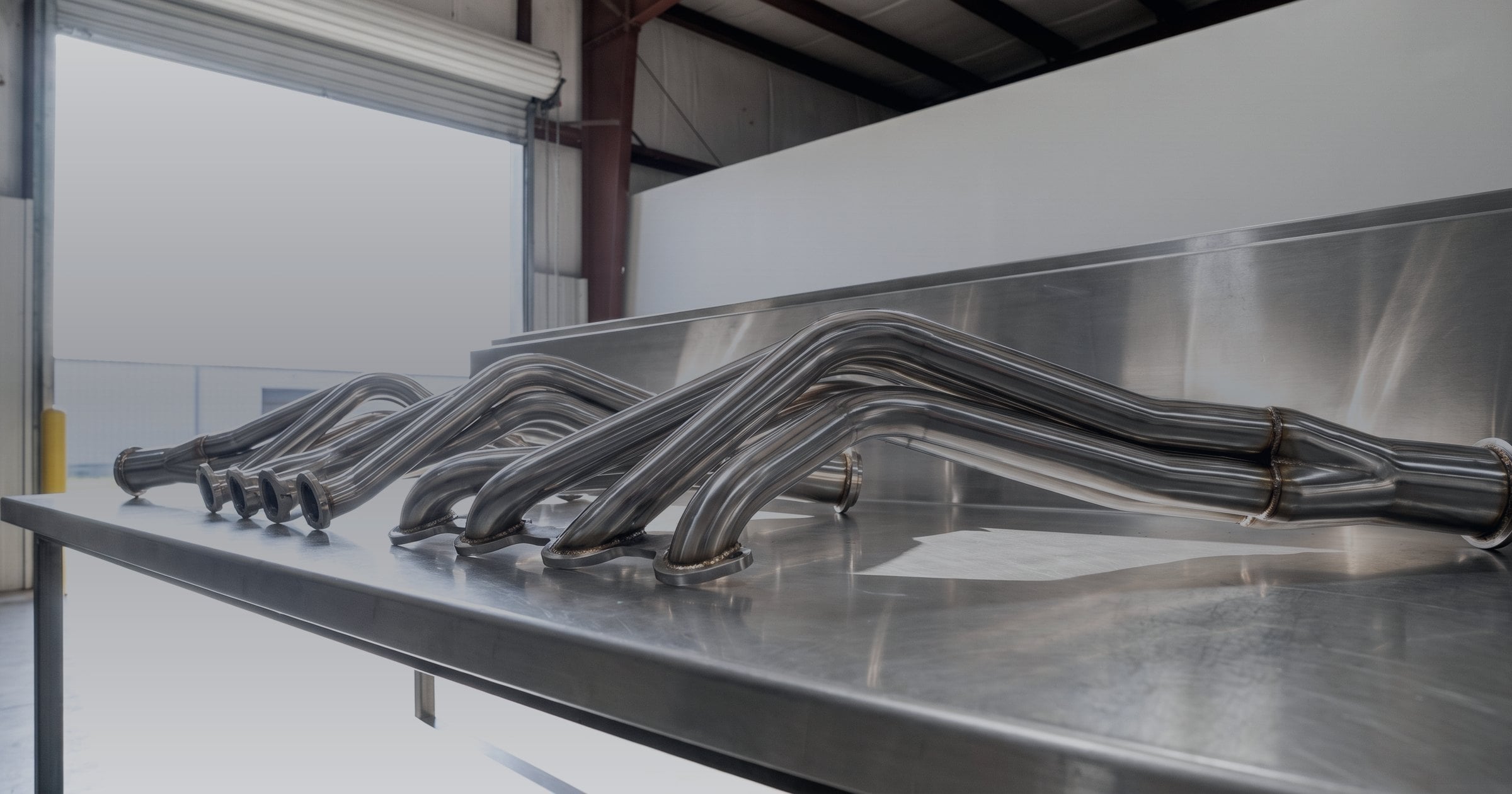
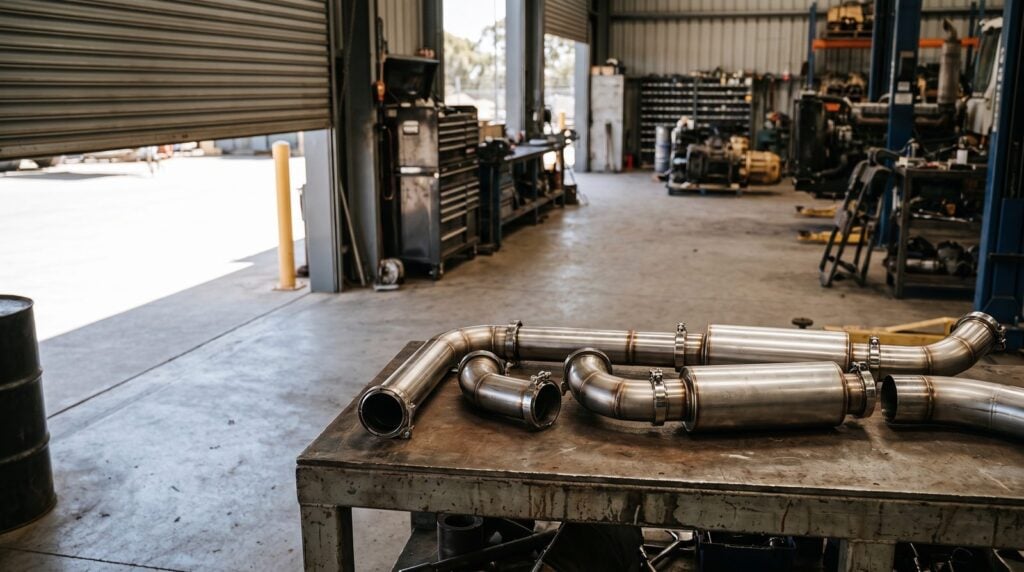
- Exhaust last. Extractors swap the cast manifold for one pipe per cylinder and cut exhaust restriction and heat soak around the manifold. Heat is what we most often see finish off manifolds, gaskets and valves on engines this age. Fit them once the engine is mechanically right. Bolting parts onto a fault only hides it for a while.
Rebuild parts are ordered by machining size, and those numbers come from your machinist once the engine’s stripped. If STD, 0.25 and 0.50 don’t mean anything to you yet, our guide to bearing and piston sizes explains what to send us.
What 1FZ-FE parts cost
These are parts prices only. Machining and fitting are on top. We don’t sell a packaged rebuild kit for this engine, so a rebuild is built up from the parts below.
| Part | Brand | Price |
|---|---|---|
| Full gasket set | KP | $484.50 |
| Piston set | TIK | $480.00 |
| Ring set | TP | $205.00 |
| Head gasket | KP, or Athena MLS 101.5mm bore | $149.00 to $335.50 |
| Timing chain set | Genuine, OSK with gears, or aftermarket | $205.00 to $290.00 |
| Oil pump and timing cover assembly | YSK | $399.00 |
| Main bearing set | TDC or NDC | $72.60 to $95.00 |
| Conrod bearing set | NDC or ACL | $72.00 to $89.00 |
| Head bolt set | NVP | $49.00 |
| Cooling hose set | NVP | $324.50 |
The small seals are cheap next to the assemblies. The timing cover gasket and O-ring, front crank seal and oil cooler gaskets are all genuine Toyota parts in the range. Reusing tired seals is the most common reason a decent rebuild gets done twice.
Exhaust parts are listed separately for the FZJ80 and the FZJ105, and they don’t swap between the two bodies. Some mufflers and tailpipes are shared with the diesel HZJ models, which is why a listing sometimes carries both codes.
- Extractors and full 2 1/2 inch system, FZJ80: $1,785.43 to $2,451.17
- Extractors and full 2 1/2 inch system, FZJ105: $2,168.85 to $2,830.80
- 2 1/2 inch system off the extractors: $747.07 to $1,161.37 on an FZJ80, $774.09 to $1,161.37 on an FZJ105. These assume you already have a usable set of extractors.
- Direct fit extractors, FZJ80: $955.55
- Direct fit extractors, FZJ105: $1,297.25
- Extractor gasket with fire rings: $34.55
- Haltech Nexus S3 plug and play adapter harness kit: $3,954.99
Some shorter listing titles don’t separate two products of the same nominal size, so ask us for the full description before you order exhaust.
Buying a used 1FZ-FE LandCruiser
These are old vehicles now, and condition varies more than kilometres do. Judge the car in front of you.
- Check it’s actually a 1FZ-FE. The 105 Series came with the 4.5 litre petrol six or the 4.2 litre 1HZ diesel, and the body looks the same. Look for FZJ in the model code.
- Compression and leak-down test. It checks the bottom end and the head, and costs less than any major part.
- Cooling system. Radiator, hoses and the oil cooler seals. This engine works hard in Australian conditions.
- Fuel use. Ask for real figures. A number that’s climbed points at ignition, sensors or a dragging brake.
- Rust and chassis. On a vehicle this age they often cost more to fix than the engine.
Run the VIN through the PPSR to check for finance owing and stolen or written-off status, then check the recall register at Product Safety Australia.
Common questions
Is the 1FZ-FE a diesel?
No. It’s a 4.5 litre petrol inline six with electronic fuel injection. It sits alongside the 1HZ and 1HD diesel sixes in the same 80 Series and 105 Series bodies, so order parts by engine code, not by model.
How much power does a 1FZ-FE make?
In the Australian 105 Series LandCruiser (FZJ105) built from 1998 to 2002, it makes 165kW at 4,600rpm and 387Nm at 3,600rpm. Many figures online are United States or Japanese market numbers for a different spec.
Can you turbocharge or supercharge a 1FZ-FE?
It’s been done, but the compressor isn’t the hard part. With 9.0:1 compression and factory management never built for boost, the fuel and ignition control is the job. We list a Haltech adapter harness for aftermarket management, but no bolt-on turbo or supercharger kit.
What does a 1FZ-FE rebuild cost in parts?
A piston set is $480.00, a full gasket set $484.50 and a ring set $205.00. Main bearing sets start at $72.60 and conrod bearing sets at $72.00. Machining and assembly are on top, and the machine shop result decides which oversize pistons you need, so get the block measured before you order internals.
When did Toyota stop using the 1FZ-FE in Australia?
The 4.5 litre petrol engines were dropped when the 100 Series Mk.II arrived in October 2002. The 1HZ diesel carried on in the 105 Series until 2007.
Check your engine code before you order
We carry pistons, rings, bearings, gaskets, seals and timing parts for the 4.5 litre petrol six in our engine internals range, plus exhaust for both bodies and the Haltech harness. Piston size depends on what the machine shop measures and exhaust depends on the body, so send your VIN, build date and engine number through our contact page and we’ll check the part numbers against your vehicle. Our founder Willy has more than 20 years on the tools as a heavy diesel mechanic, and the team works on diesels across our Brisbane and Sunshine Coast workshops. We carry petrol LandCruiser parts alongside the diesel range.
Last updated: October 2026