
Get a quote
We’re here to help you with any inquiries.
A bearing or piston size is not a quality grade. It is a measurement of how much metal came off your engine during machining. A crank ground 0.25mm under standard takes 0.25 bearings. A block bored 0.50mm over standard takes 0.50 pistons. STD means nothing had to be removed beyond a clean-up.
In most cases you can order before you know the number. You do need it before we ship, because the size decides which parts go in the box.
STD (standard). The crank was within limits, or the bore cleaned up without going oversize. No correction needed.
Undersize bearing. A bearing shell made thicker than standard to suit a crank journal that has been ground down. Sold as 0.25, 0.50, 0.75 and so on, describing how far under standard the journal now sits.
Oversize piston. A piston made larger than standard to suit a bore that has been opened up. Sold on the same numbers, describing how far over standard the bore now sits.
Main journal. The crankshaft surfaces the block’s main bearings run on.
Conrod journal. The crankshaft surfaces the connecting rod bearings run on. Measured separately from the mains.
Docket. The job sheet your machine shop writes the measurements on. This is the document we want a photo of.
A worn engine is not reassembled to the dimensions it left the factory with. The crankshaft journals get ground to clean them up, and the bores get honed or bored out. Both operations remove metal, so the parts that run against those surfaces have to be made correspondingly thicker or larger.
That is what the size on a bearing set or piston set refers to. It is not an upgrade and it is not a performance option. It is the amount of material that came off your particular engine.
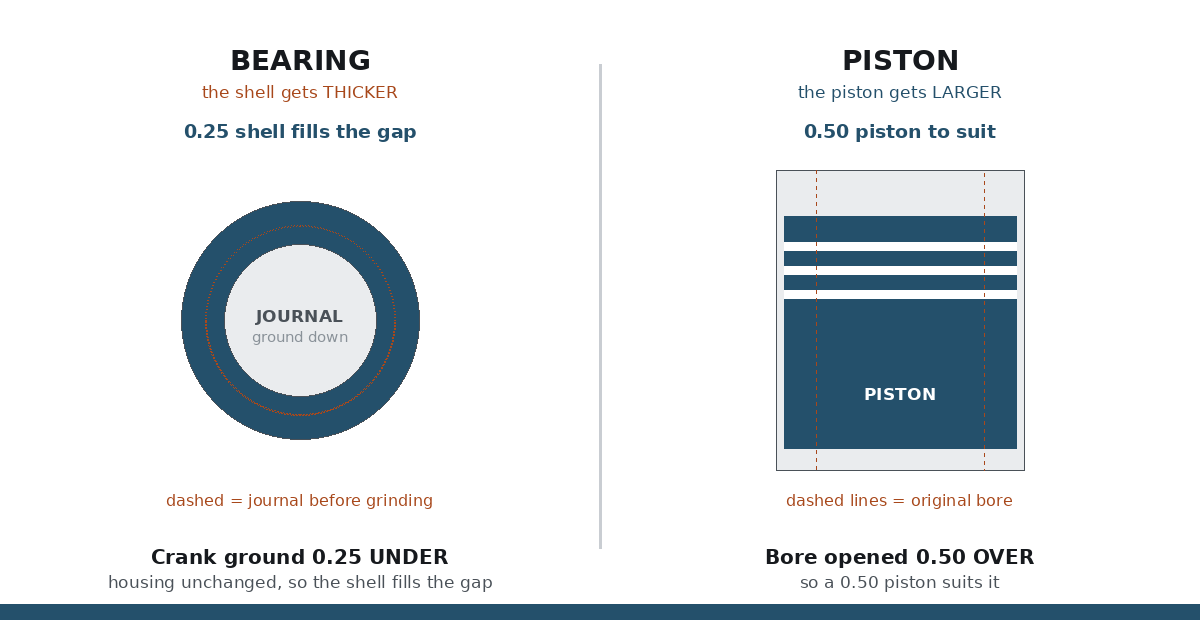
Bearings and pistons carry the same numbers running in opposite directions. This catches people out, so it is worth reading twice.
This is the standard convention across the industry, not something particular to Willys Workshop. Bearing manufacturers publish undersize sets in both metric and imperial, so a 0.25mm undersize shell is the conventional equivalent of a 0.010in one. The Australian manufacturer ACL explains the same principle in its technical FAQ, noting that a thicker bearing shell is what allows a worn crankshaft journal to be reconditioned.
Main bearings, conrod bearings and pistons are measured separately and will not always come back the same. It is normal to end up with a crank ground 0.25 under on the mains and STD on the rods, or any other combination. Send us all of them.
Most of what we stock is measured in millimetres: STD, 0.25, 0.50, 0.75, 1.00 and 1.50.
A small number of listings show +020 and +040 instead. Those are imperial sizes, in thousandths of an inch. If your dropdown shows one of them, your machinist’s numbers should be in inches too. Do not convert them yourself. Send us what the docket says.
A small number of listings show 0.025 or 0.001. Those are hone sizes, not grinding sizes. They are a very slight oversize for a bore that has been honed rather than bored, so the correction is tiny by comparison. If your machinist honed the bores and gave you a figure that small, these are the options to look for.
Do not read 0.025 as 0.25. The difference between them is a factor of ten, and picking the wrong one is one of the easiest ways to end up with parts that will not fit. If you are not certain which your docket is describing, email us before you order.
On a full rebuild kit you may be asked for up to three separate selections:
They are asked separately because they are measured separately. The rings are matched to the piston, which is why those two are combined into a single selection.
Some listings do not show an STD option at all.
If yours does not, do not assume standard is unavailable and do not pick the nearest number instead. Email us with the part and your docket and we will confirm which sizes are supplied for it, or hold it for you while the machining is done.
Once you have your sizes, find your engine by its code to see the bearings, rings and pistons we hold for it.
Your machine shop does, once the engine is stripped and the crank is out.
You cannot get these numbers from a parts catalogue, from the engine number, or by looking at the outside of the engine. That is why the size question cannot be answered when you are first pricing the job, and it is why we do not expect you to answer it up front.
If your machining is being arranged through us, we will have the numbers ourselves and will fill them in for you.
Most shops write all of this on the job docket. A photo of the docket is the easiest thing to send. We would rather read the machinist’s own handwriting than have the numbers relayed twice.
Your machinist hands back a docket reading: mains ground 0.25 under, rods STD, bore +0.50 with matching pistons.
On a rebuild kit you would select Main Bearing Size 0.25, Conrod Bearing Size STD, and Piston & Ring Size 0.50. Three different values on one order, which is normal. If you would rather not work it out, send the docket photo and we will set it up for you.
Email a photo of the docket to orders@willysworkshop.com.au, with your order number or the part you are after. If you have already ordered, quote the order number and we will match it up. Other ways to reach us are on our contact page.
Once we have the sizes we confirm the kit contents back to you, then it ships. If we cannot supply the size your engine needs, contact us and we will arrange an alternative or a refund.
Order at STD. Where the part has an STD option, the dropdown is usually already set to it for you. Send the sizes through when you have them and we will swap the affected parts before dispatch.
Put a deposit on it. On rebuild kits priced from $1,500 you will see a deposit option at 20 percent. That holds the kit while the machine work is done. The balance is settled once we confirm the sizes and it is ready to go.
No STD on your part? Email us and we will hold it against your order while you get the numbers.
Either way you are not waiting on the machine shop before you can get the parts moving.
No. The number describes how much metal was removed from your crank, not the quality of the part. A 0.50 bearing is not an upgrade over STD, and fitting one to an unground crank would be wrong.
No. The engine number tells us what the engine was when it was built, not what has been done to it since. Only a measurement taken after stripping will tell you.
That is common and it is not a problem. Send both numbers and we will build the kit to match.
No. You need it before the kit ships, not before you buy. Order at STD or place a deposit, and send the numbers through when your machinist has them.
Tell us before it ships and we will change it. If it has already gone, contact us and we will sort it out.
The same field is used across the catalogue. On a bearing, piston or rebuild kit it means the machining size described on this page.
If you already know your engine code, go straight to the parts that suit it. 1HZ engine parts and TD42 engine parts are two of the engines we carry most deeply, and every engine we stock has its own page from there.
If you are still deciding whether to rebuild, our Toyota 1HZ engine guide walks through what these engines typically need and when a rebuild is worth doing.
We’re here to help you with any inquiries.
Customer Service Opening Hours:
Monday to Friday – 8:00 AM to 5:00 PM AEST
Customer Service Opening Hours:
Monday to Friday – 8:00 AM to 5:00 PM AEST
 Zip & humm available by phone: (07) 5619 7869
© 2025 Willys Workshop | All Rights Reserved