 By Willy · Founder & Lead Diesel Specialist
Willys Workshop · Oxley & Warana · 20+ years hands-on diesel experience
Build an 80 Series in this order: suspension and load, then exhaust, then cooling, then tune. Get the order wrong and you end up paying for the same job twice.
This page is about the order to build in. The engines each have their own guide, linked below, so the engine detail lives there.
Quick Links
- Which engine you have
- Stage 1: suspension and load
- Stage 2: exhaust
- Stage 3: cooling
- Stage 4: tune and fuelling
- What to skip
- What an 80 Series build costs
- Common questions
Which engine you have
More than one engine wore the 80 Series badge, and the build changes a lot depending on which one you’ve got. These are the four this guide covers.
| Engine | Fuel | Years in the 80 Series | Power | Torque |
|---|---|---|---|---|
| 1HZ 4.2L six, naturally aspirated | Diesel | 1990 to 1998 | 94kW at 4,000rpm | 271Nm at 2,000rpm |
| 1HD-T 4.2L six, turbo, two valves per cylinder | Diesel | 1990 to 1992 | 122kW at 3,600rpm | 361Nm at 1,400rpm |
| 1HD-FT 4.2L six, turbo, four valves per cylinder | Diesel | 1992 to 1998 | 125kW at 3,600rpm | 380Nm at 2,500rpm |
| 1FZ-FE 4.5L six, DOHC, 4,477cc, 9.0:1 | Petrol | – | – | – |
For the engine detail, start with the 1HZ engine guide if yours is naturally aspirated, the 1HD-FTE engine guide for the turbo diesel family, and the 1FZ-FE engine guide for the 4.5 litre petrol. The 1HD-FTE itself is a 100 Series engine. The 80 got the 1HD-T and then the 1HD-FT, and the FTE guide covers the family and what changed after yours.
The 80 Series has a coil sprung solid axle at each end: a live axle located by links and sprung on coils, not leaves. That drives stage 1, and it’s the biggest difference between building an 80 and building a leaf sprung ute like a 79 Series.
Stage 1: suspension and load
Suspension goes first because it’s the only stage that changes how the vehicle behaves loaded. An 80 still on its original springs has been sagging under load since 1998 at the latest.
Coils at both ends
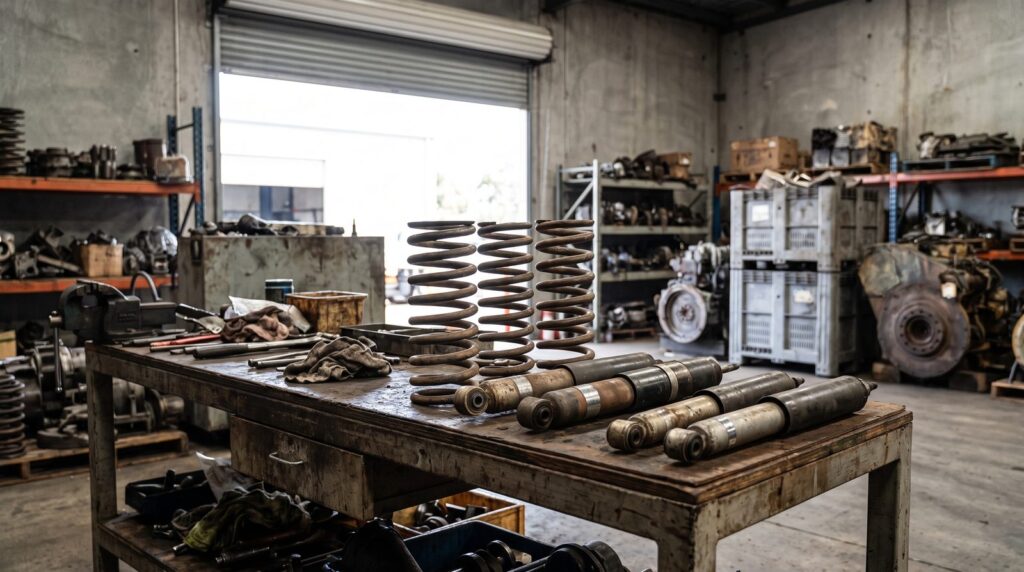
On a leaf sprung ute the rear pack carries the load and sets the ride. On an 80 there’s a coil at every corner, so the front rate matters as much as the rear. A bull bar and winch load the front springs. Drawers, water and a second battery load the rear. Buy them as a matched set for the way the vehicle actually sits.
Match the rate to the load
This is where most 80 Series builds go wrong. A rate picked for an empty wagon rides badly once it’s packed, and a rate picked for a loaded tourer is harsh on the school run. Weigh the vehicle as it normally sits, with everything that lives in it: the fridge, recovery gear, long range fuel and drawers. Guess wrong and you’re buying a second set of springs.
How high
Two inches is the common choice on an 80 Series wagon. At three inches and up you have to deal with driveline angles, brake line lengths, castor correction and steering geometry, and it changes what has to be certified. Have that conversation before you buy.
Vehicle modifications in Australia come under Vehicle Standards Bulletin 14, the national code of practice published by the Department of Infrastructure. VSB 14 sets the technical rules. The sign off comes from an approved certifier recognised by your state registration authority.
Our coil spring range covers the 80 and 105 Series, along with shocks and complete lift kits. A complete kit is usually the simplest way to keep the rates matched front to rear.
Stage 2: exhaust
Once the vehicle sits and steers properly, exhaust is the next gain and the safest one.
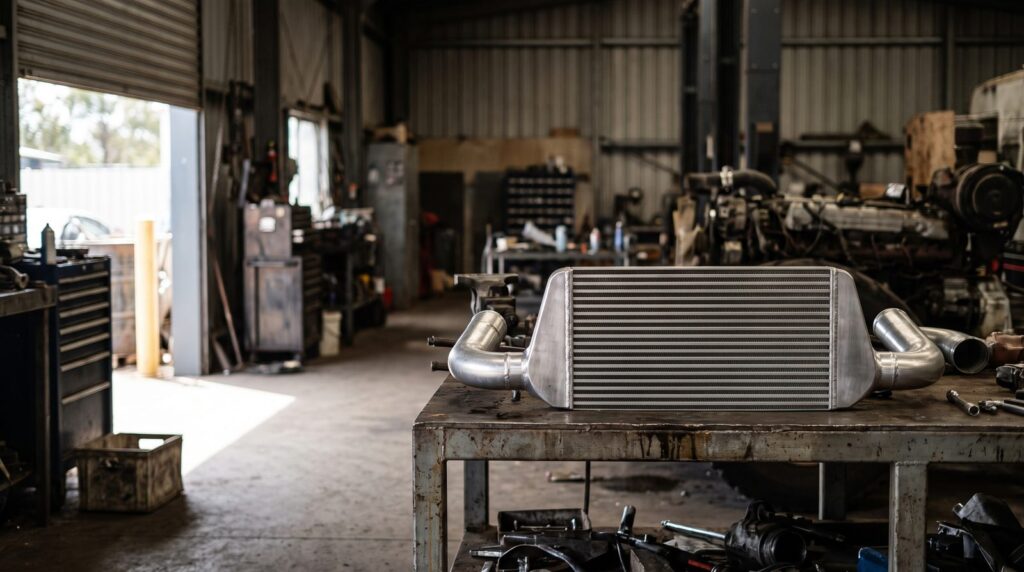
A bigger, freer system lowers exhaust gas temperature. On a turbo diesel that counts for more than the power figure, because heat kills turbos, manifolds and head gaskets. If you tow, it’s the most useful thing you can do for the engine’s life.
Extractors for petrol and diesel
Extractors replace the cast log manifold with individual tuned length pipes, which cuts the interference between cylinders as they exhaust. They’re best known as a 4.5 litre petrol mod, and there are FZJ80 sets from a 2.5 inch off-extractor kit up to a mandrel bent set with flex and a full system.
A lot of owners don’t realise there are 1HZ diesel extractors for the HZJ80 too: a 2.5 inch off-extractor set, an outside chassis set, and a 4.2 litre extractor with a full 2.5 inch system. Watch the cheapest line. It’s extractor tops only and still needs a separate base pipe.
Match the extractors and manifolds to your engine code. The FZJ80 and HZJ80 parts don’t swap.
The turbo diesels
A turbo-back system replaces everything from the turbo outlet back. The 80 Series ones are 3 inch, with a muffler, with a hotdog resonator, or with no muffler. There are six listed for the factory turbo HDJ80 1HD wagon. The cheaper HZJ80 systems are listed to suit a turbocharged 1HZ, which is a conversion, not a factory car.
The dump pipe is the short section straight after the turbo housing. It’s normally the worst restriction in a factory setup because it has to snake around the chassis rail. There are two for the HDJ80 and HZJ105 1HD, one for inside chassis routing and one for the conventional routing. Replacing it on its own rarely pays, because the restriction just moves to whatever undersized pipe is left behind it.
You can also replace the system a piece at a time, with individual pipe sections, centre resonators and centre mufflers. That lets you rebuild a rusted system bit by bit.
Stage 3: cooling
On an 80 Series turbo diesel an intercooler isn’t a refinement. You’re filling a gap Toyota left.
The move from the 1HD-FT to the 1HD-FTE was mainly about how the fuel was delivered, plus a standard intercooler, which the 1HD-FT didn’t have. The 1HD-FTE wasn’t fitted to the 100 Series at its 1998 launch. It arrived in October 2000, two years after the 80 finished. So the 1HD-FT that ran the 80 Series through to 1998 wasn’t intercooled. We treat the earlier 1HD-T as not intercooled too, but open the bonnet and check yours before you buy.
An intercooler cools the air after the turbo and before the inlet manifold. Cooler air is denser, so you get more oxygen per stroke and a lower starting temperature for combustion.
That doesn’t make it the right buy on every 80. Many owners have found the 1HD-T needs new bottom end bearings roughly every 100,000km, along with surging and poor idle. Putting an intercooler on a 1HD-T with no bearing history spends real money on intake temperature when that engine’s known failure isn’t heat. On a 1HD-T, get proof of the bottom end first. On a 1HD-FT, the intercooler is the change that earns its keep.
Our intercooler range has top mount and front mount kits for the 80 Series, listed for the 1HZ, the 1HD-T and the 1HD-FT. That includes a 1HZ and 1HD-T front mount shaped to clear a winch.
Stage 4: tune and fuelling
Tune last. On healthy hardware a tune sharpens response and holds torque better under load. On tired hardware it hides the problem for a while, then finds it for you at the worst time.
Check what your engine actually has before you plan this stage, because the 80 Series diesels weren’t electronically injected. The 1HD-FTE brought electronic control of injector timing and volume, but it arrived in the 100 Series after the 80 finished. The 1HZ runs indirect injection off a mechanical injection pump. On those engines, fuelling and boost are mechanical work, not a laptop job.
The 1HZ turbo conversion
The only complete turbo kit for the 80 Series is for the 1HZ, and it’s a big decision.
Toyota never offered a turbo 1HZ, so every one on the road is an aftermarket conversion. Under VSB 14 that means engineering and certification on top of the parts. Bring us the build before you buy parts and we’ll tell you what it needs to pass. If you go ahead, cooling and exhaust are part of that build, not extras.
What to skip
- Big tyres before springs. You get rubbing, bad geometry and a wagon that stops worse than it did.
- A tune before the intercooler on a turbo diesel. More fuel into hot air is more heat, and heat is what breaks things.
- An intercooler on a 1HD-T with unknown bearing history. Prove the bottom end first.
- Springs chosen on lift height alone. Rate matters more than inches.
- Cheap shocks. They fade when they get hot, which is exactly when you need them.
- Extractors bought on the badge. The FZJ80 petrol and HZJ80 1HZ diesel sets are different parts.
What an 80 Series build costs
These are parts prices. Fitting, wheel alignment and certification are on top.
| Stage | Part | From | To |
|---|---|---|---|
| 1 | Shock absorbers, 80/100/105 | $156.75 | $285.00 |
| 1 | Coil springs, 80/100/105 | $240.35 | $587.10 |
| 1 | Complete lift kits, 80/105 | $1,254.95 | $2,846.00 |
| 2 | Dump pipes, HDJ80 and HZJ105 1HD | $393.26 | $511.24 |
| 2 | Extractor sets, FZJ80 petrol and HZJ80 1HZ diesel | $747.07 | $3,835.82 |
| 2 | Turbo-back systems, 3 inch | $1,449.21 | $2,388.55 |
| 3 | Intercoolers, top and front mount | $1,530.00 | $2,350.00 |
| 4 | Turbo kit, 1HZ | $3,360.00 | $3,360.00 |
What sits at each end: the lift kits run from a WCS 2 inch kit to an EFS 3 inch kit. The intercoolers run from the 1HZ and 1HD-T front mount shaped to clear a winch to the Series 2 top mount for the same engines. The dearest extractor line is the HZJ80 4.2 litre set with a full system. The extractor tops only line at $730.54 sits below all of these and still needs a base pipe.
The price shape isn’t what it is on a newer 4WD. On a 79 Series the exhaust is the expensive stage. On an 80, suspension is cheap, exhaust spans the widest range, and the intercooler has no cheap way in.
Common questions
Did the 80 Series come with an intercooler?
Not the 1HD-FT. Toyota brought in a standard intercooler with the 1HD-FTE, which didn’t reach the 100 Series until October 2000. Treat the earlier 1HD-T the same way, but check yours. That’s why the intercooler is stage 3 on an 80 Series.
Can you turbocharge a 1HZ in an 80 Series?
Yes, and there’s a kit for it at $3,360.00. Toyota never offered a turbo 1HZ, so every one on the road is an aftermarket conversion, and under VSB 14 that’s certification work. Talk to us before you buy parts and we’ll spec the build to pass.
Is the 1HD-T or the 1HD-FT the better engine?
The 1HD-FT, for most buyers. The 1HD-T makes 122kW and 361Nm with peak torque down at 1,400rpm, which is lovely, but it only ran from 1990 to 1992 and owners report it needing bottom end bearings roughly every 100,000km. The 1HD-FT makes 125kW and 380Nm and ran to the end of production in 1998.
What does an 80 Series exhaust cost?
It depends how much you’re replacing. A centre resonator starts at $364.74 and a centre muffler at $442.78. Three inch turbo-back systems run from $1,449.21 to $2,388.55. A complete extractor set starts at $747.07 and goes to $3,835.82 for an HZJ80 4.2 litre set with a full system.
Is the 1FZ-FE petrol worth building?
It’s a strong 4,477cc double overhead cam six with 9.0:1 compression. Extractors are the traditional first move, but be realistic about fuel use in a heavy wagon.
Tell us how the vehicle is loaded
Spring rate depends on how the vehicle is loaded, and the intercooler depends on which of the three diesels you have, so talk to us before you guess. Send your build date, engine code and a rundown of the setup (bar, canopy, drawers) through our contact page and we’ll match the parts to the vehicle. If you’re buying an 80, put the VIN through the PPSR for money owing and stolen or written-off status, and check the recall register at Product Safety Australia. Our founder Willy has more than 20 years on the tools as a heavy diesel mechanic, and the team works on diesel 4WDs across our Brisbane and Sunshine Coast workshops.
Last updated: October 2026