
 By Willy · Founder & Lead Diesel Specialist
Willys Workshop · Oxley & Warana · 20+ years hands-on diesel experience
A dual battery system is a second battery that runs your fridge, lights and accessories, wired so it can’t flatten the battery that starts the engine. On any recent ute it needs a DC-DC charger between the two. The commonest mistake we see is a new battery and tray with no charger, which leaves a lot of money sitting in a battery that never fills.
This guide covers why you want the second battery, how lithium and AGM compare, what a DC-DC charger does, how to size amp hours against your own draw, and whether a vehicle kit beats building your own. If you already know what you need, go straight to the lithium batteries we stock, or pick a dual battery kit built for your vehicle.
At a glance
- A simple isolator won’t fill a lithium battery on a modern ute. The alternator varies its voltage to save fuel, so you need a DC-DC charger.
- Buy usable energy, not the number on the sticker. A 100Ah lithium and a 100Ah AGM are not the same purchase.
- Batteries with the same amp hours vary a lot in price. Mostly you’re paying for the case shape, so measure the space first.
- A dual battery kit is a battery and a tray. The charger, monitor and wiring are extra.
- Fit a monitor. Without one you’re guessing.
Quick Links
- Why a second battery at all
- Lithium against AGM
- What a DC-DC charger does
- Sizing amp hours to your real draw
- What the parts cost
- Vehicle kit or build your own
- Mounting, cable, fuses and the legal side
- Want it fitted?
- Common questions
Why a second battery at all
The starting battery in a diesel 4WD has one job: turn a high compression engine over. It’s built for a short, heavy draw and a quick top up. Running a fridge off it overnight is the opposite. Cycle a starting battery deeply a few dozen times and it will let you down, usually somewhere with no phone signal.
A second battery splits the two duties. The starting battery stays full. The second battery carries the camp load, and it’s chosen and wired to be run down and filled again, over and over.
It also helps off the track. A UHF, driving lights and a dash cam in parking mode all draw current, some with the key out. On its own battery, that drain stays away from the one you need at 5am.
The system has four parts: the battery, the charger that fills it, the mount that holds it, and the monitor that tells you what’s left.
Lithium against AGM
LiFePO4, or lithium iron phosphate, is the lithium chemistry used in 4WD and caravan batteries. It isn’t the same chemistry as a phone or power tool battery. Victron lists two of its strengths as “High round-trip efficiency” and “High energy density – More capacity with less weight and volume” (Victron Energy).
| Consideration | Lithium (LiFePO4) | AGM lead acid |
|---|---|---|
| Purchase price | Higher. Our lithium batteries start at $990.00 | Lower for the same sticker amp hours. We don’t stock AGM, so we can’t quote it |
| Usable share of the rated capacity | Larger, so you need fewer rated amp hours | Smaller, so you need more rated amp hours |
| Weight for the same usable energy | Lower | Higher |
| Charge acceptance | Higher, so it refills in less driving | Lower, so it takes longer to reach full |
| Charging below freezing | Restricted. Chargers protect against it | Less sensitive |
| Charger | Needs a lithium charge profile | Simpler profile |
People compare sticker to sticker, and that’s the mistake. You can use far more of a lithium battery’s rating than a lead acid one’s, so the same usable energy takes fewer rated amp hours and less weight.
AGM still makes sense for a light setup. For a couple of LED lights and a phone charger on the odd weekend, the lithium premium buys very little, and we’ll say so.
What a DC-DC charger does
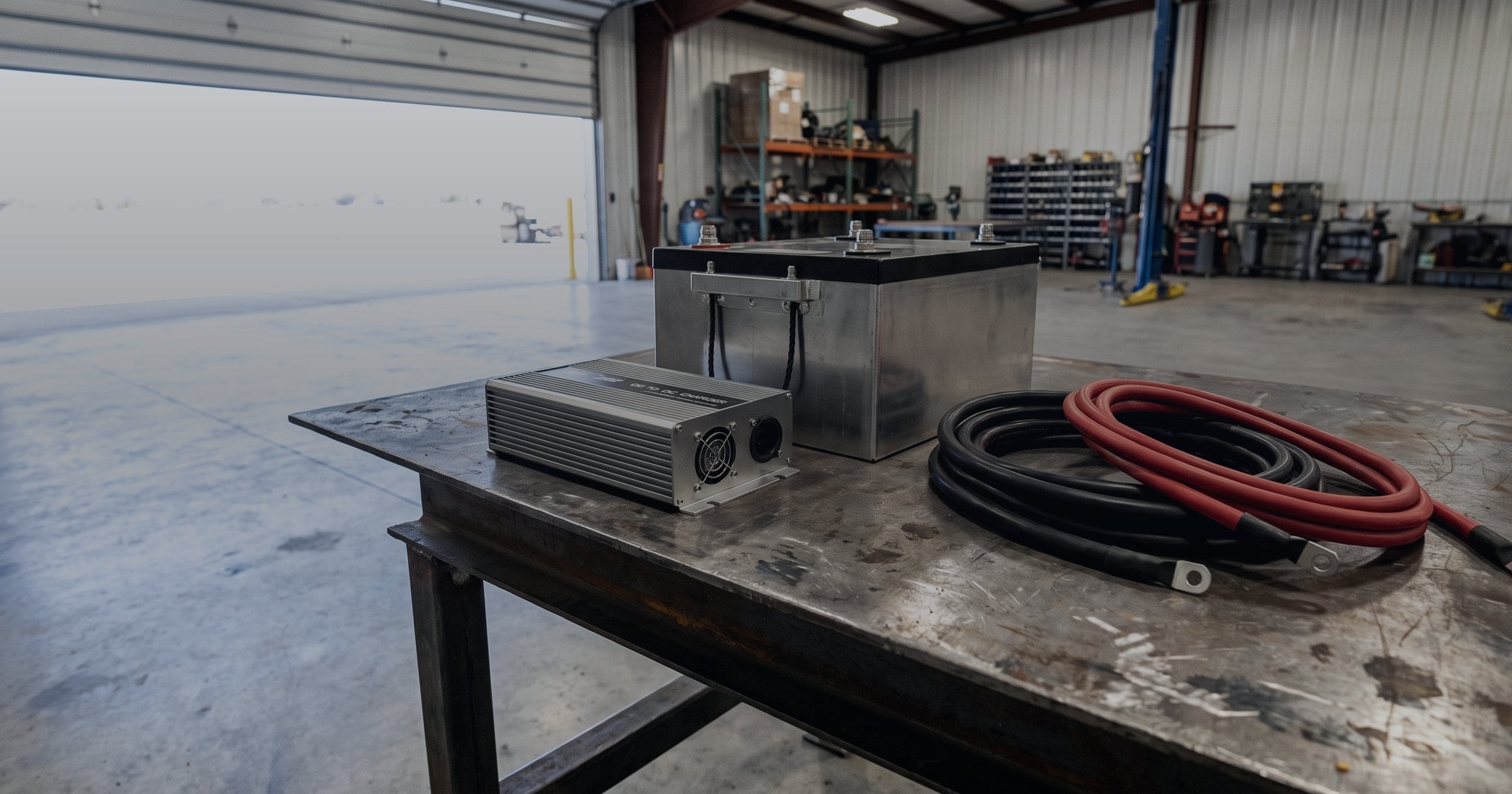
A DC-DC charger takes the vehicle’s varying alternator voltage and turns it into a steady multi-stage charge to suit the second battery’s chemistry. It’s the part people try to save on, and the part that decides whether the battery ever fills.
A smart alternator has its output voltage varied by the ECU to cut engine load and fuel use. Through a simple isolator, the second battery sees whatever voltage the ECU is making at that moment. Often that’s not enough to finish a charge.
Redarc says its in-vehicle chargers “work with either standard voltage alternators or smart alternators” and are “designed to charge your secondary battery banks to 100% state of charge while on the move” (Redarc). Victron says the Orion XS “also helps retrieve a proper charge current from intelligent Euro 5 or 6 alternators” (Victron Energy).
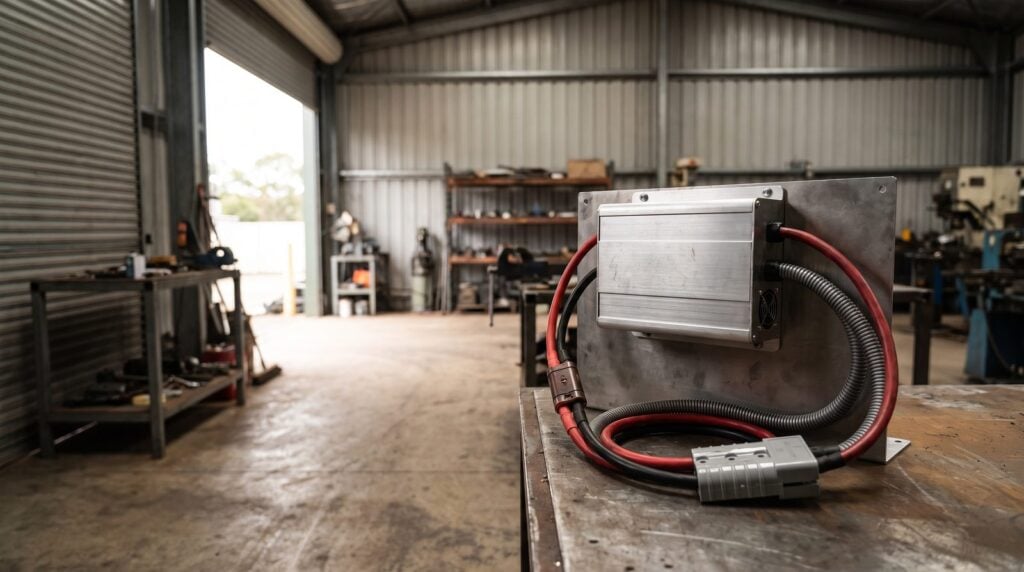
With lithium there’s a second reason, the charge profile. Lithium wants different absorption and float stages to lead acid. Victron says the Orion XS “charges all common battery types including lithium, AGM, Gel, and flooded”, with battery presets you pick in the VictronConnect app. The Redarc BCDC Core 25 and Core 40 are both listed as lithium ready.
Some units also take solar. Redarc says its chargers “are able to charge from Solar and DC inputs simultaneously”. Don’t assume every charger does. Check the spec of the one you’re buying.
Sizing the charger
Charger amps decide how long you have to drive to put back what you used. Take 50Ah out overnight and a 25A charger needs roughly two hours of driving to replace it. A 40A charger needs roughly an hour and a quarter. Both stretch near the top, because current tapers as the battery gets close to full.
So pick the charger for how you drive. Long touring days recover fine on 25A. Short hops between camps, or a big bank, suit 40A or 50A.
Sizing amp hours to your real draw
People buy 200Ah to run two LED strips, or 100Ah to run a fridge, a diesel heater and a Starlink dish. Both are wrong.
Amp hours measure charge: current in amps multiplied by the hours it flows. A load pulling 2A for 10 hours uses 20Ah. Everything else follows from that.
- List every 12V load you’ll run away from mains power.
- Multiply each load’s average amps by its hours per day. Use the average, not the peak. A fridge compressor doesn’t run all the time.
- Add the daily totals. That’s your amp hours per day.
- Multiply by the days you want to sit still without driving or solar.
- Divide by the usable share of the battery, then round up to a real battery size.
Here’s a worked example. The figures are assumptions to show the method, not measurements from your vehicle. Swap in your own.
| Load | Assumed average draw | Hours per day | Amp hours per day |
|---|---|---|---|
| 12V compressor fridge | 1.5A averaged over the cycle | 24 | 36Ah |
| LED camp and interior lights | 1.0A | 4 | 4Ah |
| Phone and laptop charging | assumed | assumed | 5Ah |
| Water pump, UHF, dash cam standby | assumed | assumed | 5Ah |
| Daily total | 50Ah |
Two days parked uses 100Ah. We plan on using about 80 percent of a lithium battery and 50 percent of a lead acid one. Those are planning numbers, not maker specs.
On that basis, 100Ah of draw needs roughly 125Ah of lithium or 200Ah of lead acid. A single 100Ah lithium is short for this example. You’d want 200Ah, or two 100Ah batteries.
The best money you can spend on sizing goes on measuring. A shunt is a small, precise resistor in the negative battery lead. It reads the real current in and out, so a monitor can show true state of charge. Victron lists the SmartShunt’s readings as “state of charge, time remaining, voltage, current, amp hours, number of charge cycles, and deepest discharge”, and you read them on your phone (Victron Energy). Fit one, do a normal trip, and you’ll know your real daily draw. Our battery monitors start at $17.00.
What the parts cost
These are parts prices from our catalogue and they update with it. Cable, fuses, lugs, an Anderson plug and fitting are on top of every figure here.
Lithium batteries
These are the 12V batteries from 50Ah to 200Ah, the band a 4WD second battery comes from. The category also holds bigger caravan and RV banks, plus 24V and 48V units, which aren’t 4WD dual battery parts.
| Battery | Capacity | Price |
|---|---|---|
| Next Generation Ultra Slim Lithium Battery 50Ah | 50Ah | $1,090.00 |
| Compact Lithium Battery 100Ah | 100Ah | $990.00 |
| Next Generation Slim Lithium Battery 100Ah | 100Ah | $1,190.00 |
| Ultra Slim Lithium Battery 100Ah | 100Ah | $1,390.00 |
| Next Generation Ultra Slim Lithium Battery 100Ah | 100Ah | $1,590.00 |
| Compact Lithium Battery 200Ah | 200Ah | $1,990.00 |
| Next Generation Slim Lithium Battery 200Ah | 200Ah | $1,990.00 |
| Ultra Slim Lithium Battery 200Ah | 200Ah | $2,090.00 |
Look down the 100Ah rows. Same rated capacity, same chemistry, quite different prices. The one thing the listings show that separates them is the case: compact, slim or ultra slim. The price list alone doesn’t tell us whether the cells or BMS differ too, so ask for both data sheets if that matters to you.
So measure the space before you shop. If a tub corner or under-seat cavity takes a compact case, you’ll pay the least for your amp hours. If the battery has to slide in behind a seat back, the slim premium buys the only shape that fits.
Chargers
Read the type column before the price column.
| Charger | Type | Price |
|---|---|---|
| Redarc BCDC Core 25 | DC-DC, in-vehicle, 25A | $399.00 |
| Redarc BCDC Core 40 | DC-DC, in-vehicle, 40A | $469.00 |
| Victron Orion XS 50A DC-DC Charger | DC-DC, in-vehicle, 50A | $540.00 |
| Redarc BCDC Alpha50 | DC-DC, in-vehicle, 50A | $899.00 |
| Victron IP22 240V 30A Battery Charger | 240V mains | $283.00 |
| Victron SmartSolar MPPT 75/15 | Solar regulator | $129.00 |
| REDARC Alpha Series Charger With RedVision Monitor | System package, 50A, 75A or 100A | from $3,999.00 |
The two cheapest lines are a trap if you need alternator charging. The Victron IP22 runs off 240V mains, which is right for topping up in the shed and wrong for charging on the move. The MPPT 75/15 is a solar regulator, not a DC-DC charger. Of the in-vehicle DC-DC units, the Redarc BCDC Core 25 is the cheapest we list. Redarc units are sold at Redarc’s recommended retail price. The Alpha with RedVision is a full system with a monitor, so don’t compare it with a bare charger.
Monitors
| Item | Price |
|---|---|
| Victron SmartShunt 300A | $116.00 |
| Victron SmartShunt 500A | $159.00 |
| Victron BMV-712 Smart | $225.00 |
| 12V Switch Panel with Bluetooth | $275.00 |
| Redarc Smart Battery Monitor | $299.00 |
Trays, mounts and brackets
Brackets suit a battery you’re mounting yourself. Trays are cut for one vehicle. Trays and mounts start at $11.00.
| Item | Price |
|---|---|
| Mounting Kit with 4x Folded Aluminium Brackets, Nutserts and Bolts | $65.00 |
| Ford Ranger DCDC Mounting Bracket | $99.00 |
| Custom Lithium Battery Tray, Toyota Hilux N80 | $220.00 |
| Custom Lithium Battery Tray, Isuzu D-MAX | $220.00 |
| Custom Lithium Battery Tray, Jeep Gladiator | $299.00 |
Vehicle dual battery kits
Each kit is built around one vehicle, and some around one build year range. Kits start at $1,389.00. Most are sold in more than one battery size, so the figure below is the smallest option.
| Vehicle | Price |
|---|---|
| Jeep Gladiator | from $1,389.00 |
| Nissan Patrol Y62 | $1,445.00 |
| Toyota Hilux N80 (2016 to 2024) | from $1,610.00 |
| Isuzu D-Max (2022 on), behind rear seat | from $1,610.00 |
| Mazda BT-50 (2022 on), behind rear seat | from $1,610.00 |
| Volkswagen Amarok (2016 to 2022), behind rear seat | from $1,645.00 |
| Toyota Hilux N90 (2026) | from $1,650.00 |
| Ford Ranger | from $1,690.00 |
| Nissan Navara NP300 | from $1,690.00 |
| Toyota Hilux N70, behind rear seat | from $1,695.00 |
| Ford Everest (2022 on) | $1,790.00 |
| Isuzu MU-X (2022 on) | $1,790.00 |
| Toyota Landcruiser 79 Single Cab | $1,790.00 |
| Toyota Landcruiser 79 Series | from $1,790.00 |
Vehicle kit or build your own
A vehicle kit is built around one vehicle, with a tray made for a factory location. Building your own means choosing a battery, charger and mount separately.
A Custom Lithium kit is a battery plus a mounting tray. The listings say “Wiring Kit not included”, and there’s no charger unless you add one. Cable, fuses, lugs and Anderson plugs are extra, or supplied by your installer. The kit pages also say some vehicles need small changes, such as altering a vent behind the tray on the Hilux N80 or removing the factory gun casing on the Gladiator.
Most kits carry a slim or ultra slim battery, the shape that fits behind or under a rear seat, and that’s where much of the price goes. With room for a compact case elsewhere, building your own can work out cheaper.
- Take the vehicle kit when there’s one for your exact vehicle and year, and you want a tray made for a factory location.
- Build your own when your vehicle isn’t on the list, when you already own part of the system, or when a compact case fits and you’d rather put the difference into the charger or monitor.
Mounting, cable, fuses and the legal side
Hold the battery down properly. A 200Ah lithium loose in a tub under hard braking is a serious projectile, so bolt the tray or bracket to vehicle structure.
Fusing is the other must. Every cable run needs a fuse sized to the cable, fitted at the source end. Long runs to a tub or canopy battery also lose voltage along the way, so size the cable for the distance and the charger current together, not the current alone. Check the cable limit on the charger too. Our Orion XS listing gives a maximum cable size of 25mm² at its screw terminals.
On safety, Product Safety Australia warns that “if a lithium-ion battery is not correctly manufactured, handled, stored or disposed of, it can catch fire, explode or vent toxic gas” (Product Safety Australia). Don’t keep using a battery with a damaged case. At the end of its life, take it to a battery recycling drop-off rather than the wheelie bin.
Adding or moving a battery is a vehicle modification. The national technical code for that is Vehicle Standards Bulletin 14. The Department of Infrastructure says “VSB 14 essentially provides the technical requirements that need to be met when modifying or constructing a vehicle” (Department of Infrastructure). It doesn’t cover each state’s paperwork, so check with your registration authority, especially for a battery inside the cabin.
Want it fitted?
We fit dual battery and lithium systems at our Warana workshop on the Sunshine Coast, where our auto electrician is based. Auto electrical work isn’t done at our Oxley workshop in Brisbane, which handles diesel mechanical work.
| Job | Fitting price |
|---|---|
| Vehicle kit behind the rear seat | Fitment from $1,150* |
| Battery in the canopy, tray or cab | Fitment from $1,450* |
| DC-DC charger only | Fitment from $575* |
*Depends on the make and model of your vehicle. Contact us for an accurate quote and to discuss your needs.
Custom Lithium kits ship without wiring, so tell us what you’ve bought and we’ll quote the cable, fuses, lugs and Anderson plugs with the fitting. More on what we do is on our auto electrical page, or ask for a fitting quote at Warana.
Common questions
Do I need a DC-DC charger, or will an isolator do?
With lithium, fit the DC-DC charger. Modern vehicles vary alternator voltage, and a simple isolator passes that straight through. Lithium also needs its own charge profile. Redarc says its in-vehicle chargers work with standard or smart alternators and charge a second battery to full while you drive, which is the gap an isolator leaves.
How many amp hours do I need?
Multiply each 12V load’s average current by its hours per day and add them up. Multiply by the days you’ll sit without driving, then divide by the usable share of the battery. In our worked example, 50Ah a day over two days needs roughly 125Ah of lithium. For the real answer, fit a shunt and measure your own draw on a trip.
Is lithium worth the money over AGM?
It depends how hard you use it. For a fridge, lights and a few days off grid, lithium usually wins on usable energy. You carry fewer rated amp hours and less weight, and it refills in less driving. For a light weekend load, the premium buys very little.
Can I charge a lithium battery in cold weather?
Charging lithium below freezing is restricted, and chargers protect against it. Victron says the Orion XS “automatically shuts down at sub-zero temperatures” to prevent damage to lithium batteries. Most Australian touring never sees it, but it can matter in the high country in winter.
What size DC-DC charger should I buy?
Match it to how you drive. Replacing 50Ah takes roughly two hours of driving on a 25A charger and about an hour and a quarter on a 40A, a bit longer as the battery nears full. Long driving days suit a 25A unit. Short hops between camps, or a 200Ah bank, suit 40A or 50A.
Does a dual battery kit come with wiring?
No. Custom Lithium kits are a battery and a mounting tray. Cable, fuses, lugs and Anderson plugs are extra, and the charger is a separate option. If we fit it at Warana, we quote the wiring with the job.
Size the system from your own draw
Most of the dual battery systems we rework weren’t badly built. They were badly specified: a battery too small, or a charger that was never going to fill it. Send us the vehicle, the build year, the loads and how long you sit still through our contact page, and we’ll check the mounting and charger size before you order. Shop lithium batteries, dual battery kits, DC-DC and battery chargers, battery monitors and trays and mounts.
Our founder Willy has more than 20 years on the tools, and the team works on diesels and 4WDs across our Brisbane and Sunshine Coast workshops. Read more about us.
Last updated: October 2026