
 By Willy · Founder & Lead Diesel Specialist
Willys Workshop · Oxley & Warana · 20+ years hands-on diesel experience
The 1HZ is Toyota’s naturally aspirated 4.2 litre six cylinder diesel, 4,164cc, making 94kW and 271Nm in the 80 Series and 96kW and 285Nm in the HZJ105. Toyota never built a turbocharged one, and almost everything owners like and dislike about the engine traces back to that decision: it is durable because it was never asked to work hard, and it is slow for exactly the same reason.
Which is why the turbo kit question comes up so often. This guide covers what the engine is, which LandCruisers carry it, what a conversion actually involves, and how the numbers stack up against simply rebuilding the thing. If you already know what you need, go straight to the turbochargers and turbo kits we stock.
At a glance
- 4,164cc cast iron six, 94.0mm bore and 100.0mm stroke, single overhead camshaft, two valves per cylinder, indirect injection.
- Compression is 22.7:1 on the original engine and 22.4:1 after the 1998 update.
- 80 Series, 1990 to 1998: 94kW at 4,000rpm and 271Nm at 2,000rpm. HZJ105, 1998 to 2007: 96kW at 3,800rpm and 285Nm at 2,200rpm.
- Toyota did not offer a turbocharged 1HZ, so every turbo 1HZ on the road is an aftermarket conversion.
- That makes it a certifiable modification, which we handle in house along with the fitting.
- Fitting, pump tuning and certification are on top of every kit price.
Quick Links
- What the 1HZ is
- Which LandCruisers got it
- Full specifications
- Why it lasts, and why it is slow
- When to rebuild a 1HZ, and when not to
- The turbo conversion question
- What the kits cost
- Turbo or rebuild, and where the money goes
- Buying a used 1HZ
- Common questions
What the 1HZ is
A 4,164cc inline six, cast iron block, cast iron head, 94.0mm bores and a 100.0mm stroke, with one overhead camshaft driven off a belt, two valves per cylinder and a swirl type chamber in a cross flow head.
Indirect injection sprays fuel into a small pre-chamber rather than straight onto the piston crown, so it burns more gently and a good deal more quietly than direct injection does. You pay for that in efficiency and in power per litre. The 1HZ uses it, and that is the first clue to its character.
The bottom end is where the reputation actually comes from: a crankshaft with twelve balancing weights running in seven bearings, and a bearing cap built as part of the crankcase in a ladder frame rather than bolted on as separate caps. The post-1998 engine went further again, with a stiffer crank, machine-bored bearings and a stiffer block.
That 1998 update is worth knowing about if you are ordering parts, because a fair bit changed at once. The nozzle orifice grew from 1.0mm to 1.2mm. The top ring groove moved from fibre reinforced metal to metal matrix composite to handle wear. Chamber and piston shape both changed to cut emissions, which dropped compression from 22.7:1 to 22.4:1. Then in October 2002 the HZJ105 picked up an EGR system and a timing control valve on the pump, which is the point at which the EGR hardware further down this page starts to apply.
Which LandCruisers got it
| Vehicle | Transmission | Years | Peak power | Peak torque |
|---|---|---|---|---|
| 80 Series LandCruiser | 5sp manual | 1990 to 1998 | 94kW at 4,000rpm | 271Nm at 2,000rpm |
| 100 Series LandCruiser (HZJ105) | 5sp manual, 4sp auto | 1998 to 2007 | 96kW at 3,800rpm | 285Nm at 2,200rpm |
That table does not cover everything owners come looking for, so two notes.
The 70 Series is missing from it, and not because the engine is. The 1HZ went into 75, 78 and 79 Series LandCruisers as well, and our catalogue carries turbo kits and intercoolers listed against those vehicles. What we do not have is a separately published output figure for them, so we are not going to invent one. Get that from Toyota rather than off a forum.
The other note is that published tables sometimes file the 80 Series 1HZ row under a model code that properly belongs to the turbocharged 1HD-T. Take 94kW and 271Nm as the 80 Series figure, then read your own engine code off the block before you order anything.
Parts carry over between these platforms more than most people expect, which is part of why the engine stayed in production for as long as it did. It is still worth ordering against your engine code and build date rather than the year on the rego papers.
Full specifications
| Specification | Value |
|---|---|
| Configuration | Inline six, cast iron block and cast iron head |
| Displacement | 4,164cc |
| Bore x stroke | 94.0mm x 100.0mm |
| Compression ratio | 22.7:1 original, 22.4:1 post-1998 |
| Valvetrain | SOHC, timing belt driven, two valves per cylinder |
| Combustion chamber | Swirl type, cross flow head |
| Fuel system | Indirect injection, injection pump, no common rail |
| Injection nozzle orifice | 1.0mm original, 1.2mm post-1998 |
| Crankshaft | Twelve balancing weights, seven aluminium alloy bearings |
| Exhaust manifold | Dual type |
| Factory forced induction | None. Toyota did not offer a turbocharged 1HZ |
| Quoted outputs | 94kW in the 80 Series, 96kW in the HZJ105. No separate 70 Series figure is published |
Confirm against your own engine before ordering.
Why it lasts, and why it is slow
Both halves of the reputation come out of the same set of decisions.
Start with how little is being asked of it. Ninety-four to ninety-six kilowatts out of 4,164cc works out at roughly 23kW per litre, and peak power lands at 3,800 to 4,000rpm, so cylinder pressures stay low and the heat load stays modest right across the range where the engine actually spends its life. Now add the hardware: iron block, iron head, crank carried on seven bearings, ladder frame bearing cap cast into the crankcase. Margin everywhere. Nothing with a vane turbo to gum up, nothing running common rail pressures.
The same numbers explain the pace, because they are the same numbers. Peak torque is 271Nm at 2,000rpm in the 80 Series, 285Nm at 2,200rpm in the HZJ105. Plenty of current dual cab utes make more than that from a 2.8 litre four. Put 285Nm under a heavy wagon on 33s with a bar and a full load in the back and it feels every bit as slow as the figure suggests.
That is the trade, and it is worth understanding before you go looking for a fix. A slow 1HZ is not a worn out 1HZ. It is an engine Toyota built for places where the fuel is questionable and the nearest workshop is a long way off.
When to rebuild a 1HZ, and when not to
Most tired 1HZ engines have not failed. They have worn out slowly and evenly over a very long time, which is precisely what a durable engine does, and it is what makes the decision awkward: nothing is broken, and nothing is what it was either. There are four ways to go, and they are nowhere near each other on price.

Repair the one fault. If compression and leak down come back healthy and the trouble is a single item, fix that item. An overdue timing belt, a head gasket or an oil leak is a job on its own. Do not pull a healthy engine apart because the odometer worries you.
Rebuild it. This is the call when the measurements are poor rather than the symptoms dramatic. Low or uneven compression across the six, heavy blow-by at the oil filler, oil use that keeps climbing. Those point at rings, bores and bearings, and no single part fixes them. It is also the right call before a turbo conversion, because a soft bottom end does not get better under boost.
Fit a used engine. Cheaper up front and quicker on the hoist, but a replacement 1HZ is another worn 1HZ carrying a history you cannot verify. Test it the way you would test a complete vehicle, using the checks further down this page.
Move the vehicle on. If the body, chassis and driveline owe you more than the engine does, the engine is not the deciding factor. Work that out before you spend, not after.
What the kit costs, and what it does not cover
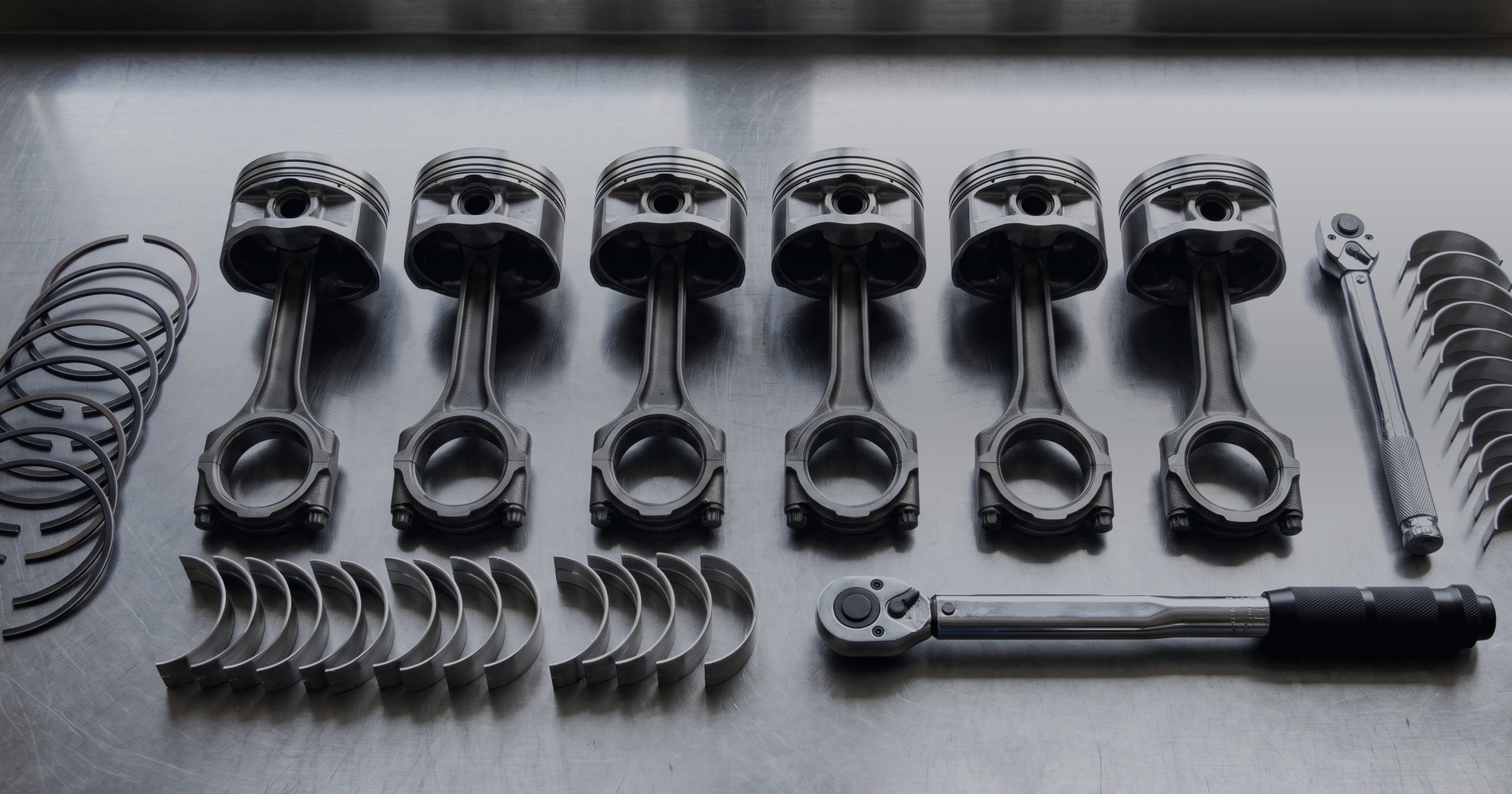
Our 1HZ engine rebuild kits start at $1,462.47 for the N/A kit.
Read that number as parts in a box, because that is all it is. Machining, labour and, on plenty of these engines, a cylinder head all sit on top of it, and the finished job comes to several times the kit price. We quote that part per engine once it is stripped and measured. Nobody can price it off a keyboard, and you should not trust anyone who does.
All three kits are ordered by size rather than pulled off a shelf. You choose a piston and ring size, a main bearing size and a conrod bearing size at the point of order. That tells you the running order of the job: the machine shop measures the block and the crankshaft first, then the kit gets ordered to suit those measurements. Buying the kit before the engine is apart is the usual way to end up with the wrong sizes on the bench.
Those size options also confirm the core of what is in the box: pistons, rings, main bearings and conrod bearings. Check the gasket and seal content against the listing when you order, because it is not identical across every kit. What is definitely not in the box is the cylinder head, the machining and the labour. Timing is worth a second look as well. Eight other kits in the same catalogue carry “With Timing” in the name and none of the three 1HZ kits do, so budget the belt, tensioner and idlers as their own line. On a belt driven camshaft that is not optional work.
The three kits are not interchangeable. N/A means naturally aspirated, so a 1HZ that has never been turbocharged, which is most of them, takes that kit. The 1HZ Turbo kit is for an engine already running boost. The high performance kit is the same rebuild with strengthened internals, for an engine going into higher-output service. None of the three includes a turbocharger. Order the wrong one and you have a set of parts specified for a different engine.
| Rebuild kit | Suits | Willys price |
|---|---|---|
| N/A Engine Rebuild Kit, Toyota 1HZ | A naturally aspirated 1HZ, never turbocharged | $1,462.47 |
| Engine Rebuild Kit, Toyota 1HZ Turbo | A 1HZ already running a turbo | $1,970.00 |
| High Performance Engine Rebuild Kit, Toyota 1HZ | Strengthened internals for higher-output service | $2,434.00 |
Prices read from our own listings on 25 July 2026, and every one of them covers parts only.
Send us the engine code and the sizes off your machinist’s report, and we will match the kit before you pay for it.
The turbo conversion question
This is the most searched 1HZ topic. It is also where bad advice does the most damage. Get the legal part and the mechanical part in the right order.
Certification
Because Toyota never offered a factory turbo 1HZ, the conversion is certifiable work under VSB 14 Section LA.
We do the certification and fit the mod plate as part of the job, so it is one conversation rather than three. Bring us the build and we will spec it to pass.
The mechanical position
A turbo kit pushes more air and considerably more heat into an engine that was designed around neither. Whether it survives that comes down to three things, none of them exotic.
Charge air heat is the first. A top mount intercooler sits above the engine and is fed by a bonnet scoop, which on a 70 or 80 Series is the usual answer simply because there is no clean path to run pipework to a front mount. Cooler charge air means lower exhaust gas temperature, and exhaust gas temperature is what quietly decides how many years a converted engine gives you.
Fuelling discipline is the second, and it is the one that catches people. The 1HZ meters fuel with an injection pump rather than a common rail, so boost and fuel have to be matched mechanically at the pump instead of dialled in with software. Over-fuel it and you will melt a piston in an engine that would otherwise have run another decade.
The third is simply the state of the thing you are boosting. A tired 1HZ with high blow-by or a soft bottom end does not become healthy under boost, it becomes expensive. Compression test and leak down test before anything else, always.
What the kits cost
Prices are from our own catalogue on 25 July 2026, parts only. Fitting, pump tuning and certification are on top.
Where a group has more than one listing we show both ends of it. Turbo kits are $3,360.00 flat across all three platforms. Top mount intercoolers start at $1,630.00 and run to $2,450.00 for the Series 2 core. Rebuild kits start at $1,462.47.
Two labelling points. Turbo kits, intercoolers and rebuild kits here are aftermarket, not genuine Toyota, because Toyota never sold a turbocharged 1HZ. The small hardware below is genuine new Toyota where the listing says genuine.
| Part | Willys price |
|---|---|
| Turbo kit, 75, 78 and 79 Series | $3,360.00 |
| Turbo kit, 80 Series | $3,360.00 |
| Turbo kit, 100 and 105 Series | $3,360.00 |
| Top mount intercooler, 70 Series | $1,630.00 |
| Top mount intercooler, 80 Series, 1HZ and 1HD-T | $1,635.00 |
| Top mount intercooler, Series 2, 80 Series, 1HZ and 1HD-T | $2,350.00 |
| Top mount intercooler, Series 2, 70 Series | $2,450.00 |
| N/A engine rebuild kit, 1HZ | $1,462.47 |
| Engine rebuild kit, 1HZ Turbo | $1,970.00 |
| High performance engine rebuild kit, 1HZ | $2,434.00 |
The rebuild kit rows are not interchangeable, and all three are parts only. Which one suits your engine is covered above under when to rebuild a 1HZ.
Small hardware, such as the seals, studs and single use bolts that get reused when they should not be:
| Part | Willys price, genuine new |
|---|---|
| Camshaft gear | $49.00 |
| Fuel pump gear bearing | $43.42 |
| Camshaft seal | $36.30 |
| Exhaust manifold o-ring | $12.50 |
| Oil cooler gasket | $12.00 |
| Conrod bolt | $11.00 |
| Oil pump relief valve plug | $8.90 |
| Thermostat seal | $6.90 |
| Exhaust manifold stud | $6.11 |
| Head bolt washer | $4.50 |
| Oil pick up gasket | $3.50 |
Conrod bolts are the row to note. The 1HZ used plastic region tightening bolts for both the crankshaft bearing cap bolts and the connecting rod cap bolts. Plastic region bolts are tightened past their yield point, so they are treated as single use. At $11.00 on our listing, reusing them is a poor trade against the rest of the bill.
EGR hardware for the 1HZ
Only the later engines have anything to remove. The HZJ105 1HZ gained an EGR system in October 2002, and 70 Series 1HZ vehicles of that era carry one as well. An early 80 Series 1HZ has no EGR at all, so check the engine before you order rather than buying off the model year. These parts are for off-road and competition use.
| Part | Willys price |
|---|---|
| EGR delete kit, 1HZ LandCruiser | $71.50 |
| EGR blanking plate, LandCruiser HZJ79 | $17.33 |
The delete kit is the complete item for the 1HZ, with the pipework and plates it needs. The HZJ79 blanking plate is the plate on its own, and it shows up under two listings on our site because the same plate suits a few unrelated platforms. Both prices are the same either way.
Turbo or rebuild, and where the money goes
Owners walk this in as one question. It is two, and separating them is worth real money.
Put the listings side by side. A 1HZ turbo kit is $3,360.00 on all three platforms. Rebuild kits run from $1,462.47 for the N/A kit up to $2,434.00 for the high performance one. Pair a turbo kit with an intercooler and your parts bill sits between $4,990.00 with the 70 Series top mount and $5,810.00 with the Series 2, and that is before a single hour of labour, before pump tuning, and before the sign-off.
So every rebuild kit we list costs less than the turbo kit on its own, and the N/A kit costs less than half of it. Most owners arrive assuming the reverse, that a rebuild is the expensive path and a turbo is the cheap way out of a slow ute. Match the kit to what you have got when you order, because an engine that has never seen boost takes a different build to a converted one. Send the engine code through and tell us which it is.
There is one thing the price list will not show you. A rebuild to original specification is not a modification, so no certification is involved at all. The turbo path is, and we handle that end of it.
Which gives us the rule we use in the workshop. Tired engine, rebuild it first and leave the turbo as a separate job for later; you spend less on parts and you are not putting boost through worn bores. Healthy engine and the only complaint is pace, take the turbo path, but budget it properly as kit plus intercooler plus pump tuning plus sign-off rather than as a kit.
If the turbo is one stage inside a longer 70 Series build rather than the whole job, the order you tackle the stages in matters as much as which parts you buy. Our 79 Series build order guide is written around the current V8 and 2.8 utes rather than the 1HZ, but the sequencing logic behind it is the same one we apply to any 70 Series.
Buying a used 1HZ
Five checks tell you most of what you need on a 1HZ vehicle.

- Compression and leak down. The direct measure of the bottom end and the head, and it decides the rebuild question.
- Blow-by at the oil filler. High crankcase pressure on a naturally aspirated diesel is a bad sign at any reading.
- Timing belt history. The 1HZ drives its camshaft off a belt, so belt and tensioner history is a real budget item.
- Signs of a previous turbo conversion. If one is fitted, ask for the certification paperwork. An uncertified conversion becomes the buyer’s problem on the day of sale.
- Coolant and head gasket. Cast iron on cast iron is tolerant, but an overheated engine is still an overheated engine.
Check the VIN through the PPSR, which is a $2 search that shows money owing, and stolen or written-off status. Then check the model against the recall register at Product Safety Australia before you buy.
Common questions
How much power does a 1HZ make?
It depends on the model. The 80 Series makes 94kW at 4,000rpm and 271Nm at 2,000rpm. The HZJ105 makes 96kW at 3,800rpm and 285Nm at 2,200rpm. There is no separate published output figure for the 70 Series 1HZ, so we do not quote one.
Did Toyota ever make a turbo 1HZ?
No. Although there are aftermarket examples of turbocharged 1HZ engines, Toyota did not offer a turbocharged 1HZ engine. Every turbo 1HZ you see is a conversion.
Is a 1HZ turbo conversion legal in Australia?
Yes, once it is certified. Because Toyota never offered a factory turbo 1HZ, the install falls under VSB 14 Code LA3, and we do that certification and the mod plate ourselves.
How reliable is the 1HZ?
It is one of the more durable diesels sold here, and the design explains why. About 23kW per litre from a cast iron block and head, seven mains, indirect injection and no factory turbo mean low stress everywhere. That drops away when owners add boost without charge cooling and fuelling discipline.
Do I need an intercooler with a 1HZ turbo kit?
Treat it as part of the same job, not an upgrade. Charge air heat is the main thing that decides how long a converted 1HZ lasts. A top mount intercooler is the practical answer on 70 and 80 Series vehicles.
Is it cheaper to rebuild a 1HZ or turbo it?
Rebuilding is cheaper in parts. Our 1HZ rebuild kits start at $1,462.47 for the N/A kit, with the 1HZ Turbo kit at $1,970.00 and the high performance kit at $2,434.00, against $3,360.00 for the turbo kit on its own. Add an intercooler and the turbo path is $4,990.00 to $5,810.00 in parts, before labour, pump tuning and sign-off.
Get the 1HZ build right the first time
Whether you are turbocharging a 79 Series or freshening a tired 80 Series, the parts choice follows the engine’s real condition. Test first, then buy.
Send us your model, build date and engine code through our contact page and we will confirm the right kit for your vehicle before you order.
Our founder Willy has more than 20 years on the tools as a heavy diesel mechanic, and the team works on diesels across our Brisbane and Sunshine Coast workshops. You can read more about us and how we work.
Last updated: July 2026