
 By Willy · Founder & Lead Diesel Specialist
Willys Workshop · Oxley & Warana · 20+ years hands-on diesel experience
A spring maker sells by load rating, not ride height. Get that the wrong way round and the vehicle sits tall, rides badly and still sags with the camper on. That’s the most common way this purchase goes wrong. West Coast Suspensions is a Perth manufacturer of 4WD lift kits, GVM upgrade kits, shocks and springs.
This guide covers what the brand makes, how the shock series differ, what a GVM upgrade does and doesn’t give you, and how to choose a spring by load. If you already know the vehicle, browse the full West Coast Suspensions range and shop it by part type.
Quick Links
- Who they are and what they make
- The shock series compared
- Monotube against remote reservoir
- What a GVM upgrade does and doesn’t cover
- Choosing springs by load
- What the range costs
- Common questions
Who they are and what they make
The business started in Perth in 1924 as Jenkins W.H. Spring and Axle Service Station, bought Metro Baldock Springs in 1987 to become the largest spring maker in Western Australia, and became West Coast Suspensions in 1997. It’s based in Bassendean. WCS says its shocks and coil springs are dyno and load tested on a ROEHRIG 10VS Damper Dynamometer to check valve force and spring rate are consistent.
Being a Perth brand, most searches for it carry a Perth qualifier, but you don’t need to be in Perth to buy it. We stock and fit the range at our Brisbane and Sunshine Coast workshops. It covers lift kits, GVM upgrade kits, shocks, coil and leaf springs, torsion bars, adjustable panhard rods, upper control arm ball joint kits, u-bolts and the fitting hardware down to centre bolts and spring inserts.
Leaf springs: WCS makes both 4WD and heavy truck suspension, and its multi leaf and parabolic assemblies are described on its own site as truck and semi-trailer products. A parabolic leaf spring has leaves that taper in thickness, so it uses fewer leaves and has less friction between them. Our WCS listings include truck parts too, so on a leaf sprung 4WD, check which range a part comes from before you order.
Kit contents: a WCS lift kit is springs and shocks, and that’s all. The Landcruiser 80 and 100 Series 2 inch kit, for example, has a pair of front coils, a pair of rear coils and two shocks for each end. The steering damper, pins and shackles aren’t included. Budget for hardware and a wheel alignment on top.
The shock series compared
The part number prefix tells you more than the marketing name. This is WCS’s own series comparison.
| Series | Shock type | Reservoir | Lift range | Bore (mm) | Rod (mm) | Body (mm) |
|---|---|---|---|---|---|---|
| G2 | Twin tube hydraulic | N/A | 0 to 2 inch | 35 | 15 | 54 |
| G3 | Twin tube gas charged | N/A | 0 to 2 inch | 35 | 15 | 54 |
| G4 | Twin tube gas charged | N/A | 0 to 2 inch | 40 | 20 | 63 |
| MX3 | Monotube | N/A | 0 to 2 inch and 1 to 3 inch | 46 | 16 | 52 |
| MXA5 / MPA5 | 8 stage adjustable monotube | External or piggyback | 0 to 2 inch | 46 | 18 | 52 |
WCS pitches twin tube as the cost effective, comfortable choice for daily use, monotube for better heat management in heavy duty use, and remote reservoir as the premium option for extreme conditions.
A monotube shock has a single pressure tube with the oil and gas split by a floating piston, so the body sheds heat straight to the air. A remote reservoir shock moves the gas chamber into a separate canister, piggybacked or on a hose, which adds oil volume and cooling area.
Here’s what the table shows. G2 to G3 adds gas charging at the same 35mm bore. G3 to G4 is the real twin tube step, taking bore from 35mm to 40mm and rod from 15mm to 20mm. MX3 and MXA5 share a 46mm bore, so the adjustable reservoir shock gets you adjustment and reservoir volume, and the piston stays the same size. MX3 is also the only series listed for a 1 to 3 inch lift.
Monotube against remote reservoir
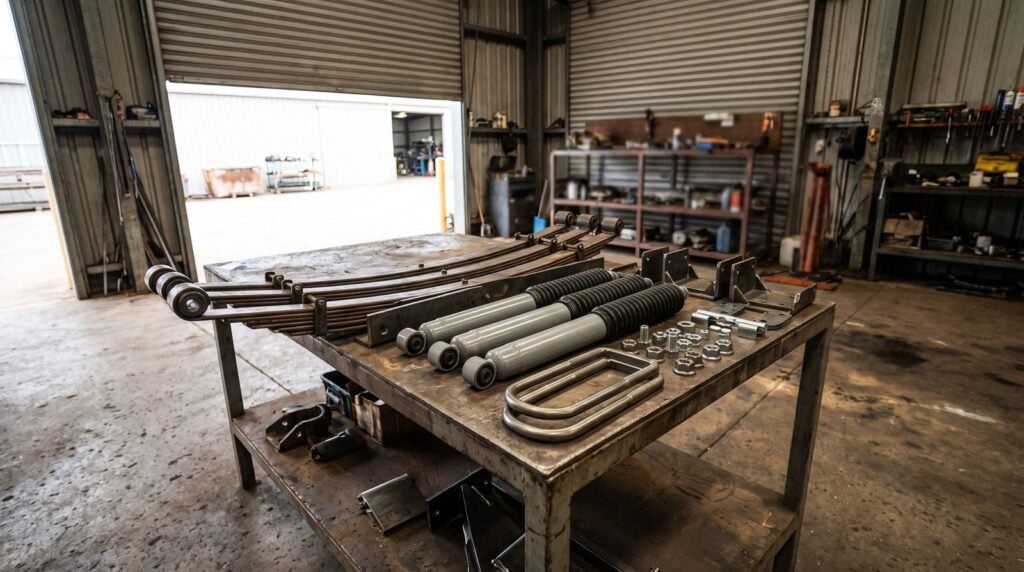
The KUN Hilux (2005 to 09/2015) gives a clean comparison. WCS lists a 2 inch monotube GVM upgrade rated to 3090kg and a 2 inch remote reservoir GVM upgrade rated to the same 3090kg. Same vehicle, same lift, same rating, so the shock is the only real difference. The reservoir kit costs more (both are in the price table below), and since both shocks have a 46mm bore, the extra money buys the reservoir and the 8 stage adjustment.
Then there’s the warranty, which almost nobody checks. WCS covers standard 4WD suspension kits for 3 years or 100,000km for recreational or private use. Monotube and remote reservoir shocks are listed as performance parts, covered for 12 months or 20,000km. Wear and tear, incorrect fitment, installation errors and motorsport use are excluded, and your Australian Consumer Law rights apply on top.
So the monotube and the reservoir shock sit in the same warranty group. The big drop comes when you step up from a standard twin tube kit to either one. WCS publishes the terms by product group, not by kit, so confirm the warranty on the exact kit before you order.
Pick the shock for the work it does. Bitumen, a tray and the odd trip away means the standard twin tube kit is the better buy, and it carries the longer cover. Sustained corrugations, long remote touring or heavy towing work the shock for hours at a time, and that’s where the reservoir earns its money.
What a GVM upgrade does and doesn’t cover
A GVM upgrade is a certified modification that raises the maximum legal laden mass of a vehicle by uprating the springs, shocks and related parts. Transport WA describes it as upgrading components so the vehicle can carry a heavier load than the manufacturer rated it for.
It doesn’t lift your Gross Combination Mass or your braked towing capacity. WCS says so for its own kits, and Transport WA says raising GVM doesn’t automatically raise GCM, and that lifting GVM without lifting GCM reduces the trailer weight you can tow once the vehicle is loaded to its new maximum. If your problem is a heavy van, this isn’t the fix.
There are two approval pathways, and they aren’t the same. Second stage of manufacture is where the upgrade is fitted before first registration by a second stage manufacturer, certified at federal level by the Department of Infrastructure under the Road Vehicle Standards legislation, and the vehicle gets a federal compliance plate. WCS says this kind of upgrade is nationally recognised, with no need to re-certify if you move interstate, and says on its home page that it’s a federally approved second stage manufacturer. The Commonwealth sets out the second stage of manufacture framework.
The in service, or state based, pathway applies after registration and issues a state compliance plate, which in Queensland is the blue modification plate. WCS says it’s certified at state or territory level by an approved automotive engineer or a DOT authorised vehicle inspector, that it isn’t always recognised interstate, and that re-registering in another state may need sign-off by a private automotive engineer. In Queensland, code LS11 of the Queensland Code of Practice covers re-rating the GVM of a light vehicle, meaning one whose current GVM rating doesn’t exceed 4,500kg (Queensland Government). Every state has its own equivalent.
Work through it in this order:
- Settle registration status first. An unregistered vehicle can take the second stage pathway. One already on the road goes down the in service route.
- Check GVM is actually your limit. If the real problem is a heavy van, you’re looking at GCM, and this kit won’t fix it.
- Line up the certifier before you buy. The kit has to match the approved component list exactly, and WCS notes the tyres and rims fitted must match the Road Vehicle Descriptor for that kit.
- Price certification as a separate line. Buying the kit isn’t buying the plate. Fitting, engineering and plating are extra.
Choosing springs by load
Most people shop by inches. A spring maker rates by constant load, and that number decides whether you get a good ride or a pogo stick.
WCS gives its spring options a constant load figure, which is the permanent extra weight over standard the spring is rated to carry. On the Landcruiser 80 and 100 Series 2 inch kit, the front options are a 60kg constant spring, a 45kg maximum spring and a heavy duty 60 to 90kg constant. The rear options are a progressive 250kg constant, a 100kg constant, a 350kg constant heavy duty and an 80kg maximum.
Work out your real permanent load first:
- Front. Bull bar, winch and driving lights are permanent weight over the front axle.
- Rear. Canopy, drawers, second battery, water and a long range tank are permanent. Passengers and recovery gear aren’t.
- Ball weight. Part of the trailer’s mass sits on the ball and acts like permanent rear load whenever the van’s hooked up.
- Progressive or constant. A progressive rear spring has a softer initial rate for an unladen ute, so it suits a vehicle that’s loaded some of the time.
Over-springing is the most common mistake we see. A 350kg constant rear spring under an empty dual cab rides badly, wears tyres unevenly and gains you nothing. Buy for the load you carry most weeks, not the worst trip of the year. For the height side of the decision, read the 4WD lift kit sizing guide. For another Australian brand we stock in depth, see the Tough Dog suspension guide.
What the range costs
These are parts prices. Fitting, alignment, engineering and certification are on top.
Lift kits. For the diesel 4WDs we mostly work on, WCS lift kits start at $1,223.60 for a 2 inch Prado 120 or 150 Series kit and $1,254.95 for an 80 or 105 Series Landcruiser. Dual cab utes sort themselves by shock: $1,610.25 to $2,272.25 on the standard twin tube, $1,926.00 to $2,594.11 on the monotube, and $2,948.33 to $3,669.51 on the remote reservoir. That’s the series table showing up in the price list.
Complete GVM upgrade kits. Most WCS GVM kits sit in our lift kit category, so look in both. A few examples:
| Complete GVM upgrade kit | Price |
|---|---|
| WCS GVM upgrade lift kit (3500kg), Toyota Prado 150 Series | $2,344.00 |
| WCS GVM upgrade lift kit (3800kg), Toyota Landcruiser 300 Series | $2,928.00 |
| WCS GVM upgrade lift kit (3510kg), Toyota Hilux GUN N80 2024 on | $3,849.00 |
| WCS GVM upgrade lift kit (3900kg), Landcruiser 79 Series to 2022 | $3,834.50 |
| WCS 2″ Monotube GVM Upgrade (3090kg), Toyota HiLux KUN | $3,735.00 |
| WCS 2″ Remote Res GVM Upgrade (3090kg), Toyota HiLux KUN | $5,076.45 |
The vehicle matters more than the rating. The 3500kg Prado kit is cheaper than kits rated lower, like the 3090kg KUN Hilux kits. If you’re building a 79 Series, our 79 Series Landcruiser upgrades guide covers the whole vehicle.
We don’t quote a starting price for shocks, coil springs, leaf springs or u-bolts on their own, because it depends too much on the vehicle. Ring us for pricing on individual parts.
Common questions
How much is a West Coast Suspensions lift kit?
For a mainstream diesel 4WD, expect $1,223.60 for a Prado and $1,610.25 to $2,272.25 for a dual cab ute on the standard twin tube shock. Monotube and remote reservoir kits cost more. Fitting and wheel alignment are on top.
Does a GVM upgrade let me tow more?
No. Transport WA says increasing GVM doesn’t automatically increase GCM, and that raising GVM without raising GCM reduces the trailer weight you can tow once the vehicle is loaded to its new maximum. WCS says the same about its own kits.
What is the difference between the G3, G4 and MX3 shocks?
Bore and construction. G3 is a 35mm bore twin tube gas charged shock, G4 is a 40mm bore twin tube with a 20mm rod, and MX3 is a 46mm bore monotube. MX3 is also the only series listed for a 1 to 3 inch lift.
Are remote reservoir shocks worth the extra money?
It depends on the work. Sustained corrugations and long haul touring justify them. Suburban and highway driving generally doesn’t. Remember WCS covers monotube and remote reservoir shocks for 12 months or 20,000km, against 3 years or 100,000km on a standard 4WD kit.
What spring rate should I choose?
Choose by permanent load. Add up the bull bar, winch, canopy, drawers, second battery, long range tank and any ball weight, then match that against the constant load rating on the spring. Over-springing an unladen ute gives a harsh ride and uneven tyre wear.
Get the right West Coast Suspensions kit for your load
Spring rate and GVM certification both depend on the exact build, so talk to us before you order. Send your vehicle, build date and a list of what you carry through our contact page, and we’ll spec the kit against the load. You’ll find the kits under lift kits and GVM upgrades. Our founder Willy has more than 20 years on the tools as a heavy diesel mechanic, and the team works on diesels across our Brisbane and Sunshine Coast workshops.
Last updated: November 2026