
 By Willy · Founder & Lead Diesel Specialist
Willys Workshop · Oxley & Warana · 20+ years hands-on diesel experience
Nissan’s 2.5 litre four cylinder turbo diesel, the YD25, went into the D22 Navara, the D40 Navara and the R51 Pathfinder. Australian outputs run from 98kW and 304Nm in the D22 up to 140kW and 450Nm in the later D40 and Pathfinder. It’s a hard working engine with one well known timing chain weakness and a few quieter faults that cost owners just as much.
This guide covers which Australian vehicles got it and in what tune, the injector, turbo and EGR cooler faults, the rebuild path, and what YD25 parts cost. If you already know you need fuel system parts, go straight to the common rail injectors we stock.
Quick Links
- What the YD25DDTi is
- Australian vehicles and outputs
- Specifications
- Which Australian Navaras actually got a YD25
- Injectors
- The turbocharger
- Timing chain and EGR cooler
- Rebuilding a YD25
- What YD25 parts cost
- Common questions
What the YD25DDTi is
The YD25 is a 2,488cc inline four with a cast iron block, an aluminium head, chain driven twin overhead cams and four valves per cylinder. Bore and stroke are 89.0mm and 100.0mm, a long stroke built for low down torque. The Nissan YD engine family shares a lot of its design with Nissan’s QR petrol engine.
Two fuel systems sit under the YD25 name, and that trips people up when ordering. One uses a VP44 electronic rotary injection pump with a line to each cylinder. The other is common rail, with a high pressure pump feeding a shared rail. The common rail engines are the ones in the D40 Navara, the late D22 Navara and the R51 Pathfinder. In Europe they’re badged DCi.
Don’t trust the DDT and DDTi suffixes. Strictly, YD25DDTi refers to the VP44 rotary pump engines, but Australian supplier listings routinely use DDTi for the common rail D40 and R51 and DDT for the D22. Order by the engine code stamped on the block and the build date, not the badge.
The D40 and R51 common rail engines use a variable geometry turbo. Movable vanes in the turbine housing change how the exhaust hits the turbine wheel, so it builds boost early without the lag of a fixed vane unit. The unit changed partway through the run.
Australian vehicles and outputs
These are Australian delivered 2.5 litre diesels only. The same ranges also had petrol V6s and, from 2010, the 3.0 litre V9X diesel, which isn’t a YD25.
| Vehicle and variant | Years | Power | Torque |
|---|---|---|---|
| D22.V Navara ST-R dual cab ute, DX single cab chassis | 2007 to 2014 (DX from 2008) | 98kW at 3,600rpm | 304Nm at 2,000rpm |
| D40 Navara King cab ST-X | 2008 to 2014 | 128kW at 4,000rpm | 403Nm at 2,000rpm |
| D40 Navara dual cab RX | 2005 to 2014 (RWD from 2009) | 128kW at 4,000rpm | 403Nm at 2,000rpm |
| D40 Navara dual cab ST-X | 2005 to 2010 | 128kW at 4,000rpm | 403Nm at 2,000rpm |
| D40 Navara dual cab ST-X | 2010 to 2012 | 140kW at 4,000rpm | 450Nm at 2,000rpm |
| D40 Navara dual cab ST 4WD | 2009 to 2012 | 128kW at 4,000rpm | 403Nm at 2,000rpm |
| D40 Navara dual cab ST 4WD | 2012 to 2014 | 140kW at 4,000rpm | 450Nm at 2,000rpm |
| D40 Navara dual cab ST RWD | 2012 to 2014 | 120kW at 4,000rpm | 403Nm at 2,000rpm |
| R51 Pathfinder Series I | 2005 to 2010 | 128kW at 4,000rpm | 403Nm at 2,000rpm |
| R51 Pathfinder Series II | 2010 to 2013 | 140kW at 4,000rpm | 450Nm at 2,000rpm |
That’s 98kW to 140kW on one engine code. A D22 with the YD25 isn’t a detuned D40. It has different fuelling and a different turbo, and it does a different job.
The 2010 update is the one to know about when buying used. A 2009 and a 2011 dual cab ST-X look almost the same and are 12kW and 47Nm apart. That’s the dual cab only. The King cab ST-X stayed at 128kW right through to 2014, so the year alone won’t tell you which tune you’re looking at.
Specifications
| Specification | Value |
|---|---|
| Configuration | Inline four, cast iron block, aluminium head, chain driven DOHC, 16 valve |
| Displacement | 2,488cc |
| Bore x stroke | 89.0mm x 100.0mm |
| Compression, D22 common rail | 18.0:1 |
| Compression, D40 and R51, 2005 to 2009 | 16.5:1 |
| Compression, D40 and R51, 2010 on | 15.0:1 |
| Turbocharger, VP44 D22 Navara | Wastegated IHI RHF4, intercooled |
| Turbocharger, D40 and R51, 2005 to 2009 | Garrett GT2056V, variable geometry, intercooled |
| Turbocharger, D40 and R51, 2010 on | BV45, variable geometry, intercooled |
| Timing drive | Simplex primary lower chain, duplex secondary upper chain |
Confirm against your build plate and the engine code on the block before ordering parts.
Which Australian Navaras actually got a YD25
This one costs Australian D22 owners money, and it’s specific to this market.
A lot of YD25 information treats the D22 Navara as a YD25 vehicle from 2001 on. That’s true in several overseas markets, but not here. The diesel D22 sold in Australia from December 2001 to 2006 ran the 3.0 litre ZD30DDT at 110kW and 314Nm, and before that it was the 2.7 litre TD27 and the 3.2 litre QD32. The D22 was then dropped locally and came back as the D22 Series V with the YD25DDTi at 98kW, from late 2007 or early 2008. Check the build plate.
So an Australian delivered D22 built before 2007 doesn’t have a YD25. If that’s your truck, our Nissan ZD30 engine guide is the one you want.
It matters at the parts counter because supplier listing titles use global model years. A D22 YD25DDT injector set listed as fitting 02-14 starts in 2002, five or six years before any Australian D22 had a YD25. The title is right for the markets it was written for, just not for Queensland. Order against the engine code on the block, never against the years in a listing title or on your rego papers.
Injectors
Injectors are the most common fuel system job on a common rail YD25, and what brings most of them in is noise, not smoke. On turbo diesel D40 Navaras, a metallic rattle after start up can come from a worn or partly blocked injector jet. Fuel additives sometimes help. Sometimes the injector needs replacing.
That’s a real diagnostic problem, because a stretched timing chain also rattles at the front of the engine. Same kind of noise, very different bills. Note any of these before you book it in:
- Rough or uneven idle that improves as the engine warms.
- Harder cold starting.
- Fuel use going up with no change in how you drive.
- White smoke on start up that clears slowly.
- A chuffing or ticking at the head, which in our workshops often turns out to be a leaking seat washer.
Do injectors as a set. Replace one and leave three tired ones and it’ll still run unevenly. Replace the seat washers and seals too. Reusing them is the most common reason the job gets done twice.
The turbocharger
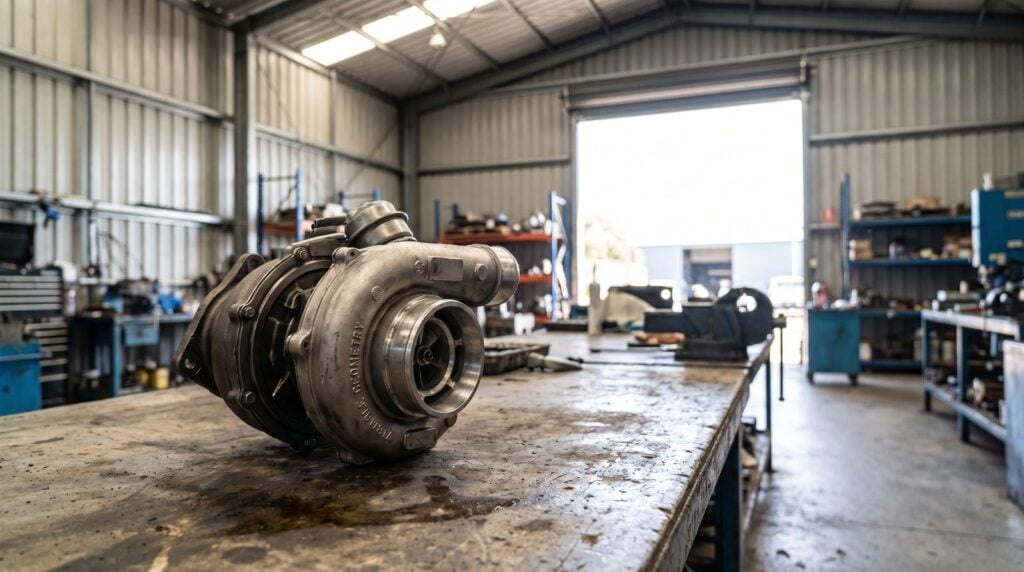
There’s no single “YD25 turbo”. The D40 Navara and R51 Pathfinder used a Garrett GT2056V variable geometry unit from 2005 to 2009, and the 2010 update changed it to a BV45. The VP44 pump D22 used a wastegated IHI RHF4. The unit on the Australian D22 Series V common rail engine isn’t documented. Order by engine code and build date, not by “Navara diesel”.
Variable geometry turbos all wear the same way. The vanes sit in exhaust gas and carbon, and when they stick you get one of two complaints. Either it feels flat and won’t build boost, or it overboosts and drops into limp mode. Have the actuator and vane movement checked before you condemn the turbo, because a sticking mechanism can often be freed and serviced.
If it has failed, find out why before fitting another. Oil feed and drain restrictions kill replacement turbos quickly, so always check the feed line. We don’t currently list a YD25 turbo.
Timing chain and EGR cooler
These are the two faults that turn a running YD25 into a rebuild.
Timing chain, in brief
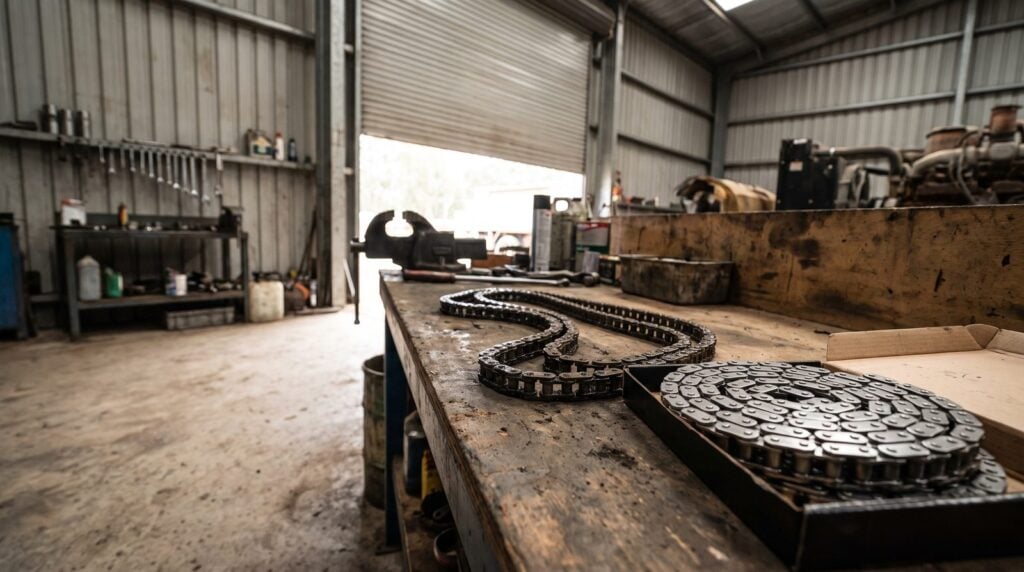
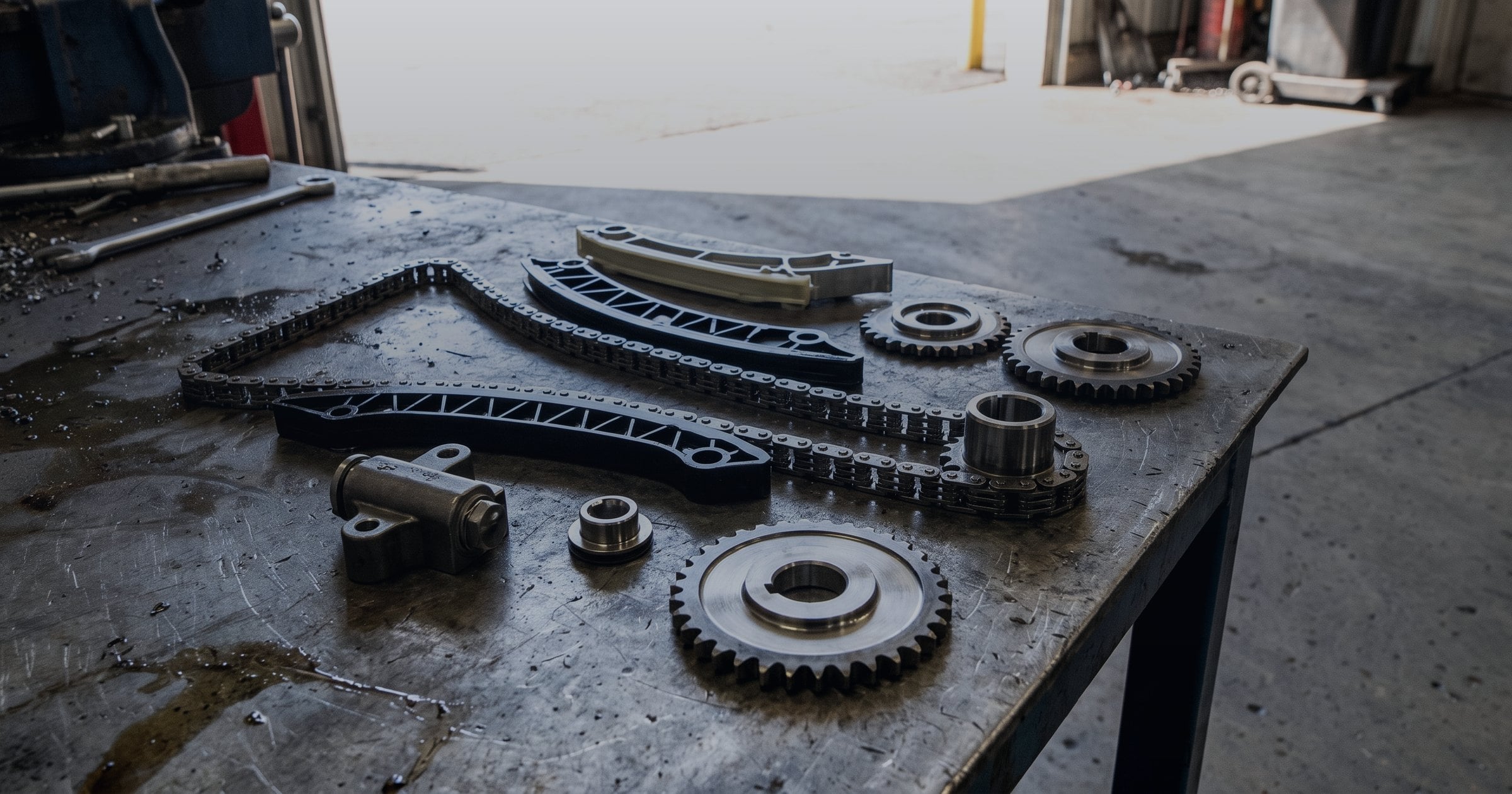
The YD25 has a single row (simplex) lower chain and a double row (duplex) upper chain. The lower chain is known to stretch, and the guides and the vacuum pump sprocket and shaft can wear with it. Let it go far enough and the valves hit the pistons. The published recommendation is to replace the lower chain and tensioners before 80,000km, then inspect it every 40,000km. The D22 carries the same fault and advice. Symptoms, how to tell chain noise from normal diesel clatter, and how the repair should be done are in our post on YD25 timing chain problems in the D40 Navara.
EGR cooler
Exhaust gas recirculation feeds some exhaust back into the intake to lower combustion temperature and cut oxides of nitrogen. On the YD25 the EGR cooler can corrode or split, inside or around its flanged ends, and leak coolant. The exhaust heat boils the coolant off, so it never pools under the vehicle. Watch for a low coolant level and coolant stains around the EGR pipe and cooler. Leave it and the coolant loss can overheat the engine and take out the head gasket.
Owners sometimes ask whether blanking the EGR fixes it. It doesn’t. The coolant runs through the cooler core, not the EGR valve, so a blank on the intake side leaves the cracked core where it was and the coolant still goes out the exhaust. The fix is to repair or replace the cooler.
Rebuilding a YD25
Most YD25s that get opened up got there through the timing chain. One that has jumped its chain isn’t automatically a write-off, but you need numbers before you decide. This is the order we work in:
- Work out what the engine did. A chain that skipped teeth and a chain that let go are different jobs. A compression and leak-down test tells you whether you’re buying a head, or a head and a bottom end.
- Head job or full rebuild. If the damage stopped at the valves, a head rebuild plus a chain set is the cheaper road. If the pistons are damaged, you need a full rebuild kit.
- Fix the cause as well as the damage. Replace chains, guides and tensioners as a set. A new chain on old guides brings the noise back.
- Sort the fuel side while it’s apart. Injectors and the high pressure pump are far easier to get at with the engine out.
- Do the EGR cooler at the same time. It’s a coolant leak waiting to happen, and access is never better.
Once you know what failed, weigh up the four options in this order, because the cheapest one is often still the right one.
- Repair the single fault. If compression is even across all four and the chain was caught before it jumped, fix that one thing and keep driving. A chain set, a set of injectors or an EGR cooler costs a fraction of a rebuild.
- Rebuild it. This makes sense when the bottom end is worn or the chain has already let go. Oil use, uneven compression and bearing noise all point that way. So does a chain strike that bent valves, because that damage rarely stops at the head. It’s worth it if the body, gearbox and running gear are sound and you’re keeping the vehicle.
- Buy a used engine. It’s usually cheaper up front. But you’re buying a simplex lower chain with no history, on an engine where the chain is meant to be replaced before 80,000km. Budget a chain job on top or you’ve bought the same problem twice.
- Move the vehicle on. If the engine needs a rebuild and the rest of the truck needs money too, add it all up first. A rebuilt engine in a worn out vehicle is money in the wrong place.
What is in a kit, and what is not
There are two engine rebuild kits for this engine, an Early and a Late. A kit is parts only. Machining, labour and, after a chain strike, usually a cylinder head all go on top, and the finished job comes to several times the kit price. We quote that once we’ve inspected the engine, because no two worn YD25s need the same work.
The sizing options tell you what’s inside. On the Early kit you pick a piston and ring size (STD or 0.50) and main and conrod bearing sizes (STD, 0.25, 0.50 or 0.75), so pistons, rings and both sets of bearings are in it. The Late kit offers bearing sizes only, with no piston and ring choice, so ask us whether pistons come with it before you order. Either way, order after the block has been measured. If STD, 0.25 and 0.50 don’t mean anything to you yet, our guide to bearing and piston sizes explains them.
Neither kit includes timing gear. Chains, guides and tensioners are a separate purchase, a cylinder head is separate again, and the listings don’t itemise every gasket and seal, so check the contents with us. If you only need pistons and rings, they’re sold separately.
The Early and Late split follows the same break as our other YD25 parts: Early to 2010, Late from 2011. The kit listings carry no years, so send us the engine code and build date and we’ll confirm which one you need.
What YD25 parts cost
These are parts prices. Fitting, machining and coding are on top.
| Part | Price |
|---|---|
| Engine rebuild kit, YD25 Early | $1,390.45 |
| Engine rebuild kit, YD25 Late | $1,448.45 |
| Timing chain sets, genuine or NVP double row upper and lower | $1,210.00 |
| Common rail fuel pump | $1,699.00 |
| Common rail injectors | $485.00 single Denso (05 to 07 Euro 3), $545.00 other singles, $2,140.00 set of four |
| Piston and ring sets | $550.00 to $687.50 |
| NVP aftermarket crankshaft | $858.00 |
| Genuine exhaust manifold | $847.00 |
| Genuine EGR cooler pipe tube | $145.00 |
| Manta full exhaust, cat retained, D22 or D40 2.5L | from $1,911.78 |
Injector prices don’t tell you quantity on their own, so read the listing or ask us before you order. The rest of the range is under timing components, common rail fuel pumps and gaskets and seals.
Exhaust parts are listed by vehicle, not engine code. The Manta range covers the D22, D40 and R51 2.5 litre in engine pipes, dump pipes, connecting pipes, mufflers and full systems. Manual and auto D40s take different parts, and Spanish and Thai built D40s differ again, so confirm the build before ordering.
Common questions
Is the YD25 a reliable engine?
It’s durable, with one well documented weakness. The lower timing chain is known to stretch, and the recommendation is to replace it and the tensioners before 80,000km, then inspect every 40,000km. Owners who service on time and act on a rattle get long lives out of them.
How much power does a YD25 make?
It depends on the vehicle and year. The D22 Series V makes 98kW and 304Nm. Most D40s and R51s make 128kW and 403Nm. The 140kW and 450Nm tune came with the 2010 dual cab ST-X, the 2012 on 4WD ST and the R51 Series II. The 2012 on RWD D40 dual cab ST is the odd one out at 120kW and 403Nm.
Did the Australian D22 Navara have a YD25?
Only at the end of its run. The Australian diesel D22 ran the 3.0 litre ZD30DDT from December 2001 to 2006, left the market, and came back as the Series V with the YD25DDTi around 2007 to 2008. Check the engine code on the block. Don’t go by the model.
Why is my YD25 rattling at the front of the engine?
It’s usually the timing chain or a worn or partly blocked injector. They sound alike to an owner but cost very different amounts to fix, so get it diagnosed before you get it quoted. Treat a front of engine rattle as the chain until it’s proven otherwise.
Can I bypass the EGR to stop the cooler leaking?
It won’t stop the leak. The coolant runs through the cooler core, so blanking the intake side leaves the cracked core in the system and the coolant keeps disappearing. Repair or replace the cooler.
Diagnose the rattle before you spend
The fuel system and turbo changed during the run, and Australian model years don’t match global ones. Send your VIN, build date and engine code through our contact page and we’ll confirm the part number before you order. Buying used? Run the VIN through the PPSR and check the Product Safety Australia recall register first. Our founder Willy has more than 20 years on the tools as a heavy diesel mechanic, and the team works on diesels across our Brisbane and Sunshine Coast workshops.
Last updated: November 2026