
 By Willy · Founder & Lead Diesel Specialist
Willys Workshop · Oxley & Warana · 20+ years hands-on diesel experience
A 2 inch lift kit is the right answer for most Australian 4WDs. In Queensland an ESC equipped vehicle can be raised up to 75mm in total without certification, made up of a maximum 50mm from suspension and 25mm from tyres (Queensland Government). Lift kit listings in our catalogue start at $1,003.20, but read that floor carefully: it is a 30mm kit for the petrol Suzuki Jimny.
This guide covers why 2 inches is the default, what changes when you go past it, why spring rate matters more than the number of inches, and how to weigh the vehicle before you buy. If you already know what you need, go to the lift kits we stock.
At a glance
- Buy the spring for the weight you carry, not the height you want. Springs are rated by added load, and getting that wrong is why a lifted ute can ride worse than the standard one it replaced.
- Weigh it loaded first, the way it actually sits with the bar, the drawers and the water on board. Tare mass off the compliance plate is not what you are driving.
- Two inches is 50.8mm. Queensland allows 50mm of suspension lift without certification, so a kit sold as 2 inch already sits fractionally over the line, and what gets measured at an inspection is your ride height change rather than the label on the box.
- Tyres come out of the same allowance. There is 25mm available for them on top of the suspension figure, so bigger rubber quietly spends part of your budget before the kit does.
- Check your own state before you buy, not after. In NSW a significant modification is assessed by a licensed certifier before registration, and that certificate is also what keeps your insurance intact.
- Ignore the cheapest kit in any catalogue. Ours is a 30mm kit for a petrol Jimny and tells you nothing about a dual cab.
Quick Links
- What a lift kit actually is
- Why 2 inch is the sensible default
- The legal position in Australia
- What changes at 3 inch and above
- Spring rate matters more than height
- Weigh the vehicle as it actually sits
- What lift kits cost
- Choosing between the brands we stock
- Common questions
What a lift kit is
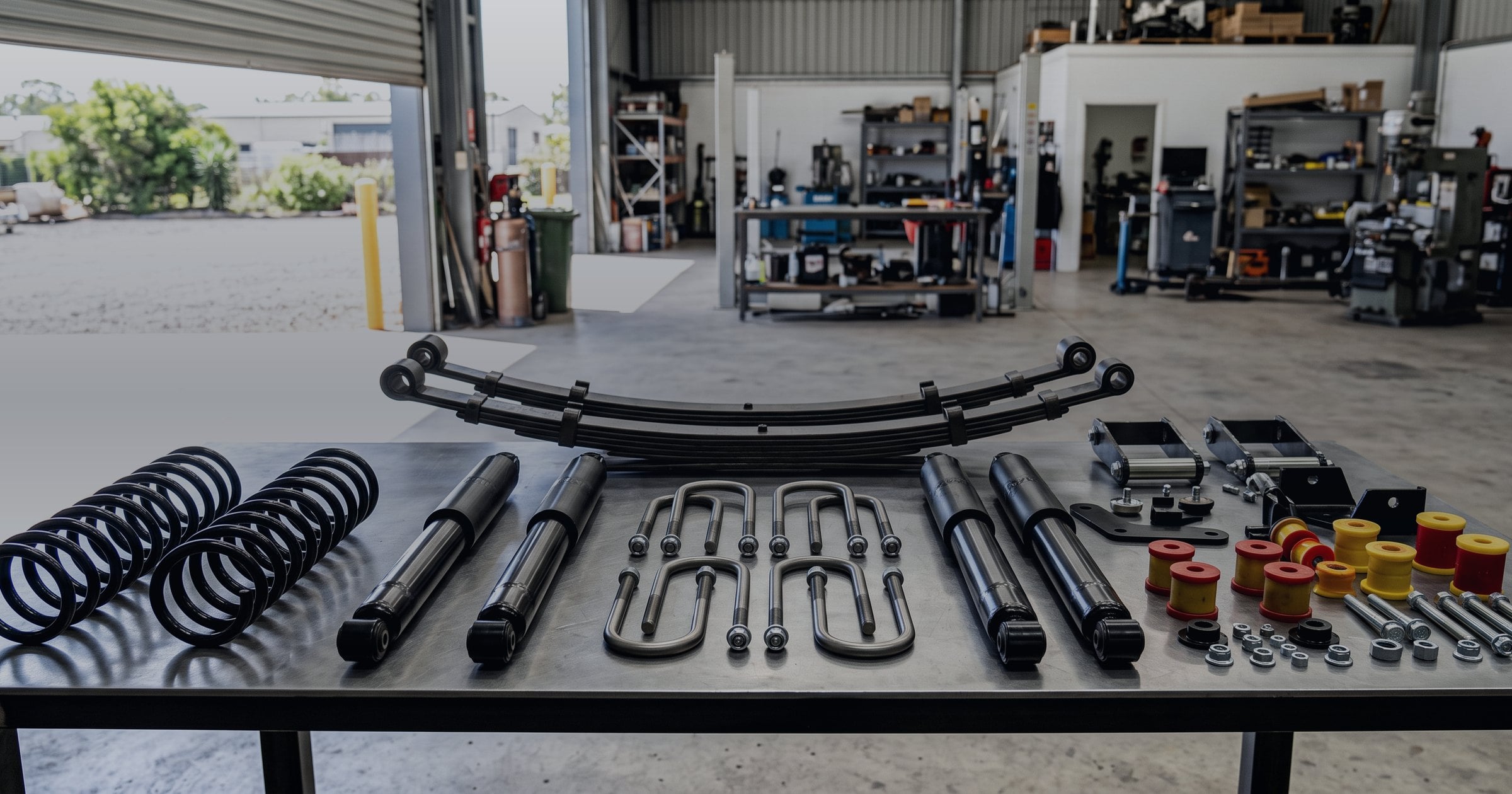
A lift kit is a matched set of suspension components that raises a vehicle’s ride height and re-tunes how that vehicle carries and damps load. The usual parts are coil springs, leaf springs, shock absorbers, bushes and fitting hardware.
Ride height is the distance from the ground to a fixed reference point on the body or chassis. That is the number an inspector measures, and the number the law is written against. Not the number printed on the box.
Height and capacity are not the same thing. Lifting a vehicle does not raise its legal Gross Vehicle Mass, and carrying more weight does not require more height.
There is also more than one way to get height. Taller springs are the usual method, larger tyres add height at the axle, and body blocks lift the body off the chassis. All three count toward the same legal total, which is where owners come unstuck.
Why 2 inch is the sensible default
Two inches has become the default for a working 4WD for three reasons, and only one is about looks.
The first is legal headroom. Fifty millimetres is the suspension component of the 75mm Queensland allows without certification, with tyres permitted to add a further 25mm. A nominal 2 inch kit sits right on that line.
The second is that 2 inches does the job. It clears a larger tyre, restores the ride height a loaded vehicle loses, and gives back the travel a flattened factory spring has taken away. For a ute carrying a tray, a bar and a canopy, most of the practical gain is in that first 50mm.
The third is that everything downstream still works. Brake lines still reach, driveshaft angles stay close to where the manufacturer put them, and steering geometry stays inside its design range. Above 2 inches, each of those becomes a job in its own right.
One detail before you shop. Two inches is 50.8mm, not 50mm. Suppliers list broadly equivalent kits as 2 inch, 50mm, 45mm and 40mm depending on the platform. What gets checked at an inspection is your vehicle’s measured ride height, not the label on the kit. Measure before and after, and keep the numbers.
The legal position in Australia
The Australian Design Rules are described by the Department of Infrastructure as the national vehicle standards for safety, anti-theft and emissions, applying to new vehicles supplied to the Australian market. Once a vehicle is in service, what you are allowed to change is governed by state and territory modification rules written against those standards. That is why the same kit can be a straightforward fit in one state and a certification job in another.
The clearest published figures we can point at come from the Queensland Government. On 20 September 2018 the Minister for Transport and Main Roads announced changes to the Queensland Code of Practice, which governs vehicle lift rules in that state. The figures below are the ones stated in that announcement.
| Queensland rule, as announced in September 2018 | Figure | Stated scope |
|---|---|---|
| Suspension component of the no-certification allowance | Maximum 50mm | Part of the 75mm total |
| Tyre component of the no-certification allowance | Maximum 25mm | Part of the 75mm total |
| Total lift, no certification | Maximum 75mm | ESC equipped vehicles, which the statement says was already allowed for non-ESC vehicles |
| Maximum lift with certification | To be raised from 125mm to 150mm | Not further qualified in the statement |
Source: Queensland Government ministerial statement, 20 September 2018. Two cautions on that table. First, the statement announced changes due the following month and said the final Code of Practice would be released in October 2018, so it records what was announced rather than the wording of the live code. Second, it is now several years old. State limits move, so we check the current figure for your state as part of quoting the job. The statement does say the 150mm ceiling brings Queensland into line with the National Code of Practice and other states, and that the 75mm allowance for ESC vehicles matches NSW and Victoria.
Modification certification is a formal assessment by a licensed engineer or approved person, confirming a modified vehicle still meets the applicable standards. The certificate is what makes the vehicle legal, not the quality of the parts.
In NSW, the state’s guidance says major or significant modifications must be assessed by a licensed certifier under the Vehicle Safety Compliance Certification Scheme before you can apply for registration, and that your insurance could be void if modifications are not assessed and certified. That page does not publish a millimetre threshold, so do not assume the Queensland figures above carry across. An uncertified lift is not an administrative nuisance. It is a claim you may not be able to make.
We supply the suspension, carry out the certification and fit the new plate, so the pathway is handled in one place. Talk to us before you buy parts, so the kit and the certification are matched from the start.
What changes at 3 inch and above
Going past the threshold is a legitimate choice. Just a bigger project than the kit price suggests, because raising the body relative to the axles moves several systems at once.
Driveline angles
Lift increases the operating angle of the tailshaft universal joints and, on an independent front end, the CV joints. Larger angles mean more vibration and shorter joint life. On some platforms a tailshaft spacer, a modified crossmember or a corrected pinion angle becomes necessary. This is the flow-on cost most people underestimate.
Brake lines and brake proportioning
Suspension travel increases with ride height, and a factory brake hose is cut to factory travel. Extended lines are the obvious fix. Less obvious is rear brake proportioning. On many utes a load sensing valve at the rear axle meters brake pressure by how far the axle sits from the chassis, so lift tells that valve the vehicle is empty when it is not. That is why our catalogue carries parts such as the EFS brake bias rod and the WCS brake proportioning extension bracket for the N70 HiLux.
Steering geometry and stability
Raising a solid axle vehicle changes the relationship between the drag link and the panhard rod, which produces bump steer if left alone. On independent front suspension, camber and castor move off the factory setting, and a castor correction is normal on larger lifts. Every millimetre of lift also raises the centre of gravity, which is why certification exists and why the Queensland allowance counts tyres as well as springs.
In short, 3 inches and above is a package rather than a part. Certification, driveline correction, brake lines, geometry correction and often a wheel and tyre decision. If you are choosing height for touring and load carrying rather than a specific clearance target, 2 inches usually wins.
Spring rate matters more than height
Almost everyone shops by the number of inches. The number that decides whether you are happy is the spring rate.
Spring rate is the force needed to compress a spring a given distance, usually expressed in kilograms per millimetre. A higher rate resists compression harder, so it holds a heavier vehicle at the correct height but rides firmer when empty.
Look at how the parts are described in our own catalogue and the point makes itself. Every one of these is sold by load in kilograms as well as height, and on the same platform the same nominal lift is stocked in several different rates.
| Part | Load figure printed in the listing title | Willys price |
|---|---|---|
| EFS 40mm coil spring, HiLux N70, KUN N80, GUN | 100kg to 130kg | from $339.15 |
| Tough Dog leaf spring, Isuzu D-Max (04/2008-2012) | 300kg | from $280.25 |
| WCS 2 inch coil springs, HiLux N70/N80, Prado 120/150 | 0kg to 250kg, sold as separate part numbers | from $238.45 |
Prices come straight from our catalogue and change when it does. The kilogram figures are read from the supplier listing titles as printed. On this side of the market they are normally quoted as constant added load, meaning permanently fitted weight rather than occasional payload, but confirm the exact definition with us or with the supplier before you order against a weighbridge slip.
That has a consequence people rarely think through. A spring advertised as 40mm gives roughly 40mm at its design load. Put a spring listed at 100kg to 130kg of added load under an empty tray and it sits higher than 40mm and rides harshly. Load that same vehicle with a steel bar, a canopy, drawers, water and a tow ball weight, and it may not reach 40mm at all. The height on the box is a result, not a setting.
This is the mechanism behind the most common complaint we hear, which is that a lifted vehicle rides badly. Usually the height was chosen and the rate was inherited. The owner picked 2 inches, took whatever spring came in the box, and ended up with a rate matched to a load they do not carry.
Choose the rate for the load, then accept the height that rate gives you at your weight.
Weigh the vehicle as it actually sits
You cannot pick a spring rate from a brochure. You need your vehicle’s weight at each axle, in the condition it normally lives in.
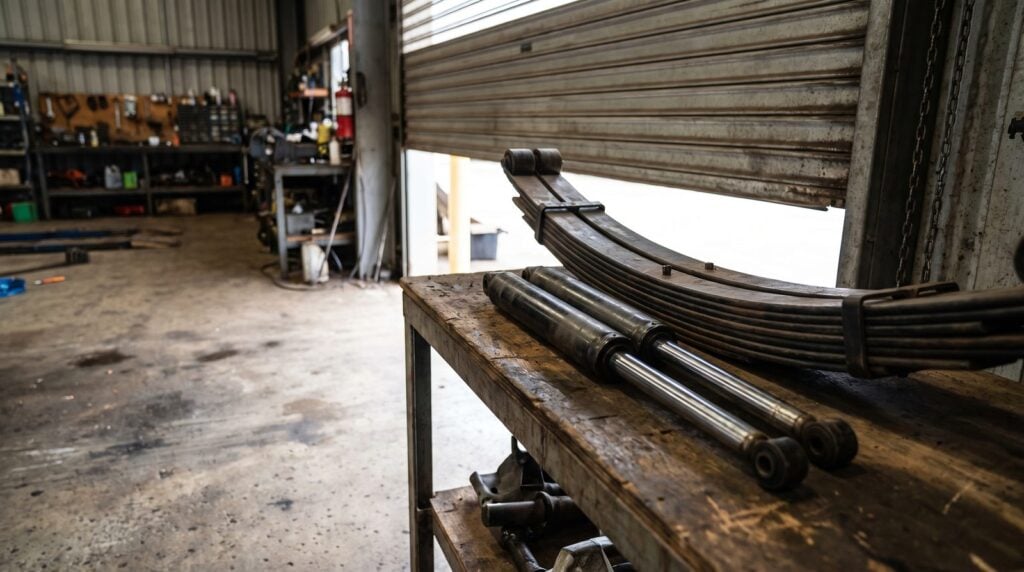
Tare mass is the weight of the vehicle as it left the factory with fluids. Not what you are driving. Once a working 4WD has a bar, a winch, a canopy or tray, drawers, a fridge, recovery gear, long range fuel and water, the axle loads look nothing like the compliance plate.
Do it this way:
- Load the vehicle the way it normally sits, including anything that lives in it permanently.
- Weigh it at a public weighbridge, front axle and rear axle separately, not just the total.
- If you tow, add the ball weight to the rear axle figure. It comes out of payload, not tow rating.
- Subtract the factory figures to get the constant added load at each end.
- Match that load to a listed spring range, for example the 100kg to 130kg figure on the EFS HiLux coil spring above.
Front and rear are usually very different vehicles. A dual cab with a winch bar carries most of its added weight over the front axle and very little over the rear when the tub is empty. Choose each end separately rather than off a matched chart. Guessing costs you a second set of springs, which is the most expensive mistake in this category.
What lift kits cost
Prices are read live from the 296 listings in our lift kits category, each the lowest for that platform. Fitting, wheel alignment and any certification are on top.
Start with the dual cabs, because that is what most people asking this question drive.
| Dual cab | Kit | Nominal lift | Willys price |
|---|---|---|---|
| Toyota HiLux GUN N80 (10/2015 to 10/2025) | West Coast Suspensions | 2 inch | from $1,891.45 |
| Toyota HiLux KUN N70 (2005 to 09/2015) | EFS | 40mm | from $2,006.25 |
| Ford Ranger Next Gen | EFS | 2 inch | from $1,905.70 |
| Ford Ranger PX1/PX2 (10/2011 to 06/2018) | EFS | 40mm | from $2,017.80 |
| Isuzu D-Max RG (09/2020 on) | West Coast Suspensions | 2 inch | from $1,935.15 |
| Isuzu D-Max (07/2012 to 08/2020) | EFS | 45mm | from $1,942.75 |
| Mazda BT-50 TF (09/2020 on) | West Coast Suspensions | 2 inch | from $1,935.15 |
| Nissan Navara NP300, leaf rear | West Coast Suspensions | 2 inch | from $1,897.15 |
| Mitsubishi Triton ML-MN | West Coast Suspensions | 2 inch | from $1,989.30 |
Wagons sit lower than the utes, because a coil sprung rear end needs less hardware than a leaf pack and a set of struts.
| Wagon | Kit | Nominal lift | Willys price |
|---|---|---|---|
| Toyota Prado 250 Series (2024 on) | Tough Dog | 50mm | from $1,078.25 |
| Isuzu MU-X (2012 to 2021) | EFS | 45mm | from $1,227.40 |
| Toyota Prado 120 and 150 Series | West Coast Suspensions | 2 inch | from $1,286.30 |
| Toyota LandCruiser 80 and 105 Series | West Coast Suspensions | 2 inch | from $1,321.45 |
| Ford Everest UA (2016 to 06/2018) | West Coast Suspensions | 2 inch | from $1,336.65 |
| Toyota LandCruiser 200 Series | West Coast Suspensions | 2 inch | from $1,373.70 |
| Nissan Patrol GU Y61 Wagon | West Coast Suspensions | 2 inch | from $1,389.85 |
| Toyota LandCruiser 300 Series GR Sport | Tough Dog | 35mm to 50mm | from $1,497.20 |
| Toyota LandCruiser 78 and 79 Series | West Coast Suspensions | 2 inch | from $2,217.30 |
Below those two tables the numbers stop describing utes and wagons altogether. The four cheapest listings in the category are all light coil sprung 4WDs, Suzuki Jimny and Jeep Wrangler TJ kits from West Coast Suspensions and EFS between $1,003.20 and $1,027.90, which is why the category floor is a useless number to shop against.
Pieces are available separately if you are replacing rather than building. Springs run from $238.45 for a set of West Coast Suspensions 2 inch coils, and $280.25 for a Tough Dog D-Max leaf. EFS 40mm coils rated 100kg to 130kg are $339.15 a spring. Shocks start at $152.00 for a Tough Dog foam cell. The small hardware that a lift drags in behind it, shackle bush kits, coil spacers, brake proportioning brackets and brake bias rods, runs $19.00 to $77.90, and a heavy duty steering damper is $152.00.
Three things to read out of those numbers.
The spread from $1,003.20 to $10,100.00 is not a ladder from bad to good, it is a spread of platforms and damper technology. A Jimny at $1,003.20 needs far less hardware than a LandCruiser 78 Series at $2,217.30. Within one platform the step up is the damper: a West Coast Suspensions 2 inch kit for the HiLux GUN N80 is $1,891.45 in standard twin tube, $2,321.80 in monotube and $3,270.85 with remote reservoirs.
The $10,100.00 ceiling is one listing, a Tough Dog 40mm kit for the Isuzu D-Max RT (04/2016 to 08/2020). Ignore it as a guide to what a lift costs. All but 11 of the 296 listings sit under $3,900, and the second highest kit in the category is $4,536.25. If you drive a D-Max RT, ask us for a current figure rather than reading that number off the range.
The small parts at the bottom are the ones people leave out. A brake bias rod at $27.55, or a proportioning bracket at $33.25, is a rounding error next to the $1,891.45 HiLux kit above. Skipping it is how a lifted ute ends up braking as though it is empty.
Choosing between the brands we stock
Three suspension brands account for the lift kit listings we priced above. The choice is usually about how the vehicle is used rather than which brand is better.
Tough Dog reaches further into older and less common platforms than the others in our listings, including the Daihatsu Feroza and Rocky, the Suzuki Sierra and the 40, 60 and 70 Series LandCruisers. It also holds the cheapest diesel wagon kit we list, the 50mm Prado 250 Series at $1,078.25. Its foam cell dampers are a common pick for corrugated dirt work, where heat is the enemy.
EFS prints a load figure on its coil spring listings, such as the 100kg to 130kg on the HiLux spring above, which makes matching a spring to a weighbridge number easier than reading height alone. They also come out cheaper on several current utes, including the 2 inch Ranger Next Gen kit at $1,905.70 and the 45mm D-Max (07/2012 to 08/2020) at $1,942.75.
West Coast Suspensions holds the cheapest kit in our listings and the widest coverage of current dual cabs: 2 inch kits for the HiLux GUN N80 from $1,891.45, the BT-50 TF from $1,935.15, the D-Max RG from $1,935.15 and the Ranger RA from $2,278.10. Worth a look for a partial build too, with 2 inch coil springs from $238.45 and the brake proportioning bracket from $33.25.
Buy the kit as a matched set rather than mixing springs from one supplier with dampers from another. Damper valving is developed against a spring rate.
Common questions
Is a 2 inch lift kit legal in Australia?
Generally yes, but it depends on your state and on what else you have changed. On the Queensland figures announced in 2018, that state allows a maximum 50mm of suspension lift plus 25mm from tyres, for a 75mm total, without certification, with certification available to a maximum of 150mm. Other states run their own schemes and the NSW page we cite publishes no millimetre figure, so check your own state rather than assuming. Note that 2 inches is 50.8mm, so measure the actual ride height change rather than trusting the label.
How much does a lift kit cost?
Kits in our catalogue run from $1,003.20 to $10,100.00 across 296 listings, and all but 11 sit under $3,900. The $1,003.20 end is a 30mm kit for the petrol Suzuki Jimny, so it is not a useful guide if you drive a dual cab. For a current shape ute, a 2 inch kit starts at $1,891.45 for the HiLux GUN N80, $1,905.70 for the Ranger Next Gen and $1,935.15 for the D-Max RG. For a diesel wagon, the Tough Dog 50mm Prado 250 Series kit is $1,078.25 and the West Coast Suspensions 2 inch LandCruiser 200 Series kit is $1,373.70. Fitting, wheel alignment and certification where required are on top.
Do I need an engineer’s certificate for a lift kit?
If your total ride height increase exceeds what your state allows without certification, yes. In Queensland the announced threshold is 75mm total. In NSW a major or significant modification must be assessed by a licensed certifier under the Vehicle Safety Compliance Certification Scheme before you apply for registration, and the state warns insurance could be void without it. Confirm the pathway with a certifier in your state before buying parts.
Will a lift kit increase my payload or GVM?
No. Ride height and Gross Vehicle Mass are separate things, and lifting a vehicle does nothing to its legal maximum mass. A GVM upgrade is a different product altogether: engineered suspension plus certification and a new plate. We supply the suspension, do the certification and fit the plate.
Does a lift kit ruin the ride?
Not on its own. A poor ride after a lift is almost always a spring rate mismatch rather than the height. A spring listed at 100kg to 130kg of added load rides hard under an empty tray. Weigh the vehicle loaded, then choose the rate.
Can I fit bigger tyres instead?
You can, and it will raise the vehicle, but tyre height counts toward the same legal total as the suspension lift. On the Queensland figures, the tyre contribution is capped at 25mm inside the 75mm total. Larger tyres also change your effective gearing and speedometer reading, and they do nothing for the suspension travel a flattened spring has taken away.
Get the height and the rate right the first time
Most lift kit regret is a spring rate problem wearing a height costume. Bring us a weighbridge slip rather than a target number of inches and the conversation gets much shorter.
- Browse the lift kits in our catalogue
- Tell us your bar, tray, canopy and towing setup through our contact page and we will match the kit to the weight
We quote against your actual axle loads, and we will tell you plainly when what you are describing is a certification job rather than a parts order.
Our founder Willy has more than 20 years on the tools as a heavy diesel mechanic, and the team works on diesel 4WDs across our Brisbane and Sunshine Coast workshops. You can read more about us and how we work.
Last updated: August 2026