

 By Willy · Founder & Lead Diesel Specialist
Willys Workshop · Oxley & Warana · 20+ years hands-on diesel experience
The 1KD-FTV is Toyota’s 3.0 litre four cylinder common rail turbo diesel, fitted in Australia to the Hilux, Prado and HiAce. In the Hilux and Prado it makes between 120kW and 127kW depending on the vehicle and emissions spec. It’s a durable engine with four well known weak points, and every one of them can be fixed.
This guide covers which Australian vehicles got it and in what tune, what fails and in what order, and how to tell from the engine number whether yours has the revised pistons. If you already know what you need, go straight to the common rail injectors we stock.
Quick Links
- What the 1KD-FTV is
- Australian vehicles and outputs
- Specifications
- The four common problems
- Checking for the revised pistons
- Piston fault or injector fault
- Rebuild, repair or sell
- What the parts cost
- Upgrade order if you’re keeping it
- Buying a used 1KD
- Common questions
What the 1KD-FTV is
It’s a deep-skirt cast iron block with liner-less bores and a reinforcing rib to cut vibration, under an aluminium head. Two counter-rotating balance shafts, driven off the crank timing gear, cancel the secondary shake every inline four has.
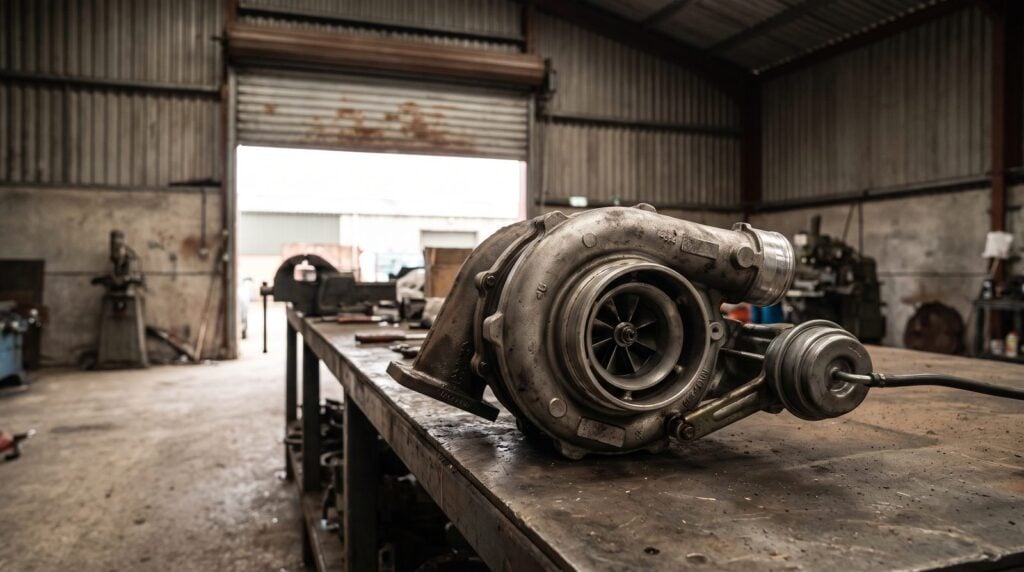
The turbo is a variable nozzle type. Movable vanes in the turbine housing change how exhaust gas hits the turbine wheel, and a DC motor with a vane position sensor sets them. That’s how it builds boost from low revs without much lag. It’s also the most misdiagnosed part on the engine, because a sticking vane feels just like general tiredness.
Fuelling is Toyota’s D-4D common rail. The rail has a pressure sensor and a mechanical limiter that relieves at 200 MPa, and the injectors sit in the centre of the combustion chamber.
Australian vehicles and outputs
Outputs aren’t the same across the range, which matters when you’re comparing two used vehicles. Euro III and Euro IV here are the emissions spec Toyota built the engine to. The Australian rule for Euro 4 in light vehicles, ADR 79/02, runs on its own timetable and doesn’t set these model-year boundaries.
| Vehicle | Emissions spec | Years | Power | Torque |
|---|---|---|---|---|
| Hilux KUN26 (Mk.7) | Euro III | 2005 to late 2006 | 120kW at 3,400rpm | 343Nm at 1,400 to 3,200rpm |
| Hilux KUN26 (Mk.7) | Euro IV | late 2006 to 2015 | 126kW at 3,600rpm | 343Nm at 1,400 to 3,400rpm |
| Prado 120 Series (KDJ120, KDJ125) | Euro IV | 2006 to 2009 | 127kW at 3,400rpm | 410Nm at 1,600 to 2,800rpm |
| Prado 150 Series (KDJ150, KDJ155) | Euro IV | 2009 on | 127kW at 3,400rpm | 410Nm at 1,600 to 2,800rpm |
| HiAce (Mk.5) | Euro III | 2006 to 2010 | 80kW at 3,000rpm | 286Nm at 1,200 to 1,600rpm |
| HiAce (Mk.5) | Euro IV | 2010 on | 100kW at 3,400rpm | 300Nm at 1,200 to 2,400rpm |
A Prado feels stronger than a Hilux of the same era because it is. Same engine, different tune: 410Nm from 1,600rpm against 343Nm in the Hilux.
You’ll often see “120kW” quoted for the whole N70 Hilux run, and that’s wrong. Only the early Euro III engine makes 120kW. The Euro IV makes 126kW, and it’s the Euro IV that has the piston fault. If your Hilux was built in 2006, don’t guess from the year. Read the build plate and the engine number.
Specifications
| Specification | Value |
|---|---|
| Configuration | Inline four, deep-skirt cast iron block |
| Displacement | 2,982cc |
| Bore x stroke | 96.0mm x 103.0mm |
| Compression ratio | 17.9:1 |
| Cylinder head | Aluminium alloy, steel-laminate head gasket |
| Balance shafts | Two, counter-rotating |
| Fuel system | D-4D common rail, 30 to 160 MPa working pressure |
| Injectors | Eight-hole, 0.14mm holes |
| Turbocharger | Variable nozzle vane type |
Confirm against your build plate before ordering parts.
The four common problems
In the order you’re most likely to meet them.
Injectors
This is the number one 1KD job. The injectors are precision parts working at very high pressure, and they wear. The copper seat washers under them fail too, which lets combustion gas past.
Injector life on this engine is shorter because of high fuel pressure, several injections per combustion stroke, tight tolerances and fuel quality. The usual recommendation is to replace them every 100,000km, with a test of injector feedback volumes at each service.
What you’ll notice:
- White smoke on start up that’s slow to clear, or doesn’t.
- A rough idle that smooths out once it’s warm.
- Harder cold starts.
- Fuel use creeping up with no change in how you drive.
- A ticking or chuffing at the head, which usually means a seat is leaking.
Do them as a set. Replace one and leave three tired ones and it still runs unevenly, and you get a second bill a few months later. Replace the seat washers, tube seals and clamp bolts at the same time. They’re cheap next to the injectors, and reusing them is the most common reason the job gets done twice.
Cracked pistons on Euro IV engines
This is the fault the 1KD is known for, and Toyota has acknowledged it. Technical Service Bulletin EG-008T-0112, issued in September 2014, covers cracked pistons in the Euro IV 1KD-FTV. Vehicles built from 2006 to 2014 with the Euro IV engine are the ones at risk. The cracks vary in size and can become a localised rupture, and they’re most common between 100,000km and 150,000km.
The cause is a design change. Earlier engines had a metal fibre structure fused into the piston crown and didn’t have the problem. The Euro IV piston lost that reinforced zone, and engine reconditioners describe what was left as an inadequate strength margin.
A cracked piston shows up as a sudden strong knock, loss of power, the engine running rough or on three cylinders, and excess crankcase pressure.
EGR and intake fouling
Exhaust gas recirculation (EGR) feeds some exhaust back into the intake to lower combustion temperature. On a diesel that gas carries soot, and soot mixed with oil vapour builds a hard deposit in the intake manifold and the EGR cooler.
It comes on slowly, so most owners don’t notice until it’s bad. Power drops away, fuel use creeps up, and it feels flat off idle. A blocked EGR cooler can also crack inside and put coolant where it shouldn’t be.
Short trips make it worse. A Hilux doing school runs never gets hot for long enough to keep the intake clear. The same ute doing highway kilometres stays much cleaner. A catch can fitted early is the cheapest way to slow it down, because it takes the oil vapour out before it meets the soot.
Turbo and the variable nozzle
The vane mechanism lives in exhaust gas and carbon. When it starts sticking you get one of two complaints, depending on where it sticks. Either it feels gutless and won’t build boost, or it overboosts and drops into limp mode.
Have the actuator and vane movement checked before you condemn the turbo. A sticking mechanism can often be freed and serviced. The nozzle vane position sensor and the turbo driver module fail in their own right, so rule them out before buying a turbo you might not need. If the turbo has died, find out why before fitting another. Oil supply and drain problems kill replacement turbos quickly.
Checking for the revised pistons
You can answer this from the engine number. According to the bulletin, Toyota made two production changes in 2014: “improved injectors to prevent wrong combustion” and stronger pistons. They came in from these engine numbers:
- Prado 150 Series (KDJ150, KDJ155): from engine number 2361817, January 2014.
- Hilux Mk.7 (KUN26): from engine number A477120, July 2014.
If your engine number is after the changeover, you have the stronger piston. The risk is a lot lower, though cracked pistons have still been reported in revised engines at a lower rate.
If it’s a Euro IV engine before the changeover, it’s in the at-risk group. That doesn’t mean it will fail, but it’s a reason to test. A 2011 Prado 150 with 130,000km, for example, sits right in the 100,000km to 150,000km window and is worth a leak-down test before any big spend.
Every Euro IV 120 Series Prado is pre-changeover, because that model finished in 2009. The numbers above don’t cover the HiAce, so on a Euro IV HiAce check the engine number with Toyota.
Piston fault or injector fault
Injectors and cracked pistons overlap in both symptoms and kilometres, and that’s where money gets wasted. Both cause rough running, smoke and poor performance. Piston cracking is most common from 100,000km, the same point injectors are due. So a set of injectors goes in, it still runs badly, and it was a cracked piston all along.
Some signs lean one way. White smoke on a cold start that clears slowly, and a rough idle that smooths out when warm, point at injectors. A sudden knock with power loss, running on three cylinders and excess crankcase pressure point at a piston. An injector back-leakage test confirms the injectors. Only a compression and leak-down test finds a cracked piston.
Injectors are the more common fault. But on a pre-changeover Euro IV engine running rough and losing power between 100,000km and 150,000km, do a compression and leak-down test before you commit to four injectors. It costs a fraction of the injectors.
Rebuild, repair or sell
Repair the single fault when it’s contained and the bottom end is healthy. Injectors, an EGR cooler, a turbo or a set of seat washers are all bolt-on work. If compression and leak-down come back good, fix the fault and keep driving it.
Rebuild the engine if a piston has cracked. The engine has to come apart either way, so most of the labour is already committed, and doing one piston costs close to doing four. On a pre-changeover Euro IV engine at 100,000km to 150,000km, the other three pistons have done the same work. A rupture also sends debris through the engine, so the bearings and bores are rarely clean.
Buy a used engine if the vehicle is worth less than the job. The catch is that most used 1KDs for sale are Euro IV engines from before the 2014 changeover. Check the donor’s engine number against the changeover numbers, or you can buy the same fault twice.
Move the vehicle on if the body, gearbox and running gear are finished too. A fresh bottom end won’t bring the rest back.
We stock two North Vic Parts engine rebuild kits for the 1KD-FTV. The standard kit is ordered by piston and ring size, main bearing size and conrod bearing size, so pistons, rings and bearings are the core of it. The high performance kit is ordered on piston and ring size only, so confirm its bearing sizes with us. Neither is a “with timing” kit, so budget timing parts separately. No rebuild kit includes a head, injectors or a turbo.
A kit is parts only. Machining, the labour to strip and rebuild, and in most cases a head all sit on top, and the finished job costs several times the kit price. We quote each one once the machine shop has measured it. Those measurements also decide the piston and bearing sizes. If STD, 0.25 and 0.50 don’t mean anything to you yet, our guide to bearing and piston sizes explains what to send us.
What the parts cost
These are starting prices for parts only. Fitting and ECU coding are on top.
| Part | Price |
|---|---|
| Genuine Denso injector, N70 Hilux 2006 to 2009 (Code 11) | from $495 single or $1,940 for a set of four |
| Genuine Denso injector, Prado KDJ120R 2006 to 2009 (Code 13) | from $515 single or $2,000 for a set of four |
| Genuine Denso injector, Code 18, 2009 to 2015 | from $545 single (N70 Hilux) or $2,140 for a set of four (Prado KDJ150, KDJ155) |
| Injector seat washer, genuine | from $5.99 |
| Injector fit set, bolts and seals (NVP) | from $154 |
| Turbo driver module, Hilux or Prado, genuine | from $544.50 |
| EGR cooler assembly, genuine | from $695 |
| Full gasket set (KP) | from $543.40 |
| Engine rebuild kit (NVP) | from $1,579.20 |
| High performance engine rebuild kit (NVP) | from $2,083.80 |
The injectors are genuine Denso, supplied new and calibration coded. The code stamped on your old injector decides which part number you need, which is why two N70 Hilux injectors from the same model year can carry different prices. Injectors well under the genuine price are usually aftermarket or reconditioned, so they aren’t a like for like comparison, and a badly made injector can take the engine with it.
For exhaust, we carry Manta 3 inch systems with the catalytic converter retained: a turbo back system for the Hilux KUN26R from $1,542.96, and one with centre muffler and tail pipe for the Prado KDJ120 and KDJ150 from $1,584.48. Fitting is quoted separately.
Upgrade order if you’re keeping it
- Fix what’s worn first. Injectors, turbo health and a clean intake. There’s no point tuning an engine that can’t breathe or fuel properly.
- Exhaust. A freer system lowers exhaust gas temperature, and heat is what kills turbos, manifolds and head gaskets. Most of the gain comes from getting a 3 inch pipe on the turbo outlet and removing the factory restriction close to the head.
- Cooling and airflow. An intercooler upgrade earns its keep in hot conditions and when towing.
- Tune last. With healthy hardware, a tune is where the drivability gain is, mostly throttle response and how it holds torque under load. A tune laid over a mechanical fault hides it for a while, then it lets go at the worst time.
There’s a specific caution on this engine. To reduce the risk of cracked pistons in a Euro IV 1KD-FTV, the published recommendations are not to chip tune it, not to drive it under heavy load for long periods, and to service the injectors every 100,000km. Those steps lower the odds of failure but don’t fix the piston design.
So a hard tune on a pre-changeover Euro IV engine works against the advice issued for the known fault. A moderate tune on a healthy, post-changeover engine is a different matter. Not sure which you have? Check the engine number first.
Buying a used 1KD
- Engine number against the 2014 changeover. It takes two minutes and tells you whether it has the stronger piston.
- Cold start. White smoke that hangs around points at injectors.
- Compression and leak-down test. The direct test for the piston fault.
- Crankcase pressure. Heavy blow-by at the oil filler is a warning sign.
- Injector history. Injectors done properly, with seats and seals, is a good sign. No record at 150,000km is a budget item.
Run the VIN through the PPSR for finance owing and stolen or written-off status, and check Product Safety Australia for recalls. Toyota ran a number of campaigns across this era. If it’s a Hilux and you want more on injector symptoms, see our guide to N70 Hilux injector costs and symptoms.
Common questions
Is the 1KD-FTV a reliable engine?
Yes, if it’s maintained. Euro IV engines built from 2006 to 2014 carry the cracked piston risk Toyota acknowledged in 2014, and injectors wear on all of them. Owners who service on time, use good fuel and fit a catch can generally get a long life out of one.
How long do 1KD-FTV injectors last?
The recommendation is to replace them every 100,000km, but it varies a lot with fuel and service history. Treat white smoke on start up, a rough cold idle and rising fuel use as the signal to have them tested.
How much power does a 1KD-FTV make?
It depends on the vehicle and emissions spec. The Hilux KUN26 makes 120kW and 343Nm in Euro III form and 126kW and 343Nm in Euro IV form. The 120 and 150 Series Prado both make 127kW and 410Nm. The HiAce makes 80kW in Euro III form and 100kW in Euro IV form.
Can I fit a bigger turbo to a 1KD-FTV?
You can, but it’s rarely the right first step. Sort the injectors, intake and exhaust first. Most people who put a bigger turbo on a tired engine are disappointed, because the turbo was never the restriction. On a pre-changeover Euro IV engine there’s another reason to be careful: the published advice for cracked piston risk includes not chip tuning it.
How do I know if my 1KD has the revised pistons?
Check the engine number stamped on the block. Toyota brought in the changes from engine number 2361817 in January 2014 on the 150 Series Prado, and from A477120 in July 2014 on the Mk.7 Hilux.
Read the engine number before you spend
We stock genuine new injectors, seat and seal kits, EGR parts, gaskets, common rail fuel pumps and rebuild kits for the 1KD-FTV in the Hilux, Prado and HiAce. Toyota changed injector and turbo specs during the run, so send your VIN, build date and engine number through our contact page and we’ll confirm the right part number before you order. Our founder Willy has more than 20 years on the tools as a heavy diesel mechanic, and the team works on diesels across our Brisbane and Sunshine Coast workshops.
Last updated: October 2026