
 By Willy · Founder & Lead Diesel Specialist
Willys Workshop · Oxley & Warana · 20+ years hands-on diesel experience
EFS is an Australian-owned 4WD suspension brand. Its parent company has been making and repairing 4WD suspension since 1962, and it took the EFS name in 2002 (EFS). This guide covers what EFS makes, how the shock ranges differ, and how to read a load rating before you spend the money.
Most people come to EFS through a lift kit search, pick a height, and never look at the spring rate. That’s backwards. What decides how the vehicle rides is the load you carry every day, not the inches. If you already know what you need, go straight to the EFS suspension range we stock.
Quick Links
- What EFS makes
- The shock ranges compared
- Coil and leaf springs
- Brake lines, panhard rods and brake bias
- How to read an EFS load rating
- Choosing by use
- What EFS lift kits cost
- Common questions
What EFS makes
EFS ran separately from its parent company from the early 1990s, changed from the Enforcer name to EFS in 2002, and released the first EFS range in 2003. It sells “a complete integrated suspension package of springs, shocks & components”: shock absorbers, Easy Fit Struts, steering dampers, leaf springs, coil springs, GVM upgrades and the smaller parts that go with them.
A lift kit is a matched set of springs and shocks sold as one package, valved to work together at a stated ride height. That matters with EFS, because it says plainly that it doesn’t believe in a “one shock suits all” approach. Its shocks and valving are vehicle and height specific. Order the shock for the wrong lift height and you’ve bought a shock built for a different vehicle.
On an independent front end, the Easy Fit Strut comes pre-assembled and goes on without a spring compressor, in Elite and XTR versions with a choice of spring rates. There’s no published vehicle list for it. We don’t currently stock Easy Fit Struts or the MXP and MRP 2.5 shocks, so ask us if you want any of them and we’ll order them in.
The shock ranges compared
Most of the buying decision sits here. These are the four ranges we stock, with the figures EFS publishes. The adjustable MXP (a 2.5 inch monotube) and MRP 2.5 sit above them.
| Range | Body | Piston | Rod | Construction |
|---|---|---|---|---|
| Enforcer | Large external tube, 2mm walls | Not stated | 15mm hardened chromed | Twin tube, dynamic motion control |
| Elite | 51mm to 60mm external tube, 2mm walls | 35mm | 16mm hardened chromed | Twin tube, dynamic motion control |
| XTR | 64mm external tube, 2mm walls | 40mm | 20mm hardened chromed | Twin tube, dynamic motion control |
| X-Treme | 45mm bore, 2mm walls | Iron piston rings | 20mm hardened chromed | Twin tube hydraulic, dynamic motion control valve |
The body figures aren’t all the same measurement. The Elite and XTR figures are outside tube diameters. The X-Treme figure is an internal bore.
The Elite and the XTR are the same design at two sizes. Both are twin tube with low-pressure nitrogen, 2mm walls and dynamic motion control. The XTR is just bigger, with more tube and a bigger piston. EFS says the extra oil is there to keep the valve cooler. That’s a heat argument. It says nothing about stiffness.
The X-Treme’s 45mm bore looks smaller than the Elite’s 51mm to 60mm, but one is an inside measurement and the other an outside one, so the numbers can’t tell you which shock is bigger. EFS calls the X-Treme its premium range, developed from 4WD competition, with a Viton seal, high-temperature fluid and an internal hydraulic rebound stop. Don’t rank these ranges on one number.
EFS says the XTR was designed for heavily laden touring on corrugated outback roads. For a vehicle that spends most of its life on bitumen with a bullbar and a canopy, the Elite is the usual pick, and it’s the range with by far the widest vehicle coverage in our listings.
Coil and leaf springs
A coil spring carries the vehicle’s weight and sets ride height. The shock controls how fast the spring moves. Get the spring wrong and no shock will fix it.
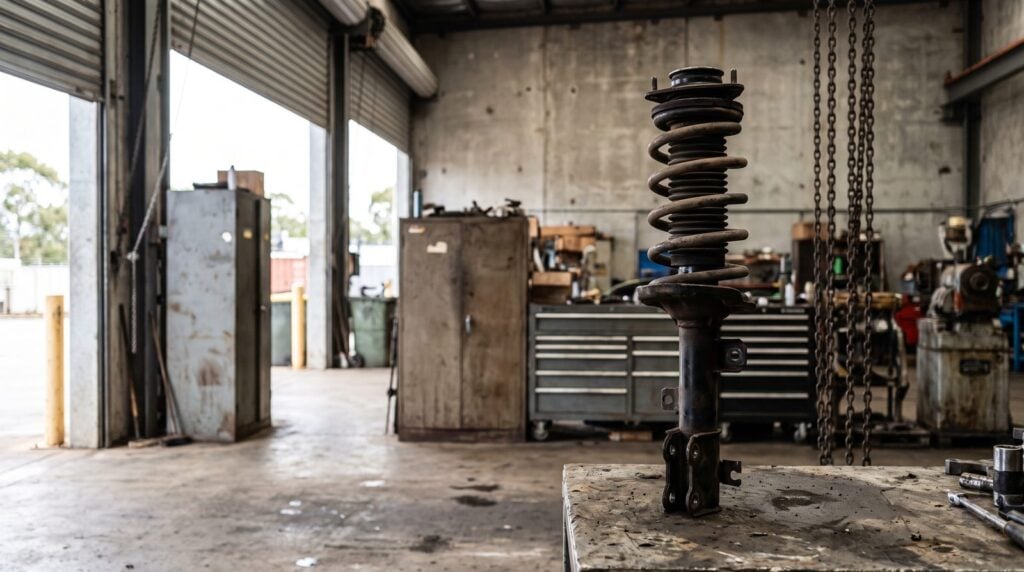
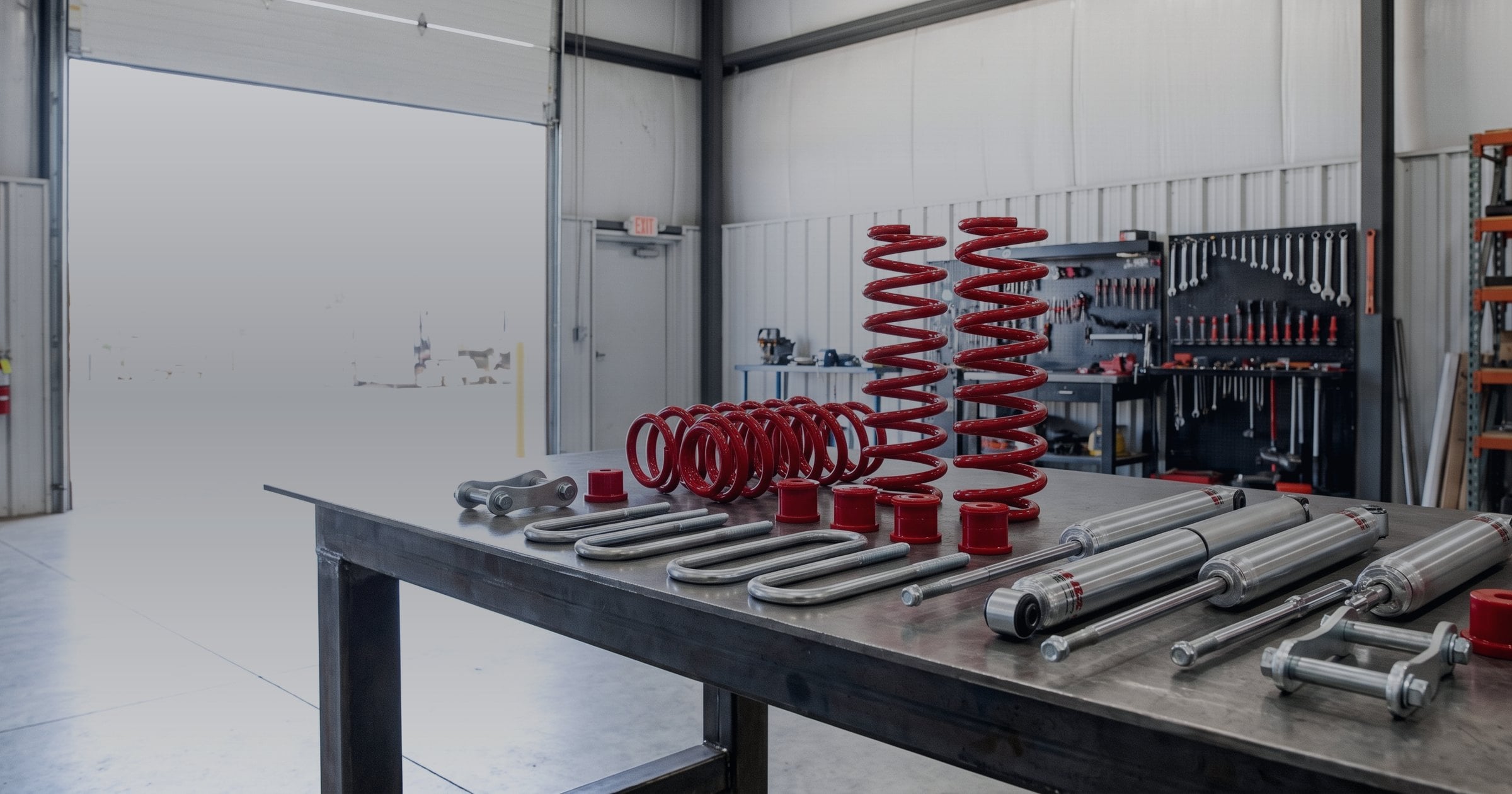
EFS says its coil springs use premium spring steel made in compliance with ISO-9002, and come in heights from standard up to 125mm. Spring rates are offered by the weight needed to compress the coil, to suit towing, heavy accessories and extra ride height. They’re shot peened, scragged and powder-coated.
Its multi-leaf springs are Japanese grade SUP9 and SUP9A alloyed carbon spring steel, in 30mm to 80mm raised heights, with tapered leaf ends, bolt clip liners, leaf insert pads, bolt clips and military wraps.
That gap catches people out. The coil range goes a lot higher than the leaf range. On a leaf-sprung ute, rear lift from springs alone tops out at 80mm, and anything past that comes from shackles or blocks. Our 4WD lift kit sizing guide covers where the practical and legal limits sit.
Brake lines, panhard rods and brake bias
The small parts get forgotten until the vehicle is on the hoist and the job stops. EFS lists 20 component types, from torsion bars, bush kits and u-bolts to castor correction, extended shackles and sway bar links. Three of them are the ones a lift actually forces on you.
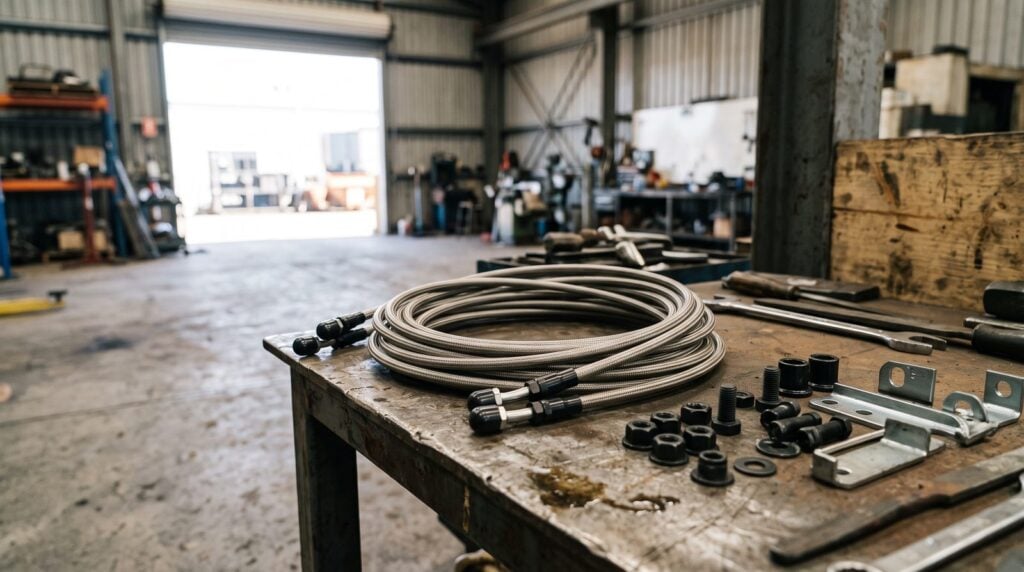
Extended brake lines are longer flexible hoses, so the line isn’t stretched at full droop once the vehicle sits higher. EFS’s are dual skin, double-crimped rubber, SAE J1401 approved. They aren’t optional trim. A standard-length line on a lifted vehicle is under tension every time the wheel drops into a hole. We only list two EFS lines, one for the Navara D40 rear and one for the 80 and 100 Series LandCruiser, so ask us for anything else.
An adjustable panhard rod puts the axle back in the middle of the vehicle. EFS says that once a 4WD is lifted past a certain height, the standard panhard rod pulls the diff across. If the axle looks like it’s shifted toward one guard after a lift, that’s the part you need.
Brake bias adjustment is the third. EFS says that if you raise a LandCruiser 79 Series or a Hilux above standard height, you need to adjust the rear brake bias for correct braking, either with a spacer block or an adjustable rod on the brake bias lever. We don’t list an EFS brake bias part, so that one comes in on order.
How to read an EFS load rating
No part of the EFS range gets misread more often. EFS spring listings carry the load rating in the product name, like [400kg] or (100-130kg). It isn’t a certified capacity, and the way it’s written isn’t consistent.
Take the 200 Series (10/2007 to 2011) coil springs. Four of the five front springs are rated as bands, 0-60kg, 60-80kg, 80-120kg and 120-150kg, and the fifth is a single 50kg. The rear springs for the same vehicle are single figures: 100kg, 250kg, 400kg and 500kg. So front ratings tend to be bands and rear ratings single figures, but it’s a tendency, and you can’t count on it for your vehicle. Treat every figure as a guide, and if a number matters for your build, check it against the current EFS catalogue before you order.
EFS doesn’t publish a key for what the number means. This is how we read them, so check with us before you commit:
- A front figure usually means accessory weight over standard. That’s the bar, the winch, the bash plates and the lights. Weigh the parts or ask the bar maker.
- A rear figure usually means constant load. The weight that lives in the back all the time: drawers, a fridge, a second battery, water, tools and ball weight. A one-off trip to the tip doesn’t count.
- Constant means constant. The most common mistake we see is a 500kg rear spring bought because the vehicle sometimes carries 500kg. Empty, it rides like a trailer.
That means the two ends of the vehicle are answering different questions. A tourer with a heavy bar and an empty tray needs an uprated front and a near-standard rear. A tradie with a bare front and a loaded canopy needs the opposite. Put one “heavy duty” kit on both ends and you’ll end up harsh at one end and still sagging at the other.
Weigh the vehicle first. A weighbridge ticket, loaded the way you actually travel, turns all of this into simple sums.
Choosing by use
Work down this list in order. Height is the last decision.
- Weigh the vehicle as you travel. Front axle, rear axle and total, on a weighbridge, with the gear in it. Everything below depends on this.
- Rate the front for accessories and the rear for constant load. Use the figures on the listings as a starting point and confirm them with us before ordering.
- Pick the shock range for the work. Heavily laden outback touring points to the XTR, general four wheel driving and touring to the Elite, and a budget replacement to the Enforcer.
- Choose the height last, and check what it brings with it. Extended brake lines, castor correction and a panhard rod are common at 50mm. Above that, the list grows.
- Sort out certification before the kit goes on. The national rules are in VSB 14 Section LS, Suspension and Steering, part of the National Code of Practice for Light Vehicle Construction and Modification (Department of Infrastructure). In Queensland, lifting a light 4WD comes under code LS10, High Lift up to 150mm, which counts suspension, tyres and body blocks together (Queensland Government). A modification plate under a code like LS10 is issued by an approved signatory or licensed engineer under your state’s scheme. Each state runs this differently, so check with your own road authority.
It’s worth cross-shopping. EFS and Tough Dog sit in the same part of the market and cover a lot of the same vehicles. Our Tough Dog suspension guide covers that range the same way, and Tough Dog also puts its load ratings in the listing name.
What EFS lift kits cost
These are parts prices. Fitting, wheel alignment and any certification are on top.
The cheapest complete EFS kit is $1,014.60, but that’s a 30mm kit for a 1998 to 2004 Suzuki Jimny, and the next few up are also light 4WDs. For the diesel utes and wagons, kits start at $1,213.15 for the Holden Colorado 7 and Trailblazer. The dearest is $3,641.20 for the Ford F250 (2000 to 2014).
| Lift kit | Price |
|---|---|
| Isuzu MU-X (2012 to 2021) | $1,195.10 |
| Next Gen Ford Ranger | $1,791.70 |
| Toyota Hilux GUN | $1,798.35 |
| Nissan Navara NP300, 30mm, leaf rear | $1,908.55 |
| Holden Colorado RG (06/2012 on), 45mm | $1,942.75 |
| Isuzu D-Max (09/2021 on), 45mm | $2,007.35 |
| Toyota LandCruiser 78 and 79 Series, 2 inch | $2,236.30 |
| Nissan Patrol GQ ute, leaf sprung, 2 inch | $2,539.35 |
| Toyota LandCruiser 80 and 105 Series, 3 inch | $2,765.45 |
LandCruisers have the deepest coverage, reaching back to the FJ40, FJ45 and FJ75. For the rest of a 70 Series build, see our 79 Series LandCruiser upgrades guide.
EFS coil springs on their own run from $270.75 to $674.50. The two extended brake lines are $47.50 for the Navara D40 rear and $65.55 for the 80 and 100 Series LandCruiser. Shocks, struts, leaf springs and steering dampers vary too much by vehicle for a useful starting price, so ask us for a figure for yours.
Common questions
Is EFS suspension any good?
The published construction detail holds up: twin tube shocks with 2mm walls, coil springs made to ISO-9002, SUP9 leaf spring steel and SAE J1401 brake lines. As with any brand, the result depends far more on the spring rate you choose than on the badge.
What is the difference between EFS Elite and EFS XTR?
Size and heat capacity, mostly. The Elite runs a 51mm to 60mm external tube with a 35mm piston and a 16mm rod. The XTR runs a 64mm external tube with a 40mm piston and a 20mm rod. Both are twin tube with dynamic motion control and 2mm walls. EFS aims the XTR at heavily laden outback touring.
How much lift does an EFS kit give?
EFS coil springs come from standard height up to 125mm, and leaf springs in 30mm to 80mm raised heights. Each kit is sold at a stated height, such as 2 inch or 30mm, with the shock valving matched to it. Don’t mix a kit’s springs with shocks valved for a different lift.
What does 100-130kg mean on an EFS spring listing?
It’s a load rating carried in the product name, in this case on a front coil spring for a Hilux. Front figures generally mean the weight of accessories over standard, and rear figures generally mean constant load in the tray or the back of the vehicle. EFS publishes no key and doesn’t write them consistently, so treat it as a guide and confirm it before ordering.
Do I need extended brake lines with an EFS lift?
Usually, once the lift is meaningful. A standard line on a lifted vehicle sits under tension at full droop, and that’s not a risk worth carrying for the price of the part. EFS’s lines are dual skin, double-crimped rubber, SAE J1401 approved.
Get the EFS kit that suits your load
Send us your vehicle, build date, the accessories fitted and, if you have one, a weighbridge ticket through our contact page. We’ll match the spring rate to the load you actually carry. Our founder Willy has more than 20 years on the tools as a heavy diesel mechanic, and the team works on diesels across our Brisbane and Sunshine Coast workshops.
Last updated: October 2026