
 By Willy · Founder & Lead Diesel Specialist
Willys Workshop · Oxley & Warana · 20+ years hands-on diesel experience
The 4M41 is Mitsubishi’s 3.2 litre four cylinder turbo diesel, fitted in Australia to the Pajero from the NM in May 2002 through to the NX in 2021. Outputs run from 121kW and 373Nm in the early cars to 147kW and 441Nm from December 2008. It had a nineteen year run here, and the two faults most often reported against it both come back to maintenance and fuel quality, not the bottom end.
This guide covers the Australian Pajeros and what each makes, those two faults, and how to tell which of three parts families your engine takes, plus what the parts cost.
Quick Links
- What the 4M41 is
- Australian Pajero applications and outputs
- The two faults most often reported
- Why the NS makes less torque
- Three parts families, one engine code
- What 4M41 parts cost
- Buying a used 4M41 Pajero
- Common questions
What the 4M41 is
It’s a 3.2 litre inline four turbo diesel with double overhead cams and four valves per cylinder. It replaced the 2.8 litre 4M40 in the NM Pajero in May 2002 and carried the diesel Pajero to the end of the line nineteen years later.
The engine changed part way through, and that matters more than the model badge. In the NM and NP it was direct injection, with fuel sprayed straight into the bowl in the top of the piston. From the NS in October 2006 it went to electronic common rail, with an intercooler, a diesel particulate filter and 17.0:1 compression. That’s why a gasket set for a common rail 4M41 won’t fit the earlier one. Those NS figures weren’t restated for the upgraded NT engine of December 2008, so confirm them on the car.
It runs a timing chain, not a belt, on both the turbo and common rail versions. That matters when you budget a service, because a chain isn’t a scheduled replacement the way a belt is. For bore, stroke and exact capacity, for example on a compliance or insurance form, read the build plate.
Australian Pajero applications and outputs
Three output levels ran in Australia, and the gap between them is big, so don’t assume one 4M41 Pajero is the same as the next.
| Model | Years | Transmission | Peak power | Peak torque |
|---|---|---|---|---|
| NM Pajero GLX, GLS, Exceed | 2002 | 5sp manual, 5sp auto | 121kW at 3,800rpm | 373Nm at 2,000rpm |
| NP Pajero GLX, GLS, VRX, Platinum, Exceed | 2002 to 2006 | 5sp manual or 5sp auto by variant. Platinum and later Exceed auto only | 121kW at 3,800rpm | 373Nm at 2,000rpm |
| NS Pajero, three and five door | 2006 to 2008 | Three door auto only. Five door manual or auto | 125kW at 3,800rpm | 358Nm at 2,000rpm |
| NT Pajero, three and five door | 2008 to 2011 | Three door auto only. Five door manual or auto, VRX and Exceed auto only | 147kW at 3,800rpm | 441Nm at 2,000rpm |
| NW Pajero, five door | 2011 to 2014 | Manual or auto. VRX auto only until December 2012 | 147kW at 3,800rpm | 441Nm at 2,000rpm |
| NX Pajero, five door | 2014 to 2021 | Manual or auto. Exceed auto only | 147kW at 3,800rpm | 441Nm at 2,000rpm |
If you tow, look for the NT update of December 2008. Along with the engine upgrade, five door towing capacity went from 2,500kg to 3,000kg, the biggest practical difference across the range. Output then stayed the same through the NW and NX to 2021.
The two faults most often reported
Two engine faults are listed against the 4M41 Pajero, and both are specific to this engine, not general diesel wear. They’re the two most commonly raised, drawn from owners, repairers and service bulletins. It isn’t a complete list, and it isn’t a failure rate.
Carbon sludge in the inlet manifold
Exhaust gas recirculation sends some exhaust gas back into the intake to lower combustion temperature. Positive crankcase ventilation draws oil mist and blow-by out of the crankcase and sends it back to the intake.
On the 4M41 those two meet. Exhaust gas from the EGR mixes with oil mist from the PCV, and it builds a carbon sludge in the inlet manifold that eventually blocks the airflow. The published advice is to clean the inlet manifold regularly to stop it building up.
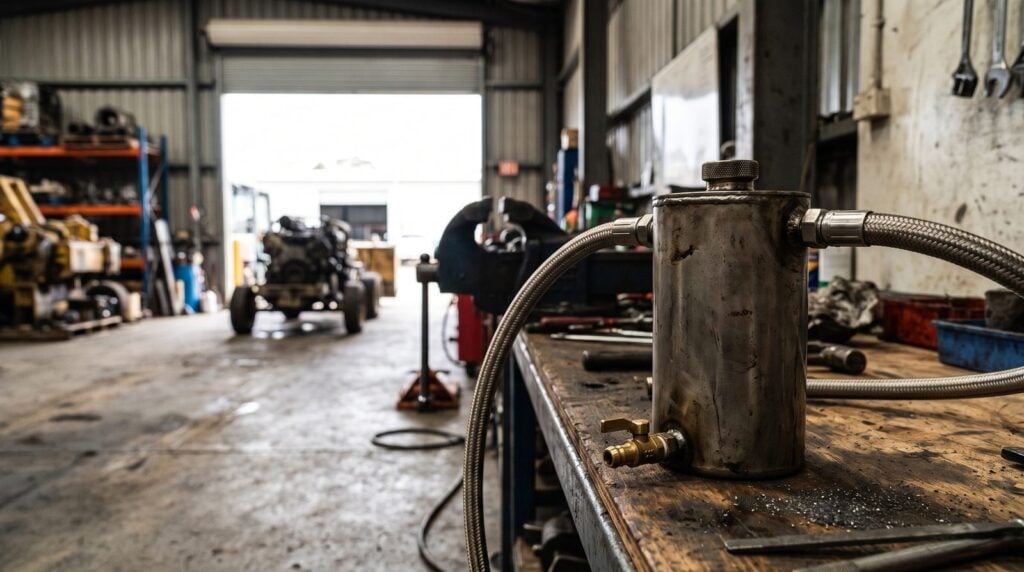
In our workshops it creeps up on people. Power falls away gradually, fuel use goes up, and the engine feels flat off idle. We tend to see it on vehicles that do short trips, because the engine spends less time hot. The sludge needs both the soot and the oil mist, so taking one out leaves the other far less to stick to. A catch can fitted early takes the oil mist out before it meets the soot, and it doesn’t touch any emissions equipment.
Suction control valve failure
The suction control valve is the solenoid that meters how much fuel the high pressure pump draws in. On the 4M41 it pulses up to 180 times a second.
When it’s damaged you get three symptoms: power falling away under hard acceleration, mainly between 1,800rpm and 3,000rpm, surging during steady acceleration, and higher fuel use. Dirty diesel damages it easily, there are reports of failure around 60,000km, and replacement is the only fix.
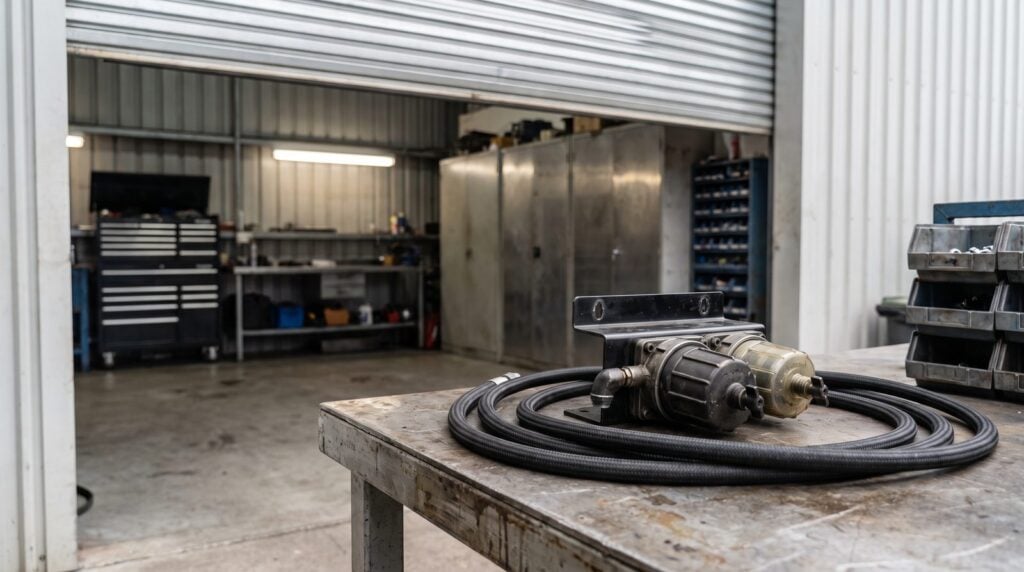
Because the cause is fuel quality, not kilometres, the cheapest thing you can do is filter the fuel better. A Fuel Manager pre-filter kit protects a valve that hasn’t failed yet. It won’t fix one that has.
The two faults overlap. Both give you a flat engine and higher fuel use, and cleaning the intake without testing the fuel system fixes half the problem at best. Get the fuel side checked before you commit to a manifold clean.
The rest of the Mk.3 Pajero fault list is chassis and body: sticking in 4H after shifting on the move, water getting into wheel bearings, a chafing seat wiring harness, and a cracked transmission cooler inside the radiator. None of those are 4M41 problems, so don’t go hunting for engine faults because of them.
Why the NS makes less torque
The NS of 2006 to 2008 was the first common rail 4M41 in Australia. It gained 4kW over the NP, from 121kW to 125kW, but lost torque, from 373Nm to 358Nm at the same 2,000rpm. That’s 15Nm less than the direct injection engine it replaced, in a body that had grown 105mm longer and 45mm taller and now carried a particulate filter.
The real jump came two years later. The NT arrived in December 2008 with the upgraded engine, and torque went from 358Nm to 441Nm, 83Nm or 23 percent in one update. Power went up 22kW and five door towing capacity rose by 500kg.
So an NS isn’t the cheap way into the modern Pajero it looks like on paper. It carries the full common rail parts cost, the particulate filter and the suction control valve risk, and it makes less torque than a 2005 NP.
Three parts families, one engine code
This is where 4M41 orders go wrong. There’s no single 4M41 gasket set. There are three, listed under the one engine code, and they don’t swap:
- 4M41T Non Common Rail. The earlier direct injection engine, NM and NP.
- 4M41 C/R. The common rail engine.
- 4M41 C/R Late. A later common rail specification.
A VRS gasket set is a valve regrind set, covering the head and everything above it. A full set also covers the sump and timing cover. Both come in common rail and common rail late. Read the description, not the price, because the common rail VRS set and the common rail full set cost the same and aren’t the same set.
Timing parts follow the same pattern. There are chain sets for the 4M41 Turbo and separate ones for the 4M41CR, and each comes with or without gears. Ordering by model year is how people end up with the wrong set on the bench, so we confirm fitment by VIN before anything ships. You don’t want to find out a gasket set is wrong with the head already off.
Bearings and pistons are ordered by machining size, which your machinist gives you once the engine is apart. Our guide to bearing and piston sizes explains what STD, 0.25 and 0.50 mean and what to send us.
What 4M41 parts cost
These are parts prices. Fitting, bleeding and any coding are on top.
| Part | Price |
|---|---|
| Piston and ring set, 4M41T common rail | $775.00, or $699.00 in 0.1mm oversize |
| KP full gasket set, 4M41T non common rail | $595.00 |
| KP full gasket set, 4M41 C/R | $557.70 |
| KP full gasket set, 4M41 C/R Late | $595.00 |
| KP VRS gasket set, 4M41 C/R or C/R Late | $557.70 or $437.20 |
| NVP timing chain set with gears and OE chain, 4M41CR | $575.00 |
| NVP timing chain set, 4M41 Turbo, with or without gears | $510.00 or $395.00 |
| Denso injector, 4M41CR Pajero 09/2008 on | $635.00 |
There’s no single part number rebuild kit, turbo, high pressure pump or suction control valve listed for this engine. Ask us and we’ll tell you straight away whether we can get one.
Pajero 3.2 bolt-on parts
These are listed under the Pajero, not the engine code. The intercoolers cover both generations, so check the generation in the product name.
- Intercooler, NM and NP V60, 2000 to 2006: $1,100.00, or $1,730.00 for the Series 2
- Intercooler, NS, NT, NW and NX V80, 2006 on: $1,100.00, or $1,740.00 for the Series 2
- HPD catch can, Pajero NS, NT, NW and NX with snorkel: $410.00
- Fuel Manager pre-filter kit, Pajero: $430.00
- Manta 3in dump pipe off the turbo with high flow cat, NS to NX: $730.00, or $949.01 in stainless
- Manta 3in rear muffler with droopy tip, NS to NT: $490.00, or $825.00 in stainless
The Manta range covers the NS on common rail 3.2, roughly 2006 on. It doesn’t cover the NM and NP direct injection cars. The catch can and pre-filter are the two parts that deal directly with the two faults above.
Buying a used 4M41 Pajero
- Confirm the build date, not the model year. It decides which parts family the vehicle takes, and whether you’re looking at 373Nm, 358Nm or 441Nm.
- Drive it between 1,800rpm and 3,000rpm under load. Surging or a flat spot in that band is the suction control valve symptom.
- Ask to see the inlet manifold. Carbon build-up is a listed fault on this engine, so check for it, especially on a vehicle that’s done short trips.
- Check the service history. Dirty fuel damages the valve, so a carelessly fuelled vehicle is a bigger risk.
Run the VIN through the PPSR for money owing and stolen or written-off status, and check the recall register at Product Safety Australia. If you’re also looking at a Patrol of the same era, we have a guide to the Nissan ZD30.
Common questions
Is the Mitsubishi 4M41 a reliable engine?
The two faults listed for the 4M41 Pajero are carbon sludge in the inlet manifold from the EGR and PCV systems, and suction control valve damage. Both are maintenance and fuel quality problems, not bottom end failures. A short fault list doesn’t prove it’s a good engine, but in our workshops a 4M41 kept on clean fuel with the intake looked after does big kilometres.
Does the 4M41 have a timing chain or a timing belt?
A chain, on both the turbo and common rail versions. It isn’t a scheduled replacement item, but it isn’t a lifetime item either, so if you hear noise from the front of the engine, get it looked at.
Which 4M41 Pajero has a DPF?
The common rail engine that came in with the NS in October 2006 has a diesel particulate filter. The earlier NM and NP direct injection engines don’t. Check the exhaust on the actual car, not the badge.
What does a 4M41 rebuild cost in parts?
There’s no single rebuild kit, so it’s built up from parts. A piston and ring set runs to $775.00, a full gasket set to $595.00, a timing chain set with gears to $575.00, and bearings and conrod parts to $169.00. Machining, assembly and fitting are all on top.
Why is my Pajero surging under acceleration?
On a common rail 4M41, test the suction control valve first. The signs are power falling away under hard acceleration between 1,800rpm and 3,000rpm, surging during steady acceleration, and fuel use going up. Failures have been reported around 60,000km. Get it tested before you replace it.
Confirm fitment by VIN before you order
Three parts families sit behind one engine code, so send us your VIN, build date and engine number through our contact page and we’ll confirm the right pistons, gaskets and seals, timing components or common rail injectors before you order. For a fuel system or turbo part, we’ll tell you whether we can get it. Our founder Willy has more than 20 years on the tools as a heavy diesel mechanic, and the team works on diesels across our Brisbane and Sunshine Coast workshops.
Last updated: November 2026