
 By Willy · Founder & Lead Diesel Specialist
Willys Workshop · Oxley & Warana · 20+ years hands-on diesel experience
A cracked cylinder head is what this engine is known for, and almost every time the crack is a symptom of overheating. The head itself isn’t the fault. The 1KZ-TE is Toyota’s 3.0 litre single overhead cam turbo diesel four, sold here in the Mk.6 Hilux at 85kW and in the 90 and 120 Series Prado at 96kW and 343Nm.
This guide covers which Australian vehicles got it and in what tune, why the head cracks, how to test for it before you spend money, and what the parts cost. If you already know what you want, go straight to the exhaust systems we stock.
Quick Links
- What the 1KZ-TE is
- Australian vehicles and outputs
- Specifications
- Cracked cylinder heads
- Fix the cooling system first
- 1KZ-TE and 1KD-FTV compared
- When a rebuild is the right call
- What 1KZ-TE parts cost
- Upgrade order if you’re keeping it
- Buying a used 1KZ-TE
- Common questions
What the 1KZ-TE is
Toyota introduced it in 1993, and it reached Australia in the 1997 Mk.6 Hilux. The block is deep-skirt, externally ribbed and linerless, with plateau honed bores. Plateau honing is a two stage finish that leaves a flat bearing surface with oil-holding valleys underneath, so the rings bed in faster and wear less.
It’s an indirect injection diesel, so fuel is sprayed into a small swirl pre-chamber, not straight onto the piston crown. Injection is electronically controlled, through a Denso vane-type pump, with ceramic-tipped glow plugs. Compression is 21.2:1, which is high. In our experience a high compression indirect injection diesel runs hot by nature.
The single overhead cam works two valves per cylinder. It’s driven by gears to the injection pump gear and then a toothed rubber belt with an automatic tensioner. Twin balance shafts in the crankcase spin at twice crank speed to cancel the shake an inline four makes.
The turbo is a water-cooled Toyota CT12B. The 96kW engines also have an air-to-air intercooler, which cools the compressed intake air using outside airflow.
Australian vehicles and outputs
| Vehicle | Transmission | Years | Peak power | Peak torque |
|---|---|---|---|---|
| Mk.6 Hilux | 5sp manual | 1997 to 2000 | 85kW at 3,600rpm | 295Nm at 2,400rpm |
| Mk.6 Hilux | 5sp manual | 2000 to 2005 | 85kW at 3,600rpm | 315Nm at 2,000rpm |
| 90 Series Prado | 5sp manual, 4sp auto | 2000 to 2002 | 96kW at 3,600rpm | 343Nm at 2,000rpm |
| 120 Series Prado | 5sp manual, 4sp auto | 2003 to 2006 | 96kW at 3,600rpm | 343Nm at 2,000rpm |
The Prado makes 11kW more than the Hilux, and the Prado engines are the intercooled ones. A 2003 Hilux and a 2003 Prado 120 share the engine code but not the output, so a Hilux that feels down on a Prado of the same age isn’t necessarily sick. It was built that way.
Partway through the run the Hilux gained torque without gaining power. Peak torque went from 295Nm at 2,400rpm to 315Nm at 2,000rpm, which makes it a better engine to tow and crawl with.
For the 120 Series Prado the engine got a lighter aluminium sump, electronic throttle control and an intercooler protector. The Hilux Surf isn’t among the listed Australian applications, so if you’ve got one, go by the build plate and engine number.
Specifications
| Specification | Value |
|---|---|
| Configuration | Inline four, deep-skirt linerless block |
| Displacement | 2,982cc |
| Bore x stroke | 96.0mm x 103.0mm |
| Compression ratio | 21.2:1 |
| Cylinder head | Aluminium alloy, cross-flow, steel laminate head gasket |
| Valvetrain | SOHC, two valves per cylinder, belt and gear drive |
| Fuel system | Electronic indirect injection, Denso Generation 3 vane-type pump |
| Firing order | 1-3-4-2 |
| Turbocharger | Water-cooled Toyota CT12B |
| Intercooler | Air-to-air on 96kW engines, 320mm x 230mm x 65mm |
| Redline | 4,400rpm |
Confirm against your build plate before ordering parts.
Cracked cylinder heads
The head cracks because the engine overheats, and that’s why overheating on a 1KZ-TE needs attention straight away. The known causes of overheating are:
- a failed viscous fan hub
- a blocked radiator
- a seized wastegate actuator, causing overboost
- a hole in the heater hose
- too much load on the cooling system, which a worn torque converter can add to.
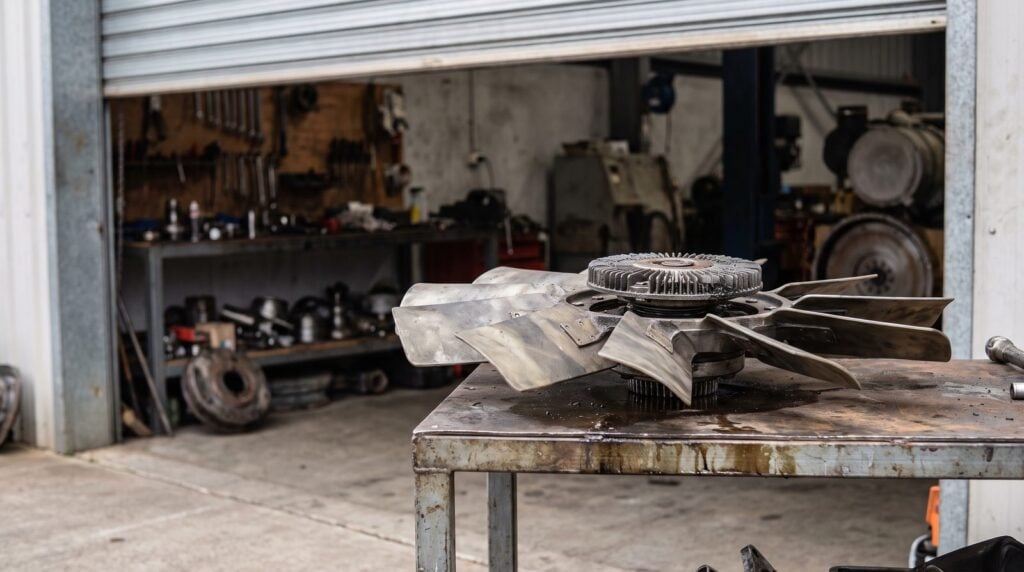
A viscous fan hub is a temperature sensitive coupling that lets the fan slip at cruise and lock up when the air under the bonnet gets hot. When the fluid inside wears out, the fan never locks properly. The first sign is usually the temperature climbing on a long hill or in stop-start traffic on a hot day. At highway speed it can look fine.
The signs of a cracked head are small bubbles in the coolant pushing coolant into the overflow bottle, coolant use and discolouration, rapid overheating, and rough running with a loss of power. In our workshop we separate the causes with a combustion gas test on the coolant, a pressure test with dye and a head inspection, a compression test, a fan lock-up check and a wastegate actuator movement check.
A pressure test on the head doesn’t always show the problem. A head can pass and still be the fault, which is why the gas test and compression test matter.
A cracked head can also let the turbo overheat, which may cause excess shaft movement and let the blades touch the housing. So check the turbo before the job’s signed off.
Replace the head with a genuine Toyota one. There are reports of casting faults in non-genuine heads. We don’t stock a 1KZ-TE head, so we source and quote it.
Fix the cooling system first
Look at that list of causes again. None of them is a piston, a rod, a bearing or a head bolt. Four are cooling system parts and the fifth is a turbo control part. The head doesn’t handle heat well, and there are five separate ways for that heat to get to it. Almost every time, the cracked head is downstream of the real fault.
That has three practical effects.
- Prevention is cheap and the cure isn’t. A fan hub or radiator is a fraction of the cost of a genuine head plus machining plus labour.
- A new head without a fix for the overheating fails again. If the fan hub caused it and the same fan hub is still fitted, nothing’s changed. Ask any quote what it does about the cause.
- The temperature gauge is a poor early warning on a vehicle this age. A failing fan hub shows up on hills and in hot traffic, not as a steady rise on the commute. Any needle movement under load is a fault to diagnose now.
So service the cooling system first. We carry the radiator, viscous fan hub, thermostat, water pump and hose sets for the 1KZ-TE, and every one of them costs a fraction of a head job. Start with our cooling parts and send us your VIN so we can confirm fitment.
1KZ-TE and 1KD-FTV compared
The 1KD-FTV replaced the 1KZ-TE. The two share the same 96.0mm by 103.0mm bore and stroke for 2,982cc, and almost everything else changed. The 1KD is common rail direct injection with double overhead cams, four valves per cylinder, a variable nozzle turbo and 17.9:1 compression, and makes 80kW to 127kW depending on the vehicle. Its known fault is cracked pistons on Euro IV engines, not cracked heads.
There’s a buying trap in the dates. The 1KZ-TE ran in the 120 Series Prado from 2003 to 2006, then the 1KD-FTV took over from 2006. So “120 Series Prado” alone doesn’t tell you which engine you’re looking at. Check the engine code stamped on the block.
When a rebuild is the right call
Most people get here the same way. The head’s cracked, or compression came back uneven, and someone’s said the word rebuild. There are four options.
Repair the single fault. With modest kilometres, even compression across all four and clean oil, a head plus the cooling fault behind it is the whole job. On this engine that’s the common outcome, because every known cause of the overheating sits outside the rotating assembly.
Rebuild. This is the answer when it’s been run hot for a while, or when high kilometres have brought oil use, low or uneven compression and blow-by. Once the bottom end has been heat soaked, a fresh head on a tired engine is money half spent.
Buy a used engine. Cheaper on paper, but you get an unknown cooling history on the one engine where cooling history decides everything. Ask the seller what they can prove.
Move the vehicle on. A Mk.6 Hilux or 90 Series Prado can be worth less than the job. Get the quote first, then decide.
We carry one engine rebuild kit that covers the 1KZ and 1KZ-TE. It’s ordered by piston and ring size, main bearing size and conrod bearing size, so the machine shop measures the block first and you order to those numbers. It isn’t a “with timing” kit, so the timing belt kit is a separate line. The listing doesn’t itemise gaskets or head bolts, so tell us what your builder wants and we’ll confirm what’s in the box.
A kit is parts only. Machining, labour and, on a 1KZ-TE, very often a head all sit on top, and the finished job comes to several times the kit price. Assume a head is in your quote until a machine shop tells you the old one cleans up. We quote each job once it’s been measured. If STD, 0.25 and 0.50 don’t mean anything to you yet, our guide to bearing and piston sizes explains what to send us.
What 1KZ-TE parts cost
These are starting prices for parts only. Fitting is extra. We don’t stock a 1KZ-TE cylinder head, injectors or turbo, so ask us to quote those.
| Part | Price |
|---|---|
| Radiator, Toyota 1KZ | from $395.00 |
| Dayco viscous fan hub, 1KZ-TE 3.0L | from $183.00 |
| Genuine thermostat, 1KZ 3.0L | from $69.00 |
| NVP water pump, 1KZ-TE | from $94.60 |
| NVP cooling hose set, Prado KZJ90 and KZJ95 | from $164.45 |
| NVP cooling hose set, Hilux | from $280.50 |
| Engine rebuild kit, 1KZ and 1KZ-TE | from $1,424.45 |
| KP full gasket set | from $479.00 |
| KP head gasket, 1KZ-TE SOHC | from $145.00 |
| NVP head bolt set | from $52.80 |
| Timing belt kit | from $295.00 |
The small genuine seals and gaskets, like the sump seal, cam seal and oil pickup gasket, are the ones people skip and regret. They cost almost nothing next to the labour of going back in a second time.
Other parts from this guide:
- Manta 3 inch turbo-back with catalytic converter, centre and rear muffler, Prado: $2,169.76 to $3,129.87
- Front mount intercooler, Prado 120 Series: from $1,600.00
Turbo-back means everything from the turbo outlet rearward is replaced, so the dump pipe, centre section and rear muffler all change. That’s where nearly all the restriction is on a factory 1KZ-TE. We also carry front mount intercoolers for the Hilux; ask us for the one that fits yours.
Upgrade order if you’re keeping it
- The cooling system. On this engine it’s the main way to prevent the known failure.
- Exhaust. Bigger exhaust systems and radiator upgrades are common Prado modifications to help cooling. Less restriction after the turbo means lower exhaust gas temperature.
- Intercooling and airflow. Worth the most in hot conditions and when towing. The 85kW Hilux engine isn’t listed with a factory intercooler, so check what yours has.
- Tune last, and only on healthy hardware. An engine that fails from heat isn’t one to chase numbers on before the cooling is proven, and with a 4,400rpm redline there isn’t much top end to chase anyway.
Buying a used 1KZ-TE
- Engine code on the block. A 2006 120 Series Prado could have either engine.
- Coolant and the overflow bottle. Bubbles, discolouration or coolant use are the cracked head signs.
- Temperature under load. Drive it up a hill and sit it in traffic. Normal at highway speed proves very little.
- Turbo shaft play. If the head’s cracked at some point, the turbo may have cooked with it.
- Cooling parts in the service history. A radiator, fan hub and hoses done recently is a real plus on this engine.
Run the VIN through the PPSR for finance owing and stolen or written-off status, then check the recall register at Product Safety Australia.
Common questions
Is the 1KZ-TE a good engine?
It’s durable, simple and low-stressed, with one well known weakness. Indirect injection, two valves per cylinder and a 4,400rpm redline make it undemanding, and there’s no common rail injector bill waiting. The weakness is that overheating cracks the head, and four of the five known causes are cooling parts that wear with age. Look after the cooling and it lasts.
Why do 1KZ-TE cylinder heads crack?
Overheating, not a defect in the head. The known causes are a failed viscous fan hub, a blocked radiator, a seized wastegate actuator causing overboost, a hole in the heater hose, and too much load on the cooling system, which a worn torque converter can add to. Replace the head without fixing the cause and it’ll happen again.
How much power does a 1KZ-TE make?
The Mk.6 Hilux makes 85kW at 3,600rpm, with 295Nm at 2,400rpm from 1997 to 2000 and 315Nm at 2,000rpm from 2000 to 2005. The 90 and 120 Series Prado both make 96kW at 3,600rpm and 343Nm at 2,000rpm.
How do I know if my 1KZ-TE head is cracked?
Look for small bubbles in the coolant pushing coolant into the overflow bottle, coolant use and discolouration, rapid overheating, rough running and loss of power. A pressure test on the head doesn’t always find it, so have a combustion gas test on the coolant and a compression test done as well.
Is an exhaust upgrade worth it on a 1KZ-TE?
Yes, and power is the smaller reason. Bigger exhausts are a common Prado modification to help cooling, because a freer exhaust lowers exhaust gas temperature. On an engine whose known fault comes from heat, that counts for more than the power figure.
Check the engine code before you order
A 120 Series Prado of the wrong year has a different engine entirely, so check fitment first. Send your VIN, build date and engine code through our contact page and we’ll confirm the right intercooler, gaskets or rebuild parts before you order, and quote a head, injectors or turbo if you need one. Our founder Willy has more than 20 years on the tools as a heavy diesel mechanic, and the team works on diesels across our Brisbane and Sunshine Coast workshops.
Last updated: November 2026