

 By Willy · Founder & Lead Diesel Specialist
Willys Workshop · Oxley & Warana · 20+ years hands-on diesel experience
The 1VD-FTV is Toyota’s 4.5 litre 90 degree V8 diesel, and it comes two ways. The 70 Series LandCruiser runs a single turbo version. The 200 Series runs a twin turbo version with a lot more output. Same engine code, two different vehicles, and the parts don’t always cross over.
Getting that wrong is the most expensive mistake people make on this engine. This guide covers which vehicle got which, the specs, the recalls, and what the parts cost. For the build order on a 79, see our 79 Series LandCruiser upgrades guide.
Quick Links
- What the 1VD-FTV is
- Single turbo or twin turbo
- Specifications
- Recalls and known faults
- When a rebuild is the right call
- What the parts cost
- Upgrade order
- Buying a used 1VD
- Common questions
What the 1VD-FTV is
Production started in 2007, and it was Toyota’s first V8 diesel. The block is nodular graphite iron, with stiffening plates across the base to cut vibration. Nodular graphite iron is cast iron where the graphite forms as spheres, not flakes, which makes it much stronger in tension than ordinary grey iron. On a V8 diesel running this much cylinder pressure, that matters.
The bottom end is well built. The crank is forged steel with induction hardened fillets, the rods are high-strength steel, and the aluminium pistons have an internal cooling channel and a Ni-resist top ring carrier.
Each bank has double overhead cams with roller rockers and hydraulic lash adjusters. The intake cams are driven by gears and a timing chain, and the exhaust cams run off a gear on the intake cam. It’s a chain, so there’s no timing belt interval to budget for.
Australian delivered vehicles got two extras: an air pre-cleaner, and a dual fuel tank setup with a main tank and a sub tank.
Single turbo or twin turbo
Read this before you order anything. The detailed specs further down describe the twin turbo 200 Series engine, not the 79.
| Vehicle | Turbo arrangement | Years | Power | Torque | Transmission |
|---|---|---|---|---|---|
| 200 Series LandCruiser | Twin turbo | 2007 on | 195kW at 3,400rpm | 650Nm at 1,600 to 2,600rpm | 6 speed automatic |
| 79 Series LandCruiser | Single turbo | 2007 on | 151kW at 3,400rpm | 430Nm at 1,200 to 3,200rpm | 5 speed manual |
The 76 and 78 Series share the single turbo setup, but don’t assume the 79 figures carry over exactly. And “2007 on” is the life of the engine, not a promise that a given 79 has one, because a 2.8 litre 1GD-FTV option came into the 79 Series in 2023. Check the build plate.
The gap is 44kW and 220Nm. Fitting 200 Series parts to a 70 Series won’t close it.
The parts split along the same line. We carry two engine rebuild kits, one for the 200 Series and one for the 70 Series. The genuine crankshaft, the performance conrods and the piston sets are listed by engine code alone, because the bottom end is shared. The genuine turbos are left hand and right hand units for the 200 Series, one per bank. The DPFs split the same way: a single unit for the VDJ70 and a left and right secondary pair for the VDJ200.
So the deeper into the engine you go, the more the two versions share. The closer you get to the intake, exhaust and emissions hardware, the less they share. Bottom end work is largely a 1VD-FTV job. Anything that breathes is a 200 Series job or a 70 Series job, and ordering by engine code alone is how you end up with a 200 Series turbo that won’t bolt to your ute.
Specifications
| Specification | Value |
|---|---|
| Configuration | 90 degree V8, nodular graphite iron block |
| Displacement | 4,461cc |
| Bore x stroke | 86.0mm x 96.0mm |
| Compression ratio | 16.8:1 |
| Cylinder heads | Aluminium alloy, DOHC per bank, four valves per cylinder |
| Camshaft drive | Gears and timing chain |
| Firing order | 1-2-7-3-4-5-6-8 |
| Turbochargers, 200 Series | Two low-inertia RHV4, variable nozzle vanes, water-cooled bearing housings |
| Fuel supply pump | HP4 type, three plungers, suction control valve |
| Injectors | Nine-hole, solenoid type, 25 MPa to 175 MPa on Euro IV models |
| Intercooler | Air-to-air, mounted on top of the engine |
| Emissions control, 200 Series | Water-cooled EGR and an oxidation catalytic converter |
These figures describe the twin turbo 200 Series engine. Confirm against your build plate before ordering.
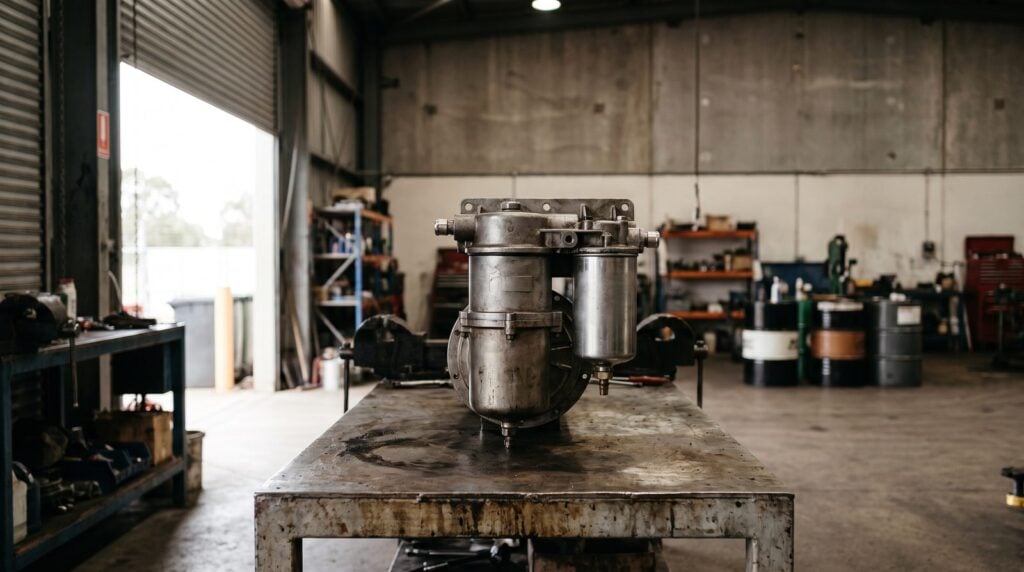
The turbos are a variable nozzle type. Movable vanes in the turbine housing change how exhaust gas hits the turbine wheel, and the ECM drives them with DC motors. It works out target boost from engine speed, injection volume, atmospheric pressure and coolant temperature. At low revs the vanes close to speed the gas up and build low-end torque. Higher up they open to cut back pressure. The engine also uses pilot injection, a small shot of fuel before the main one, to start combustion gently and cut noise.
Recalls and known faults
Check these before you spend money chasing a symptom.
- Low-pressure fuel pump recall (campaigns VGG17 and VGG05, PRA 2020/18242). 200 Series built September 2013 to April 2019. The pump could stop working, so the engine may stall and not restart, or run rough. The fix is a new pump.
- Brake fluid leak recall (PRA 2014/14035). 200 Series 4.5 twin turbo diesel built May 2012 to March 2014. A brake hose bracket on the front diff could fracture.
- Driveshaft noise (TSB T-SB-0117-08). 2007 to 2008 200 Series. A thunk from the rear when taking off or pulling up. A revised tailshaft was fitted.
CV joints and boots come up regularly too. Split boots let dirt and water into the joint, and you’ll see grease near the front wheels or hear clicking while driving. Smaller items include an oil leak low on the engine traced to the dipstick tube O-ring.
There’s no cracked piston campaign on this engine. That story belongs to the 3.0 litre four, covered in our 1KD-FTV engine guide.
Exhaust gas recirculation (EGR) returns a measured amount of exhaust to the intake to lower peak combustion temperature and cut NOx. On the 1VD-FTV that gas is cooled through a water-cooled EGR cooler, then metered by a linear solenoid valve working with the diesel throttle. Soot and oil vapour foul the intake over time, and short-trip vehicles suffer worst because they never run hot for long enough. The early 200 Series ran EGR and an oxidation catalytic converter with no particulate filter. Later 200 Series and 70 Series builds also carry a DPF.
When a rebuild is the right call
Everything in the section above has a cheaper answer than a rebuild. A recalled fuel pump gets a pump. A vane mechanism stuck in carbon gets the turbo sorted. A fouled intake gets cleaned, and a weeping dipstick tube gets an O-ring. None of those is a reason to pull an engine down.
A rebuild makes sense when the bottom end itself is finished: low oil pressure, a knock under load, heavy blow-by, or metal in the oil. No single part fixes those. Then weigh it against the other options:
- Repair the single fault. Cheapest by a long way when one part has failed and the rest of the engine measures up.
- Buy a used engine. You take on unknown history and wear, and on a 200 Series you take on two turbos with it.
- Move the vehicle on. Fair enough when the body and driveline are as tired as the engine. Sound 70 and 200 Series LandCruisers aren’t cheap to replace, so a good vehicle with a worn engine is usually worth rebuilding.
Our engine rebuild kits are chosen by vehicle, not engine code. You pick piston and ring size from STD, 0.02, 0.50, 0.75 and 1.00, and main and conrod bearing size from STD, 0.25 and 0.50, so the box holds pistons, rings, main bearings and conrod bearings. Those sizes come off the machine shop’s measurements. Neither kit is labelled “with timing”, so don’t assume the chain, guides and tensioner are in it. Ask us. There’s no cylinder head or HP4 supply pump in the kit either, and there’s no high performance version. For a built engine, look at the ceramic coated pistons and H beam conrods in the costs section.
A kit is parts in a box. Machining, labour and usually a cylinder head sit on top, so the finished job costs several times the kit price. We quote each engine once the block and head are measured. If STD, 0.25 and 0.50 don’t mean anything to you yet, our guide to bearing and piston sizes explains what to send us.
What the parts cost
These are parts prices only. Fitting and coding are on top.
| Part | Price |
|---|---|
| Engine rebuild kit, 1VD 200 Series | $2,455.68 |
| Engine rebuild kit, 1VD 70 Series | $2,470.68 |
| Genuine turbocharger, 200 Series, left hand side | $2,371.50 |
| Genuine turbocharger, 200 Series, right hand side | $2,371.00 |
| Powermax turbocharger, 1VD-FTV 4.5 V8 | $3,250.00 |
| Genuine crankshaft | $2,178.00 |
| FAST performance H beam conrod with aftermarket bolts | $1,740.00 |
| FAST turbo piston set, ceramic coated | $1,190.00 |
| TIK piston set | $990.00 |
| Denso injector, 200 Series pre DPF | $495.00 |
| Denso injector, 79 and 200 Series late DPF, 08/2015 on | $715.00 |
| Genuine oil cooler assembly, 200 Series | $949.00 |
| Genuine main oil pump assembly | $410.00 |
A full turbo replacement on a 200 Series means two units, one per bank. The same goes for the 200 Series secondary DPFs. Other parts from this guide:
- Injector fit sets: $252.55 and $259.00, and a fuel injector line set at $465.00
- OEM standard DPF with OEM sensors, VDJ70 Series: $6,280.00
- OEM DPF replacement, VDJ70 2016 to 2024: $1,790.00
- Secondary OEM DPF replacement, VDJ200: $1,035.96 each side
- OTC intercooler fan set: $1,299.00
- NVP heavy duty clutch kit, 70 Series manual: $931.19
The two 70 Series DPFs are the biggest price spread on the vehicle, so ask us about them before you commit. We don’t list an HP4 supply pump or a cylinder head for the 1VD-FTV. Given the fuel pump recall, contact us for high pressure fuel parts.
Upgrade order
- Fix what’s worn first. Turbo health, a clean intake, cooling. There’s nothing gained tuning an engine that can’t breathe.
- Cooling and airflow. The factory intercooler sits on top of the engine. It’s compact, but it heat-soaks in traffic and on long climbs, which is why intercooler fan sets exist.
- Exhaust. A freer system lowers exhaust gas temperature, and heat is what kills turbos, manifolds and head gaskets. A DPF back system replaces everything behind the particulate filter, and a cat back replaces everything behind the catalytic converter.
- Tune last. On healthy hardware the gain is in throttle response and torque under load, more than a peak figure.
Buying a used 1VD
- Confirm which engine it is. Single turbo 70 Series or twin turbo 200 Series. That decides every parts order after it.
- Check the recalls. The fuel pump campaign covers a six year build window.
- Listen at the front. Clicking on lock, or grease near the front wheels, points at split CV boots.
- Watch for boost faults. A vane mechanism living in exhaust carbon can stick, and it feels like general tiredness.
Run the VIN through the PPSR for finance owing and stolen or written-off status, then check the model on the recall register at Product Safety Australia.
Common questions
Is the 1VD-FTV single turbo or twin turbo?
Both, depending on the vehicle. The 70 Series LandCruiser runs a single turbo and the 200 Series runs twin turbos. Always identify the vehicle before ordering intake or exhaust parts.
Does the 1VD-FTV have a timing belt?
No. Gears and a timing chain drive the intake cams, and the exhaust cams run off a gear on the intake cam. There’s no belt replacement interval.
Was there a recall on the 1VD-FTV?
Yes. A recall covered the low-pressure fuel pump on 200 Series vehicles built from September 2013 to April 2019, under campaigns VGG17 and VGG05. The pump could stop working, causing a stall or rough running. Check the recall register at Product Safety Australia and confirm your own VIN with Toyota. Don’t go by model year.
Can I fit 200 Series turbochargers to a 79 Series?
No. The 200 Series uses a left hand and a right hand turbo because it’s a twin turbo V8, and the 70 Series is a single turbo engine. Order by vehicle, not by engine code.
What does a 1VD-FTV rebuild kit cost?
Our engine rebuild kits are $2,455.68 for the 200 Series and $2,470.68 for the 70 Series. They’re separate part numbers because the two versions aren’t the same assembly. Machining and fitting are on top.
Tell us which LandCruiser it’s in
We stock rebuild kits for both versions, plus the engine internals, pistons and gaskets and seals the two share. Turbochargers, DPFs and exhaust go by VDJ number, not engine code. Send your VIN and build date through our contact page and we’ll check the part number before you order. Our founder Willy has more than 20 years on the tools as a heavy diesel mechanic, and the team works on diesels across our Brisbane and Sunshine Coast workshops.
Last updated: November 2026