

 By Willy · Founder & Lead Diesel Specialist
Willys Workshop · Oxley & Warana · 20+ years hands-on diesel experience
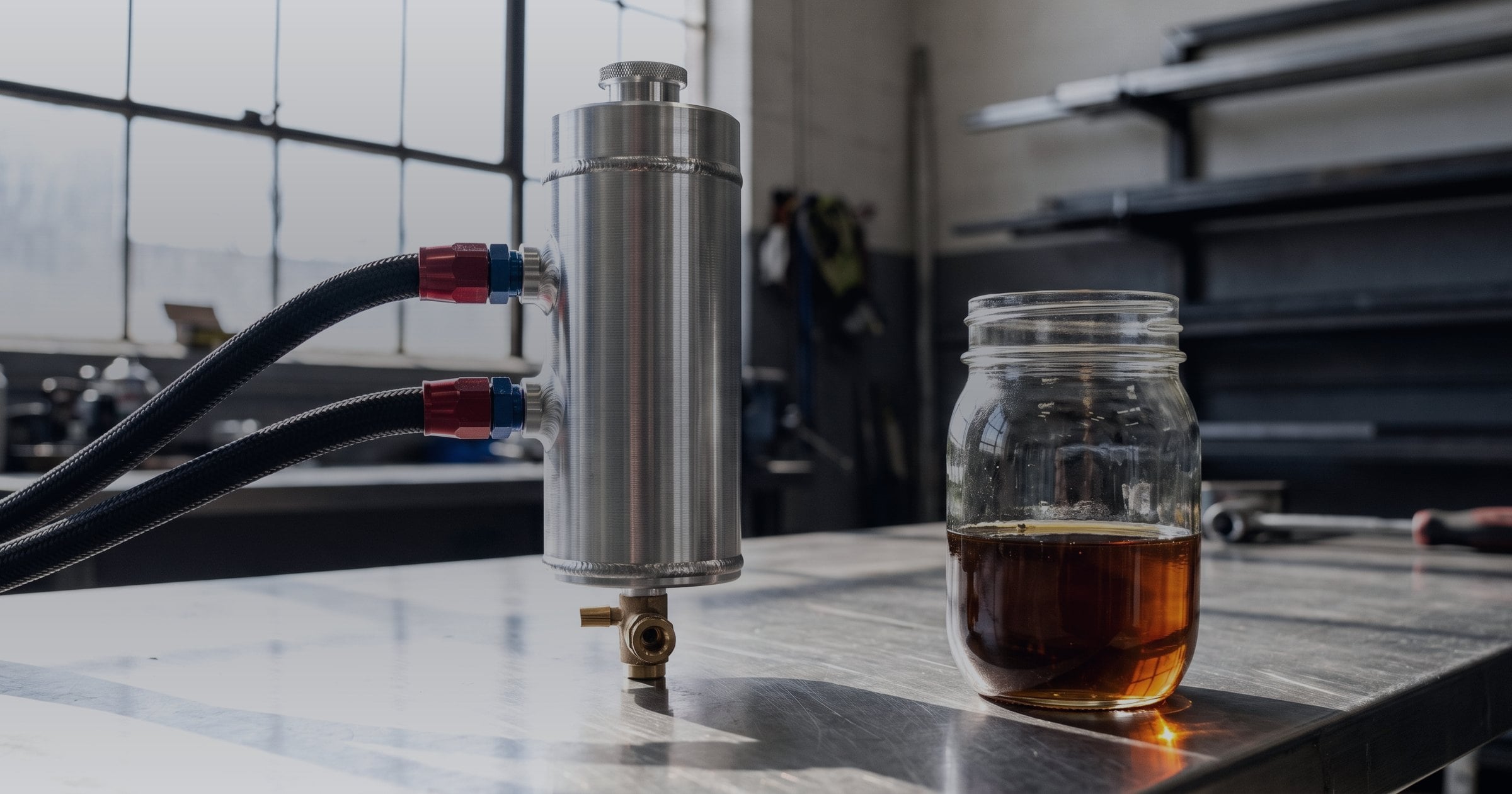
A catch can is an oil separator plumbed into the crankcase breather line, between the engine and the intake. It stops oil mist reaching the inlet, where it meets recirculated exhaust soot and bakes on.
This guide covers what the hardware does, why short-trip vehicles suffer worst, and how ProVent relates to Direction Plus. It also gives real prices, service advice and the legal line. If you know the brand you want, go straight to the Direction Plus range.
At a glance
- ProVent is a MANN+HUMMEL oil separator. Direction Plus builds the Australian vehicle-specific kits around it.
- MANN+HUMMEL publishes separation efficiency above 90 percent at 0.6 micron and above 98 percent at 1.5 micron, mass weighted, for its ProVent 100, 200 and 300 modules. Those are module ratings for engines from 75kW up, not a test of any vehicle kit.
- Service life is stated as greater than 2,000 hours. That is an hours figure, not a distance.
- Direction Plus states 98 percent oil separation for the ProVent Ultimate kit, on a benefits list carrying the note that some of those benefits apply only where the oil is returned to the sump.
- On the EGR side we also stock blanking plates and delete kits.
- A closed catch can takes nothing off the vehicle. It sits in the breather line and everything else stays where it is.
Quick Links
- What a catch can does
- Why short-trip diesels suffer most
- ProVent and Direction Plus
- Filtration versus a baffled can
- What the range costs
- Servicing: count hours, not kilometres
- A catch can is not a delete
- Choosing one
- Common questions
What a catch can does
Blow-by is combustion gas that slips past the piston rings and ends up in the crankcase. Every engine makes some; a worn one makes considerably more. It has to go somewhere, so it gets drawn back out through a breather.
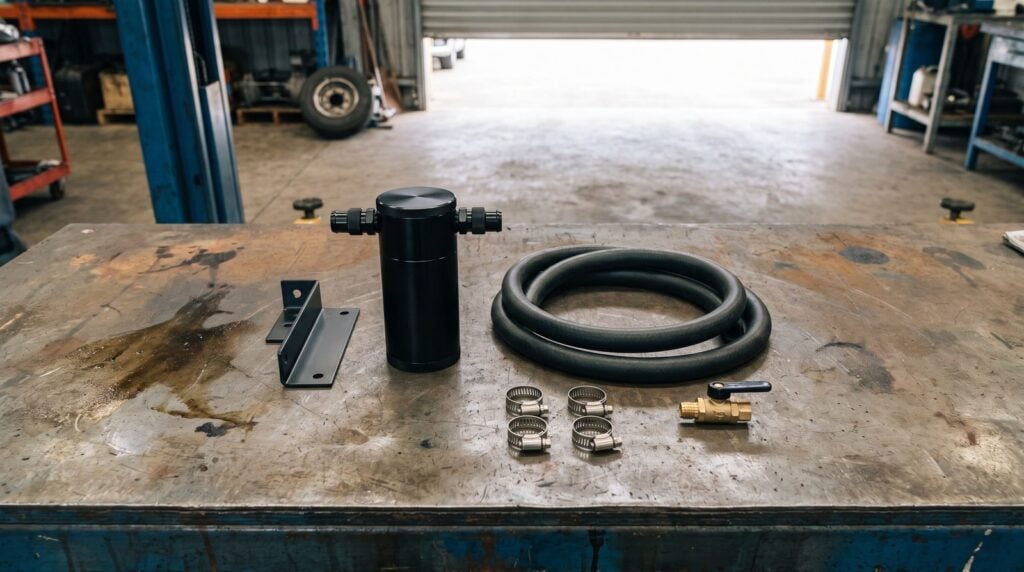
Crankcase ventilation is the system that pulls those gases back out and feeds them into the intake to be burnt. Every modern diesel has one and it stays exactly where it is. A catch can does not replace it and does not remove anything, it simply sits in that line and takes the oil out on the way through.
The trouble is what travels with the gas. Blow-by carries a fine oil mist, delivered straight back into the intake.
Where the deposit comes from
Exhaust gas recirculation feeds a measured amount of exhaust back into the intake to bring combustion temperature down, and on a diesel that gas is thick with soot. Here is the part that matters: oil mist on its own would largely pass straight through, and dry soot on its own would largely blow through as well. Put the two together and you get something closer to a paste.
That paste bakes onto the inlet manifold, the EGR cooler and the swirl flaps, layer on layer, and by the time the ute feels properly flat the ports can be half shut. By that stage it is a manifold-off job, and cleaning it costs many times what stopping it would have.
A catch can breaks that chemistry at the cheapest possible point. Take the oil out and the soot has far less to stick to.
Why short-trip diesels suffer most
Deposits build fastest in engines that never get properly hot, and a modern diesel doing school runs and a supermarket trip spends most of its working life below the temperature it was designed around.
Three things stack up on that vehicle at once. Water stays in the crankcase instead of boiling off, which thickens the mist. EGR flow is at its highest at light load and low road speed, which is exactly where the ute lives. And the intake never sees the heat or the airflow that keeps a highway vehicle’s ports reasonably clear.
Which is why two utes showing the same odometer reading can be in completely different condition inside. One at 120,000km of highway towing will often have a cleaner inlet than the same model at 80,000km of city work. Hours of low-load running tells you far more than distance does.
The other group worth prioritising is high blow-by engines, where the breather is working hard the whole time and the can fills noticeably faster. Our Toyota 1HZ engine guide treats crankcase pressure as a genuine diagnostic signal rather than a footnote, and blow-by at the oil filler is one of the checks it tells you to take seriously.
ProVent and Direction Plus
People ask us to compare these two constantly, and they are not competitors at all.
MANN+HUMMEL is the German filter maker behind the ProVent separator. Its own description of the mechanism is a coalescer. Take its account of the much larger ProVent 500, the module built for engines above 1200kW. Dirty blow-by gas enters from below into the coalescer and flows through it from the inside to the outside, “whereby the aerosol is separated with high efficiency by the filter media”. Then “the separated oil then flows through the oil return channel back to the oil sump of the engine”. That passage describes the big industrial unit, not the one on your ute. The separating principle is the same across the range.
Direction Plus is the Australian brand that builds vehicle-specific kits around that separator, alongside its Fuel Manager, PreLine-Plus and TransChill lines. A kit is listed as the ProVent can, a model-specific laser cut stainless bracket, hose and reducers, the nuts, bolts and clamps, and instructions.
So what you are actually buying is a German separator in an Australian bracket kit, which is why both search terms land you on the same shelf.
Published ProVent figures
Every row below is for the ProVent 100, 200 and 300 modules unless stated.
| Specification | Published figure | Source |
|---|---|---|
| Separation at 0.6 micron, mass weighted | above 90 percent | MANN+HUMMEL |
| Separation at 1.5 micron, mass weighted | above 98 percent | MANN+HUMMEL |
| Service life | above 2,000 hours | MANN+HUMMEL |
| Operating temperature | -40C to +120C, peak 150C | MANN+HUMMEL |
| Engine power range, ProVent 100 / 200 / 300 | 75 to 200 / 200 to 400 / 400 to 1200 kW | MANN+HUMMEL |
| Blowby flow, ProVent 100 / 200 / 300 | under 100 / 200 / 300 litres per minute | MANN+HUMMEL |
| Oil separation, ProVent Ultimate kit | 98 percent | Direction Plus |
Three caveats. MANN+HUMMEL publishes those numbers as ratings for the module on an engine inside those power bands, not as a measurement of a fitted kit on a 3.0 litre ute. The MANN+HUMMEL page covers the 100, 200 and 300 and lists no 150, although an element listed as PVE150DP is a real part we stock, so order elements by the number on the housing. And the 98 percent headline is the kit maker’s own claim, not a third party test. Treat both sets as maker’s figures.
Filtration versus a baffled can
If you read one section on this page, make it this one, because it decides whether the thing you bolt on does any good at all.
A baffled can is an empty chamber with plates in it. Vapour slows down, hits the plates, and the heavy drops fall out of suspension. It will collect visible oil, and a surprising amount of it on a hard worked engine, so it looks like it is doing the job. What it cannot do is catch the fine mist, because drops that small simply follow the air around the baffle and carry on into the inlet.
A coalescing filter goes about it differently: the mist is drawn through media that makes tiny droplets merge into big ones, which then drain out under their own weight. That is the mechanism MANN+HUMMEL describes, and it is the reason a filtered can can put a number against a stated droplet size while a baffled one cannot.
So the buying test is short. Ask what the can claims, at what droplet size, and who published the figure. No efficiency rating and no micron figure means you are buying a chamber rather than a separator, whatever the machining looks like.
None of which is an argument for spending the most money in the catalogue. A billet can still collects liquid oil, and on an older high blow-by engine that is genuinely worth having. It is an argument against expecting a cheap one to keep a modern EGR inlet clean.
What the range costs
Prices are from our catch cans and secondary filter kits categories on 25 July 2026, including the EGR hardware. Fitting is extra.
| Product category | Products | Lowest | Highest |
|---|---|---|---|
| Catch cans | 140 | $15.00 | $884.55 |
| Secondary filter kits | 168 | $47.27 | $884.55 |
Both of those floors need explaining rather than quoting. The $15.00 is a hose reducer (PV2519DP), not a catch can. The $47.27 is a Fuel Manager Post-Filter Replacement Element, 2 micron (36693), not a kit. The two categories overlap, because the combined pre-filter and catch can kits are filed in both, which is why they share a ceiling.
| What it is | Named product | Willys price |
|---|---|---|
| Hose reducer | ProVent Catch Can Reducer 25-19mm (PV2519DP) | from $15.00 |
| Drain fitting | ProVent Catch Can Drain (DPDRAIN) | from $31.81 |
| Moulded hose kit | ProVent Catch Can Moulded Hose Kit, Triton MQ and Pajero Sport (PV629HKDP) | from $61.82 |
| Replacement element | ProVent Catch Can Replacement Element (PVE150DP) | from $82.73 |
| Replacement element, larger | ProVent Catch Can Replacement Element (PVE200DP) | from $92.73 |
| Extended drain kit | ProVent Extended Drain Kit (PVRESDPK) | from $185.00 |
| Universal can, no vehicle kit | Universal ProVent Ultimate Catch Can (PV200DP) | from $240.00 |
| Complete vehicle-specific kit | ProVent Catch Can Kit, Patrol GU (PV626DPK) | from $350.00 |
| Universal complete kit | Universal ProVent Ultimate Catch Can Kit (PV201DPK) | from $390.00 |
| Alternative brand, universal | Universal HPD Catch Can Oil Separator | from $375.00 |
| Combined pre-filter and catch can kit | PreLine-Plus Pre-Filter and ProVent Combo Kit, Hilux N80 Hybrid 48V (PLPV684DPC) | $884.55 |
Kit pricing then varies by how much bracketry and hose the vehicle needs. The table below counts the products whose titles carry “catch can” or “ProVent”, grouped by the vehicle category they are filed under, read live on 26 July 2026.
| Vehicle group | Products | Lowest | Highest |
|---|---|---|---|
| Hilux | 15 | $88.18 | $884.55 |
| Land Cruiser | 23 | $380.00 | $849.09 |
| Ranger | 10 | $390.00 | $844.55 |
| Triton | 10 | $61.82 | $830.00 |
| Prado | 14 | $390.00 | $795.00 |
| Navara | 10 | $150.00 | $687.27 |
| Everest | 8 | $361.82 | $735.45 |
| BT-50 | 12 | $390.00 | $735.45 |
| D-Max and MU-X | 10 | $405.00 | $735.00 |
The Direction Plus D-Max and MU-X kits sit in the engine-code categories instead, at $405.00 for PV645DPK and $495.00 for PV644DPK. Land Cruiser works the same way, with the listings above making up one category while the engine-code categories such as 1HZ and 1HD repeat most of the same cans at $410.00.
Read those minimums carefully, because three of them will mislead you. The Hilux floor of $88.18, the Triton floor of $61.82 and the Navara floor of $150.00 are all moulded hose kits rather than cans, filed against the vehicle they suit. Look for the cheapest complete standalone kit instead and you get $385.45 for a Hilux and $393.64 for a Triton, with the dearest standalone across both at $416.36.
That ladder tells you something no individual product page will. The separator on its own is $240.00 as a universal unit, so on a $390.00 universal kit roughly $150 of what you are paying is bracket, hose and hardware. The combination kits are clearer still if you price the same vehicle both ways: the standalone kit for the Hilux N80 Hybrid 48V is $395.45 and the PreLine-Plus combination kit for the same ute is $884.55, which puts about $489 of that top price on the fuel pre-filter side. Sort your fuel filtration separately and you are paying for it twice.
EGR-side hardware
A catch can attacks the oil half of the deposit. The other half is the EGR feed itself, and we stock the hardware that shuts it off. These parts are supplied for off-road and competition use.
| What it is | Named product | Willys price |
|---|---|---|
| Blanking plate | Hilux 3.0L 2005-2014 1KD-FTV EGR Blanking Plate (EGR-P12-WH) | from $17.33 |
| Blanking plate | Isuzu D-Max, Holden Rodeo and Colorado 3.0L 4JJ1-4JJ3 EGR Blanking Plate (EGR-P3-WH) | from $17.33 |
| Blanking plate | Ford PX Ranger and Mazda BT-50 3.2L and 2.2L EGR Blanking Plate (EGR-P2-WH) | from $17.33 |
| Blanking plate | Nissan Patrol ZD30 EGR Blanking Plate (EGR-ZD30) | from $27.50 |
| Delete kit | 1HZ Toyota LandCruiser EGR Delete Kit (EGR-KT-1HZ) | from $71.50 |
| Delete kit | Nissan Patrol TD42 EGR Delete Kit (EGR-TD42-KT) | from $93.50 |
| Delete kit | OTC EGR Delete Kit, Toyota 1VD-FTV 4.5 V8, 76, 78 and 79 Series (EGRDEL-1) | from $220.00 |
A plate is mechanical and blocks the port; a delete kit adds the pipework and hardware to close the circuit properly. Fitting is on top of every price above.
Servicing: count hours, not kilometres
Almost every catch can question online asks for a kilometre figure. The published number is in hours, and that mismatch is where owners get it wrong.
MANN+HUMMEL publishes a service life above 2,000 hours for the ProVent 100, 200 and 300 modules. Convert that at an assumed average speed and the spread is huge.
| Duty cycle | Assumed average speed | 2,000 hours is about |
|---|---|---|
| Highway and touring | 80km/h | 160,000km |
| Mixed regional | 60km/h | 120,000km |
| Suburban and short-trip | 30km/h | 60,000km |
| Towing and low range work | 20km/h | 40,000km |
That sum is ours, applied to the published 2,000 hour figure for the module. It is an illustration, not a maker’s schedule, and it is not a duty cycle MANN+HUMMEL has tested. The point still holds. The vehicle that needs a can most, the short-trip suburban diesel, reaches the same element life in roughly a third of the distance a tourer does.
So service by condition:
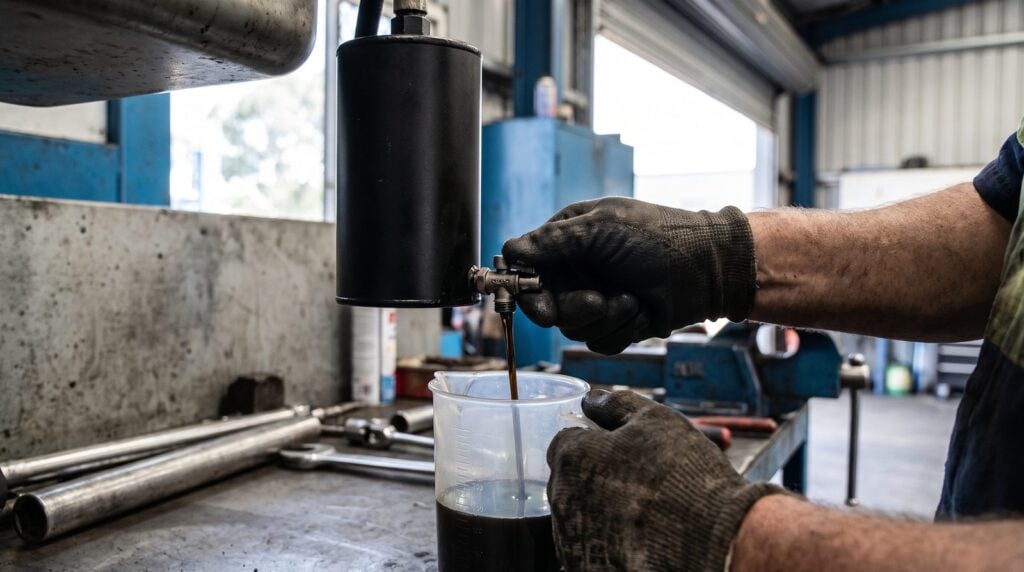
- Drain at every oil service. That is enough on most vehicles, and the volume is your best read on engine health.
- Log what you drain. A can that fills faster than it used to is telling you blow-by has risen. That is a compression problem, not a can problem.
- Replace the element when flow feels choked or the housing is heavily fouled. Elements are from $82.73.
- Check the drain and hoses yearly. A blocked drain turns a separator into a reservoir.
Never let a full can sit. It will pass oil straight through, and the filtering you paid for stops.
A catch can is not a delete
This needs saying plainly, because the two get lumped together.
A catch can fitted in the breather line, with the outlet still going back to the intake, removes nothing. No emissions device is disconnected and no sensor is defeated. That is a closed install, and it is how every kit on this page is designed to go on.
VSB 14 Section LA states, in its engine reconditioning requirements, that where gaseous or noise emission ADRs apply, all standard equipment relating to noise and emission control “must be retained and operate correctly”, and that replacement parts should be of a standard equivalent to the original equipment. Emission control for light vehicles sits in the ADR 79 series, such as ADR 79/02. A closed catch can leaves all of that intact.
One install detail does change the answer. Venting the outlet to atmosphere instead of returning it to the intake defeats the ventilation duty ADR 26 introduced, and it puts oil mist on your driveway, so plumb it closed.
If your vehicle carries other work, check the whole package rather than the can. Our 79 Series build order guide sets out how to sequence modifications so they work with each other rather than against each other.
Choosing one
- Vehicle-specific kit or universal. If a kit exists for your model, buy it. The bracket and moulded hoses are the difference between a two hour fit and an afternoon of fabrication.
- Filtered or baffled. On any EGR-equipped common rail diesel, buy a filtered separator. On an older engine without EGR, a simpler can is a fair choice.
- Can only, or combination kit. If fuel pre-filtering is handled, the standalone kit is better value.
- Sizing. Match the unit to engine output and blow-by volume, not to price.
- Drain access. Make sure you can reach the drain from underneath.
Fit it early. A can bought at 40,000km is planned maintenance. The same can at 200,000km goes onto an inlet that already needs cleaning.
Common questions
Is a catch can legal in Australia?
Yes, when it is plumbed closed and returns the breather to the intake. Nothing is removed, so VSB 14’s rule that emission control gear be retained and operate correctly is unaffected. Venting the outlet to atmosphere is a different matter, because open crankcase venting is the outcome ADR 26 was introduced to prevent, and light vehicles today are covered by the ADR 79 series.
Does a catch can stop EGR clogging completely?
No. It removes the oil that binds the soot, which slows the deposit a lot, but soot still passes through the EGR circuit. Treat it as stretching the gap between intake cleans, not ending them.
How often should I empty a catch can?
Drain it at every oil service, and more often if you are collecting a lot. MANN+HUMMEL publishes an element service life above 2,000 hours, so a short-trip vehicle reaches it in far fewer kilometres than a tourer.
Is a ProVent worth the extra over a cheap catch can?
On a modern EGR diesel, usually yes, because a coalescing filter catches the fine mist a plain baffle lets past. MANN+HUMMEL publishes separation above 98 percent at 1.5 micron as a module rating for the ProVent 100, 200 and 300. Cheaper baffled cans mostly publish no figure at any drop size, so the two cannot be compared on paper.
What is the difference between ProVent and Direction Plus?
ProVent is the MANN+HUMMEL separator. Direction Plus is the Australian brand that builds the vehicle-specific bracket and hose kits around it, such as its PreLine-Plus combination kits. A Direction Plus kit gets you both.
Do I need the combined pre-filter and catch can kit?
Only if you want fuel pre-filtering too. Those kits solve two problems in one install, which is why they top the range at $884.55. If a fuel pre-filter is already fitted, the standalone kit is the better buy. That starts at $350.00 for a Patrol GU and sits near $400 for most current utes.
Get the right catch can for your vehicle
We stock the Direction Plus and ProVent range, replacement elements, hose kits and drains, plus HPD alternatives, across a wide spread of Australian diesel 4WD applications.
Kits are model-specific and hose routing changes between build years. Send us your make, model, build date and engine code through our contact page and we will confirm the right kit number.
Willys Workshop has been working on diesels for more than 20 years across our Brisbane and Sunshine Coast workshops. You can read more about us and how we work.
Every price here was read from our own catalogue on 25 July 2026. Every manufacturer figure was verified against the source linked beside it during our editorial fact-check. Anything we could not verify was left out.
Last updated: July 2026