

 By Willy · Founder & Lead Diesel Specialist
Willys Workshop · Oxley & Warana · 20+ years hands-on diesel experience
Upgrade an N70 Hilux in four stages. Fix what’s worn, then exhaust, then cooling and airflow, then tune. The KUN26 makes 120kW and 343Nm in Euro III form, and 126kW and 343Nm in Euro IV form from 2006 to 2015. Neither figure shows up at the wheels on tired hardware.
Every N70 sold here as a 3.0 litre turbo diesel runs the 1KD-FTV. Two known faults in that engine, the copper injector seat and the cracked piston, decide where the first money goes.
Quick Links
- What the N70 Hilux is
- Which N70 you have
- Stage 1: fix what’s worn
- Stage 2: exhaust
- Stage 3: cooling and airflow
- Stage 4: tune
- What N70 parts cost
- Common questions
What the N70 Hilux is
The N70 Hilux is the seventh generation Hilux, sold here from 2005 to 2015, and the 3.0 litre turbo diesel carries the KUN26 code. The 1KD-FTV first appeared in Australia in this Hilux in April 2005. Outputs changed once during the run, which matters when you’re comparing two utes in a yard.
| Emissions spec | Years | Power | Torque | Transmissions |
|---|---|---|---|---|
| Euro III | 2005 to 2006 | 120kW at 3,400rpm | 343Nm at 1,400 to 3,200rpm | 5sp manual, 4sp auto |
| Euro IV | 2006 to 2015 | 126kW at 3,600rpm | 343Nm at 1,400 to 3,400rpm | 5sp manual, 5sp auto |
Both rows include 2006, so the year alone won’t tell a 2006 owner which engine they’ve got. The build plate and engine number will.
From the factory the N70 has a variable nozzle turbo, an air-cooled intercooler on top of the engine, cooled EGR, and a timing belt driving the intake cam. Two other factory parts matter later. An oxidation catalytic converter cleans up hydrocarbons and carbon monoxide, and the N70 has one instead of a diesel particulate filter. Swirl control valves are vacuum-operated flaps in the intake that close at low revs to increase swirl, and they sit in the part of the intake that soot fouls.
Which N70 you have
People treat the N70 as one vehicle, but three dated changes split the run, and the right build order depends on where your ute falls. You can check all three against the build plate and engine number.
| Change | When | Detail |
|---|---|---|
| Euro III to Euro IV | 2006 | Output rises from 120kW to 126kW; the crack-susceptible piston design begins |
| Copper to DLC injector seats | August 2007 | Diamond-like coating seats replace copper seats |
| Revised pistons and injectors | July 2014 | From engine number A477120 on the Mk.7 Hilux |
The 2014 changes come from Toyota Technical Service Bulletin EG-008T-0112.
An early Euro III N70 is clear of the cracked piston problem. The pre-Euro IV engines didn’t suffer it, because their pistons have a metal fibrous structure fused into the crown. It still has the copper seats, though. An N70 built from July 2014 has both revisions, but cracked pistons are still reported in revised engines at a lower rate, so it’s the least exposed group, not immune. The one to watch is a Euro IV N70 built before August 2007. It has the copper seat and the original Euro IV piston, so it’s exposed to both faults, and it’s where spending on power before condition goes worst.
The copper seat failure is an oil problem more than a fuel problem. Blow-by gets into the tappet cover, carbonises the oil, blocks the sump pick-up and starves the engine until the bottom end bearings melt. Read the build plate and engine number before you plan anything. Don’t guess either date from the rego papers.
Stage 1: fix what’s worn
These utes are now eleven to twenty-one years old. Most of what owners call a lack of power is wear.
The engine
Injectors are the big item. They commonly fail between 120,000km and 140,000km, but failures have been reported as early as 75,000km and some have lasted 250,000km, so kilometres alone don’t tell you much. The recommended replacement interval is every 100,000km. A well maintained N70 on clean fuel can run well past those numbers. Symptoms, costs and the compensation coding a replacement needs are in our guide to N70 Hilux injector costs and symptoms.
The parts around the injectors decide whether the job holds. Sump seals, oil cooler gaskets, camshaft seals and the oil pickup gasket are cheap next to the labour of going back in. The timing belt is a scheduled job on this engine, because the intake cam is belt driven and the exhaust cam is geared off it.
The chassis
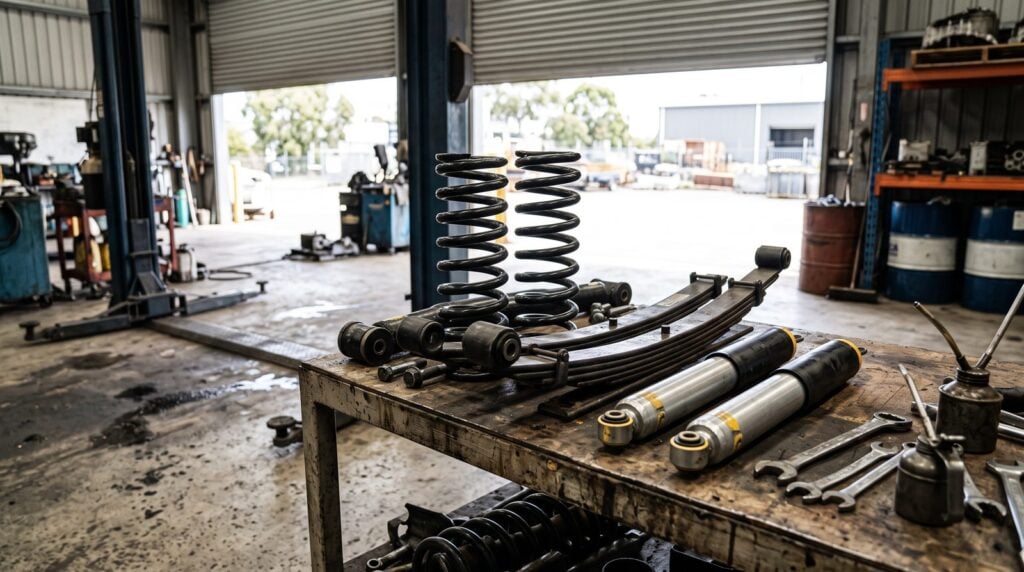
An N70 that’s carried a tray or canopy for a decade is sitting on springs and shocks that have lost their rate, and no engine work will fix how it drives. Rear leaf springs, shackles, shocks and front struts are the usual list. A work ute with sagging rear springs will feel better for a spring and shock package well before it feels anything from an exhaust. Pick load-rated leaf springs, like a 0 to 300kg rated set, for what the ute actually carries, not for a lift figure.
A greasable shackle has grease nipples so the bushes can be serviced in place on a ute that sees mud and salt water. Brake proportioning also changes when the rear goes up, which is why lifted N70s need extension brackets and bias rods.
Stage 2: exhaust
With the engine healthy, the exhaust is the first change that makes the ute drive differently.
On a turbo diesel the gain isn’t mainly peak power. A freer system lowers exhaust gas temperature under sustained load, and heat is what shortens the life of turbos, manifolds and head gaskets. That’s the reason to do it on an N70 towing through a Queensland summer.
Two things are specific to this ute. The manifold joins the front pipe with a ball joint, which wears, so inspect it while the system is off. And because the N70 has an oxidation cat and no particulate filter, there’s no filter to work around when you size a 3 inch system.
You can buy it in sections or as a complete system. Manta list the KUN26R as a dump pipe, engine pipe, cat assembly, centre section and tail pipe, and as complete 3 inch systems in aluminised or stainless. Sections suit a ute that only needs the tired half replaced, usually the dump pipe and centre. A complete system suits one going in for a single job. The centre section sets the noise: a hotdog resonator is quieter than a straight centre pipe, and a muffler is quieter again.
Stage 3: cooling and airflow
People get this stage wrong more than any other on the N70, because the ute already has an intercooler. The factory one is air-cooled and sits on top of the engine, with an aluminium core and inlet tank and a plastic outlet tank. Up there it sits in engine bay heat, out of the airflow at the front, and slow, hot, loaded work is where that hurts most.
Before you spend on cooling, clean the intake. Every N70 feeds cooled EGR gas into it, so soot and oil vapour build up in the manifold and around the swirl control valves. Deposits change how those flaps move well before anything logs a fault code. A catch can fitted early is the cheapest way to slow that down, because it takes the oil vapour out before it meets the soot. Short-trip utes are worst, because they never get hot for long enough to stay clean.
There’s a front mount intercooler for the Series 2 N70 3.0 litre D4D and a Provent Ultimate catch can kit for the N70. A catch can and a clean intake pay off on nearly every N70. The intercooler pays off on one that works hot and loaded, and very little on one that does school runs.
Stage 4: tune
Tune last, and on a Euro IV N70 read this before you book anything.
The published advice for reducing the risk of cracked pistons in a Euro IV 1KD-FTV is: don’t chip tune the engine, don’t drive it under load for long periods, and service the injectors every 100,000km. Those steps make a failure less likely but don’t fix the piston design, and the cracking most often shows up between 100,000km and 150,000km.
That advice covers Euro IV 1KD-FTV engines as a group, which on the N70 is 2006 to 2015. The July 2014 revision at engine number A477120 lowered the reported failure rate, but cracked pistons are still reported in revised engines, so a post-2014 build date doesn’t take a ute outside the advice.
So we don’t treat a power tune as a default step on a Euro IV N70, and we’ll tell you that before quoting one. A Euro III N70, 2005 to 2006, is outside the affected group. On a Euro IV ute the order is condition, exhaust, intake, and then a talk about what the tune is actually for, with the engine number in front of us. If you’re after drivability more than a bigger number, most of that is already in the first three stages.
If you’re also looking at the newer 2.8 litre ute, our N80 Hilux performance upgrades guide covers its different tradeoffs.
What N70 parts cost
These are parts prices. Fitting and alignment are on top.
| Stage | Part | Price |
|---|---|---|
| 1 | Injector, 2006 to 2009 Code 11 | $495.00 each, $1,940.00 for a set of four |
| 1 | Head gasket | $169.00 |
| 1 | Dayco timing belt | $59.80 |
| 1 | Inlet manifold gasket set, for an intake clean | $115.00 |
| 1 | Shocks, EFS Enforcer to EFS Xtreme | $119.70 to $277.40 |
| 1 | Complete lift kit, EFS 40mm or West Coast Suspensions 2 inch | $1,844.90 to $2,161.25 |
| 2 | Complete 3 inch exhaust with cat, aluminised | from $1,542.96 |
| 3 | Provent Ultimate catch can kit | from $435.00 |
| 3 | Preline Plus pre filter and Provent catch can combo kit | from $865.00 |
| 3 | Front mount intercooler, N70 3.0L D4D Series 2 | from $1,845.00 |
The genuine seals and small gaskets around an injector job run between $4.59 and $45.00. The exhaust starts at $1,542.96 with no muffler and goes to $1,642.03 with a centre muffler. Stainless costs more than the aluminised figures shown. If you’re only replacing part of the system, a dump pipe is $267.18 and a centre muffler $463.80.
A spring and shock package differs from one N70 to the next depending on what it carries, so price the components against the load before you default to a boxed lift kit.
Common questions
What should I upgrade first on an N70 Hilux?
Condition first. Injectors and their seals, a clean intake, and the rear springs and shocks. A Euro IV N70 built before August 2007 has both the copper injector seat and the original Euro IV piston, so check its condition before you spend on power.
Does an N70 Hilux have a DPF?
No. The 1KD-FTV uses an oxidation catalytic converter, not a diesel particulate filter. It does run cooled exhaust gas recirculation on Euro III and later engines. That’s why a 3 inch system for the KUN26R is built around a cat assembly.
Is an intercooler upgrade worth it on an N70?
Only once the intake is clean and the engine is healthy. It already has an air-cooled intercooler on top of the engine, and deposits around the swirl control valves are the more common restriction. A front mount earns its keep on an N70 that works hot and loaded.
How long do N70 Hilux injectors last?
They commonly fail between 120,000km and 140,000km, as early as 75,000km in some cases and as late as 250,000km in others. The recommended replacement interval is every 100,000km. White smoke on start up and a cold knock are the signs to get them tested.
Can I tune an N70 Hilux safely?
It depends which N70. For Euro IV engines, 2006 to 2015, the advice for reducing cracked piston risk includes not chip tuning the engine, and it isn’t limited to pre-2014 utes. The July 2014 revision at engine number A477120 lowered the reported failure rate without ending it. A Euro III N70, 2005 to 2006, is outside that group. Check the build plate and engine number before booking any tune, and expect us to bring this up.
Check your engine number before you order
Toyota changed the injector and piston specs during the N70 run, so check fitment first. Send your VIN, build date and engine number through our contact page and we’ll confirm part numbers for suspension, exhaust or catch cans before you order. Buying one? Run the VIN through the PPSR for money owing and stolen or written-off status, and check the recall register at Product Safety Australia. Our founder Willy has more than 20 years on the tools as a heavy diesel mechanic, and the team works on diesels across our Brisbane and Sunshine Coast workshops.
Last updated: November 2026