

Last updated: June 2026
Your injectors are the hardest-working part of your diesel. They fire thousands of times a minute, at pressures that would cut through skin, with tolerances finer than a human hair. When the fuel system is healthy you never think about it. When it isn’t, you get hard starts, black smoke, a lumpy idle and a fuel bill that creeps up for no reason you can put your finger on.
At Willy’s Workshop, in Oxley and Warana, we see fuel problems every week, and the frustrating part is how many were avoidable. So here’s how the system works, how to keep it alive, and the early signs worth catching before they cost you a set of injectors.
Quick Links:
- How diesel fuel injection works
- The parts that make up the system
- Why fuel quality and filters matter so much here
- Water in diesel fuel: the quiet injector killer
- Why modern common-rail is fussier than the old engines
- The warning signs of a tired fuel system
- Looking after your injectors
- When it’s time to test or replace
- FAQs
How diesel fuel injection works
Modern diesels run common-rail injection. A high-pressure pump charges a shared fuel rail to extreme pressure, up around 2,000 bar, and the ECU fires each injector electronically. Exact amount, exact timing, several times per combustion stroke. That precision is why a modern common-rail diesel is quieter, cleaner and stronger than the old mechanical-pump engines ever were.
It’s also why they’re fussy. Those injectors live or die on clean, water-free fuel. A common-rail system has very little tolerance for grit or water, and the parts are expensive. A full set of common-rail injectors or a high-pressure pump is a serious bill next to the filter that protects them.
The parts that make up the system
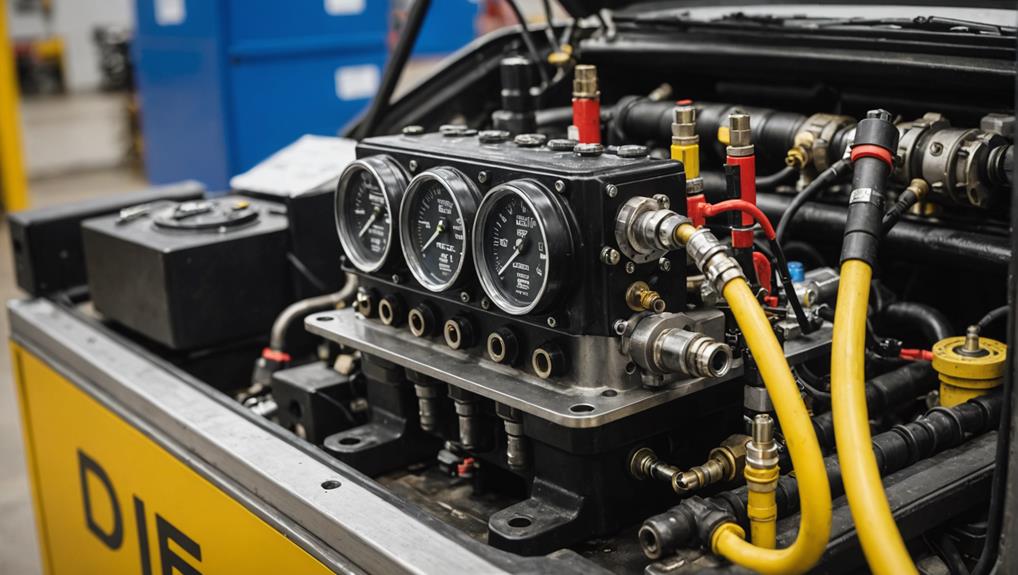
It helps to know what’s actually between your tank and your cylinders. A low-pressure lift pump draws fuel from the tank and pushes it through the filter. The filter and water separator clean it. The high-pressure pump then steps the pressure up to that 2,000-bar mark and feeds the common rail, which acts as a shared reservoir holding pressure steady for all the injectors. A pressure regulator keeps that rail pressure where the ECU wants it, the injectors do the spraying, and anything left over runs back to the tank through the return line.
Every one of those parts depends on the fuel being clean. The pump and injectors in particular are lubricated by the diesel itself, so the moment you put grit or water through them, you’re wearing out the most expensive parts in the system.
Why fuel quality and filters matter so much here
This is where a lot of Aussie diesels get let down. Dodgy fuel from a quiet outback servo, water condensing in a half-empty tank overnight, dust on a worksite, it all ends up at your injectors. Up here the summer heat and long country runs north and west of Brisbane only make it worse. Two things stand between that and a repair bill.
The first is your fuel filter. Change it on schedule, not when you remember, and fit a proper one. As a rough guide, most diesels want a fresh fuel filter every 15,000km, and closer to every 7,500km if you tow or spend time in dust. A blocked filter starves the engine, and a cheap or bypassed one lets contaminants straight through. The second is your water separator. Drain it. Water in the rail will pit and seize injectors fast, and that’s a repair, not a service.
On a vehicle you tow or tour with, a quality secondary filter kit is cheap insurance. It catches water and fine particles before your factory filter even sees them. We fit a lot of them, often alongside a catch can to keep the intake side clean too.
Water in diesel fuel: the quiet injector killer
Water is the single most common thing we see take out an otherwise healthy fuel system, and most owners never know it’s there until something lets go. It gets in a few ways. Condensation forms in a half-full tank as the temperature swings overnight. It comes in with fuel from a servo with a tired underground tank. And it sneaks in around a worn filler seal on a dusty, wet track.
The problem is that water doesn’t compress or lubricate like diesel does. At common-rail pressures it flashes and pits the precision surfaces inside the pump and injectors, and once those surfaces are damaged the part is done. Most diesels have a water-in-fuel warning light for exactly this reason. If yours comes on, don’t drive on it and hope. Drain the separator, and if it keeps coming back, get the fuel and the system checked. Draining the separator takes a minute and it’s the cheapest insurance on the vehicle. Ignoring it is how a one-minute job turns into a set of injectors.
Why modern common-rail is fussier than the old engines
If you grew up around older diesels, you might remember them running happily on rubbish fuel. Modern common-rail is a different animal. The old mechanical systems worked at far lower pressures with much bigger tolerances. They were crude, but forgiving. Today’s systems run at extreme pressure with injectors machined to microns, and that precision is what gives you the power, the economy and the lower emissions. The trade-off is sensitivity. A speck of grit or a slug of water that an old engine would have shrugged off can wreck a common-rail injector.
The warning signs of a tired fuel system
Catch these early and you’re looking at a service. Ignore them and you’re looking at injectors. The ones we see most are hard starting or long cranking, especially on a cold morning, and a rough or hunting idle that wasn’t there before.
Then there’s smoke. Black smoke under load usually means over-fuelling or poor atomisation. White smoke is the one people misread. The wisps on a cold start that clear once it warms up are normal. White smoke that persists past warm-up is not, and it often points to water contamination or an injector that isn’t sealing. On top of that, watch for a drop in power or economy you can’t otherwise explain, and any new knock or rattle under load. None of these fix themselves. A failing injector also dumps extra heat into the cylinder, so a small problem left alone turns into a big one.
Looking after your injectors
Most of it is simple. Stick to your fuel filter intervals, and use a proper filter rather than the cheapest one on the shelf. We regularly pull cheap filters at service that look fine on the outside but have partly collapsed inside from pressure, quietly starving the engine while the owner had no idea. Drain the water separator regularly, and more often if you buy fuel from servos you don’t know. Try not to run the tank to fumes all the time, because that pulls the dirtiest fuel and any water off the bottom. And if you’ve added power with a tune, make sure the fuelling is matched to it, because over-fuelling cooks injectors and spikes exhaust temps.
When it’s time to test or replace
Injectors don’t last forever, and one failing injector drags the whole engine down. If you’re chasing a misfire, smoke or a power loss, we flow-test and balance-test the injectors on the bench to find the culprit instead of throwing parts at it. That testing also tells us whether the real fault is the injectors, the high-pressure pump, rail pressure, or just a fuel supply or filter problem. Replacing injectors that were never the issue is an expensive mistake, and one we’d rather you didn’t make.
Got smoke, hard starts or a fuel-economy problem you can’t pin down?
Book it in at Willy’s Workshop and we’ll test the system properly and tell you exactly what it needs.
FAQs
How often should I change my diesel fuel filter?
As a rough guide, every 15,000km in normal use, and closer to every 7,500km if you tow, work in dust, or buy fuel from out-of-the-way servos. Check your handbook for the exact figure for your engine.
Can injectors be cleaned instead of replaced?
Sometimes. A bench clean and test can recover injectors that are dirty rather than worn. We test first, so you’re not paying for parts you don’t need.
Is water in fuel really that serious?
Yes. Water is one of the fastest ways to kill common-rail injectors, because it doesn’t lubricate and it pits the precision surfaces under pressure. Drain your separator and never ignore a water-in-fuel light.
What are the signs of a failing diesel injector?
The usual ones are hard starting, a rough idle, black or white smoke, knocking, and a drop in power or economy. Any of those is worth getting looked at before it spreads.
Does a fuel-system upgrade add power?
A healthy, well-filtered system is mostly about reliability and economy. Real power comes from tuning and supporting mods, but none of it lasts on dirty fuel.